tencent cloud

Cloud Streaming Services

Release Notes and Announcements
Announcements
User Guide
Product Introduction
Overview
CSS Products
Concepts
Features
Use Cases
Strengths
Use Limits
Purchase Guide
Billing Overview
Basic Service Fee
Value-Added Service Fee
Prepaid plan
Purchase Process
Changing Billing Modes
Refund Policy
Viewing Bills
Renewal
Processing for Overdue Payments
Billing FAQs
Live Video Broadcasting (LVB)
Overview
Use Cases
Getting Started
SDK Integration
Live Event Broadcasting (LEB)
Overview
LEB Versus LVB
Use Cases
Getting Started
SDK Integration
Live Video Caster
Overview
Application Scenarios
Feature Area Introduction
Managing Live Video Caster
General Cloud Director
Configuring Program Lists and Automated Broadcasting
Console Guide
Console Overview
Overview
Domain Management
Stream Management
Package Management
AI Features
Feature Configuration
Relay
Billing Usage Statistics
Monitoring
Toolkit
OOTB live
CAM-Based Access Control
Feature Guide
Push and Playback
Features
Practices in Typical Scenarios
Cloud Native Recording
Live Streaming Security
Global CSS Service
Callback Notifications
User Guides for Common Third-Party Tools
SDK Guide
0. SDK Integration Guide
1. Stream Push
2. Playback
3. Advanced Features
API Documentation
History
Introduction
API Category
Making API Requests
Live Pad APIs
Live Stream Mix APIs
Time Shifting APIs
Monitoring Data Query APIs
Billing Data Query APIs
Live Transcoding APIs
Delayed Playback Management APIs
Domain Name Management APIs
Watermark Management APIs
Certificate Management APIs
Stream Pulling APIs
Recording Management APIs
Live Callback APIs
Screencapturing and Porn Detection APIs
Authentication Management APIs
Live Stream Management APIs
Data Types
Error Codes
Ops Guide
Video Stuttering
Troubleshooting Push Failure
Troubleshooting Playback Failure
CLS Assists in Live Stream Troubleshooting
Troubleshooting High Latency
Troubleshooting Poor Quality of Pulled Video
Authorizing CSS to Store Screenshots in a COS Bucket
Troubleshooting
Live Stream Mixing Error `InvalidParameter.OtherError`
About Pushing
Generating Push URLs
PC Push
Playing Method
Web Player
Live Streaming Quiz
FAQs
Service Region
Live Streaming Basics
Push and Playback
CSS Billing
Global CSS Service
Live Recording
On-Cloud Stream Mix
Domain Configuration
Related to Live Video Caster
Compatibility with Apple ATS
Difference Between Stream Interruption and Stream Suspension
SLA
CSS Service Level Agreement
CSS Policy
Privacy Policy
Data Processing And Security Agreement
Glossary
DocumentationCloud Streaming ServicesLive Video CasterConfiguring Program Lists and Automated Broadcasting

Configuring Program Lists and Automated Broadcasting

PDF
Focus Mode
Font Size
Last updated: 2025-12-19 20:51:54
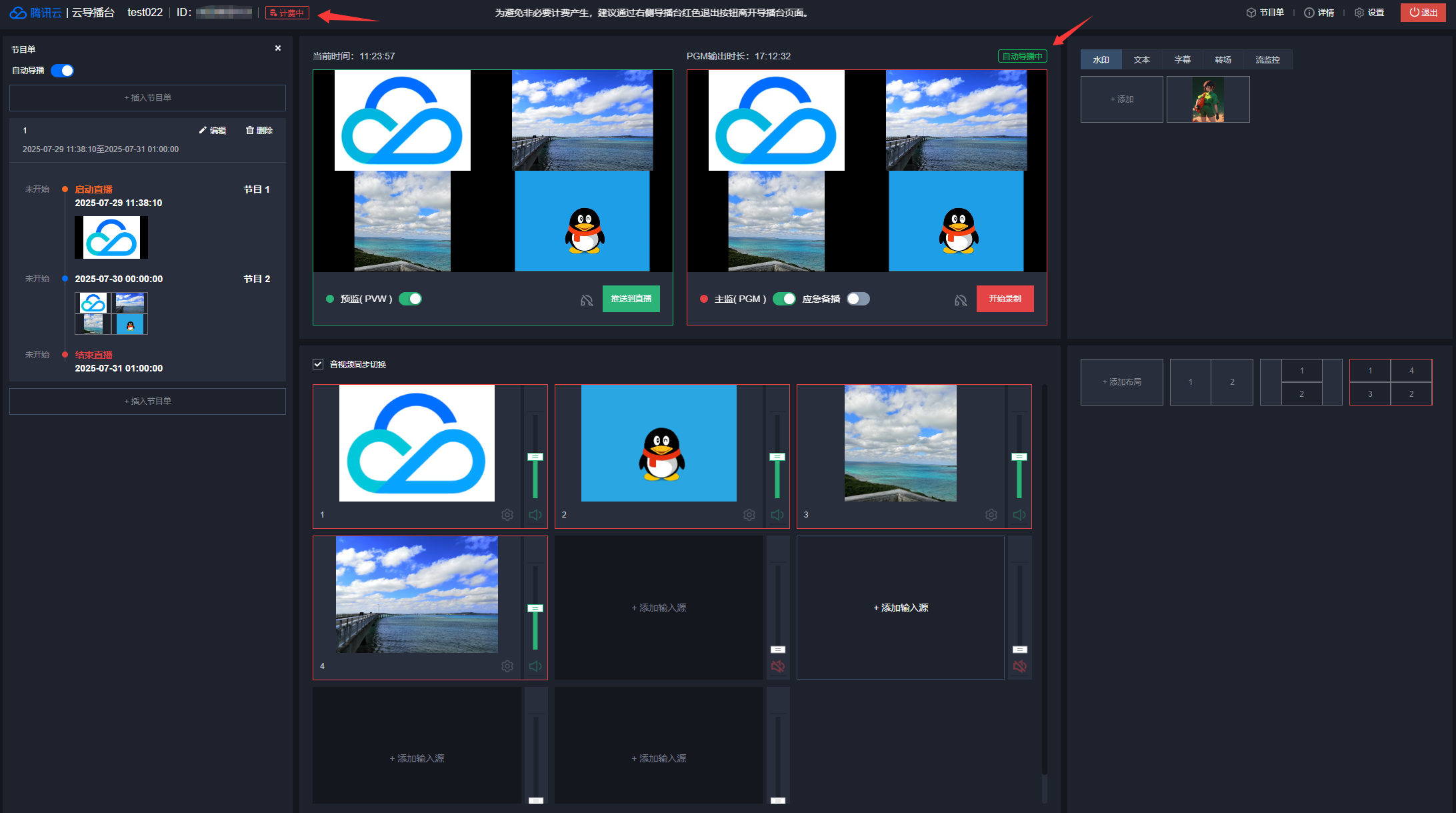
Live Video Caster (LVC) allows you to create schedules to configure scheduled broadcasting. This enables input sources or layouts to be published in a planned way.

Prerequisites

You have completed the steps in Adding Input Sources.
You have completed the steps in Directing and Editing.

Configuring a Schedule

Creating a Schedule

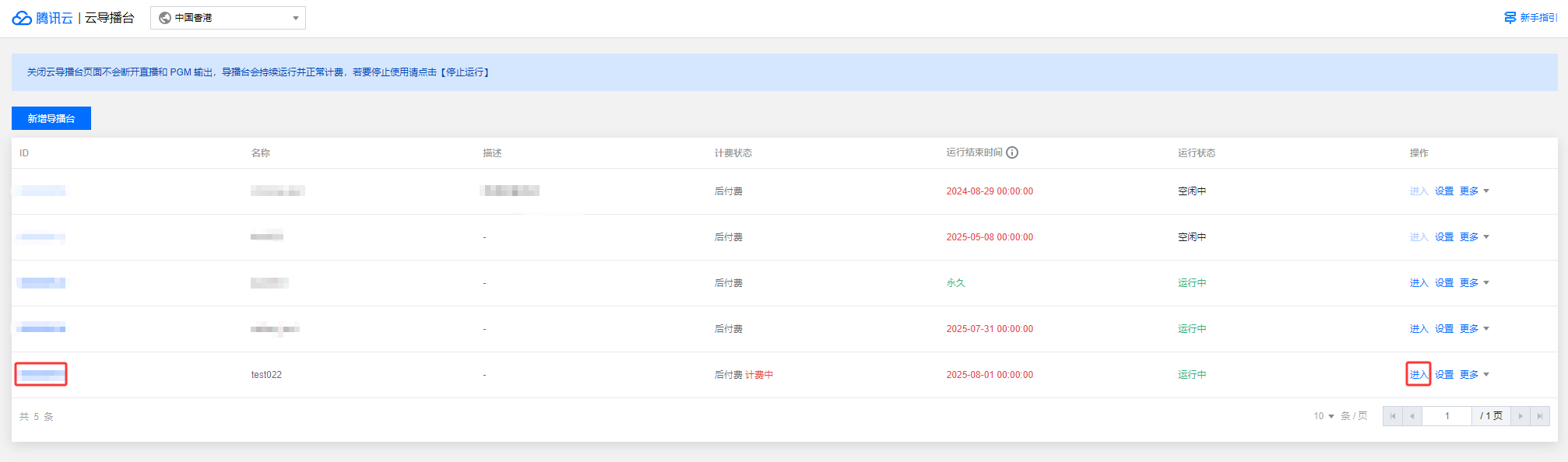
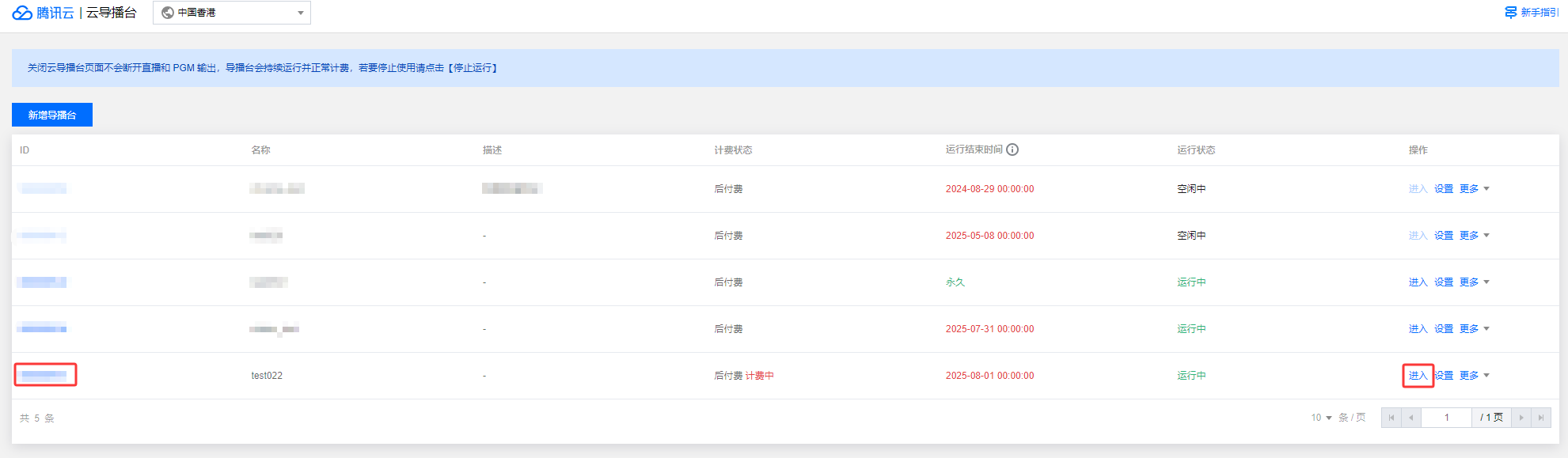
1. In the Live Video Caster list, find the target caster and click its ID or click Open on the right to enter the caster editing page.

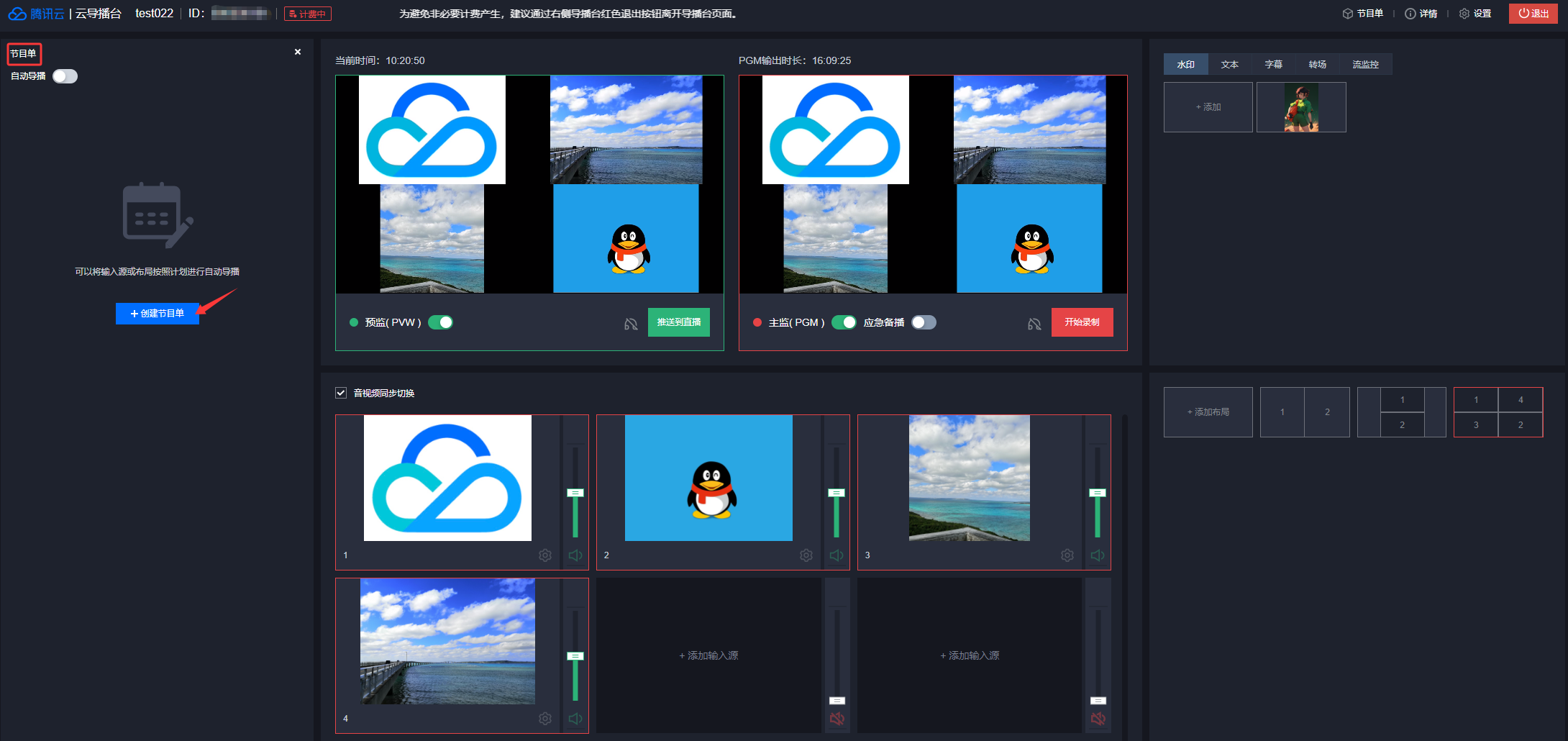
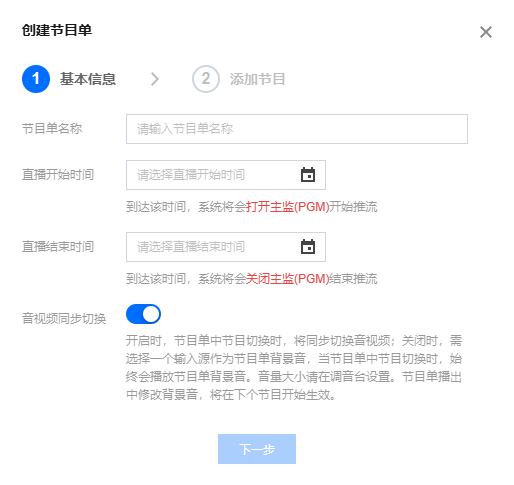
2. Select Schedule, click Create schedule, and proceed with the following configurations:

Configuration Item
Description
Schedule name
Enter the schedule name, which can consist of up to 10 characters.
Start time
Select the start time of the schedule, which should be later than the time the schedule is saved. If scheduled broadcasting is enabled, at the start time, LVC automatically turns on the main monitor (PGM) to start streaming and billing begins.
End time
Select the end time of the schedule, which must be later than the start time and not exceed the expiration time of the caster. If scheduled broadcasting is enabled, at the end time, LVC automatically stops the PGM to stop streaming, and billing ends.
Switch audio and video together
The Switch audio and video together feature is enabled by default. You can choose to manually disable this feature based on your business needs.
If it is enabled, the audio/video switches accordingly when programs in the schedule are switched. If it is disabled, you need to select an input source as the schedule background audio. The background audio will always play regardless of program switches. You can set the audio volume in the soundboard.Changes to the background audio for an ongoing schedule will take effect at the start of the next program.

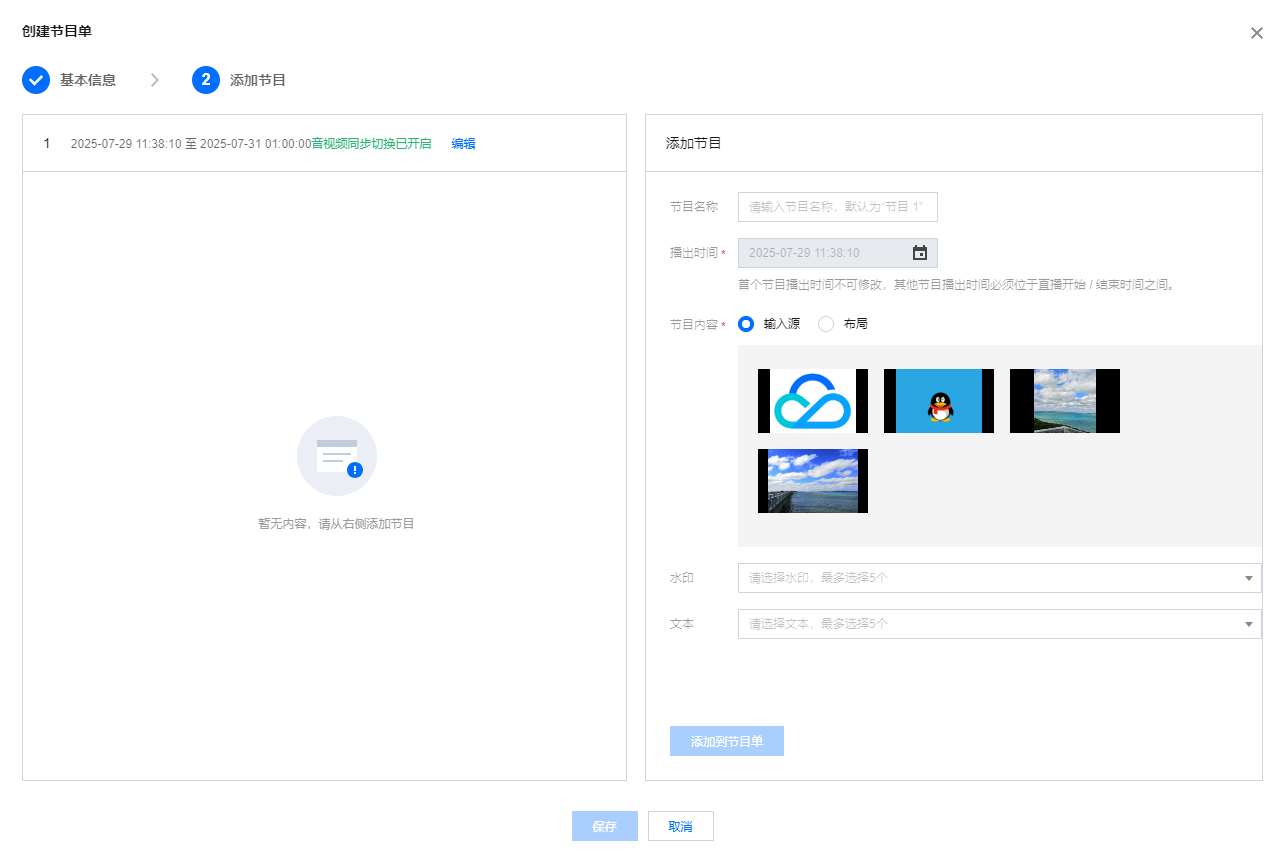
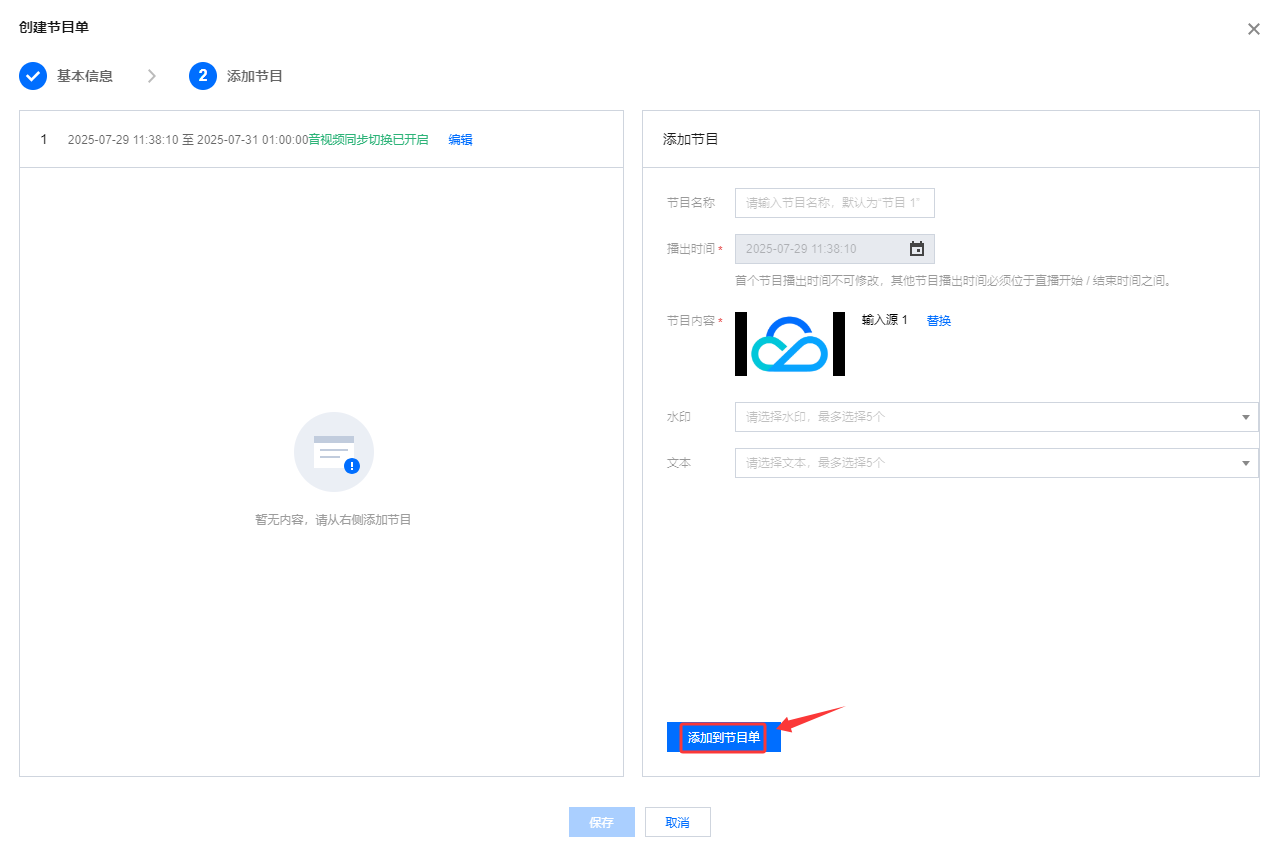
3. Click Next and configure the following items in the Add program area:
Configuration Item
Description
Program name
Enter a program name, which can consist of up to 10 characters.
Stream time
The stream time of the first program must be the same as the schedule's start time. For others, the stream time should be between the schedule's start time and end time.
Program type
You can choose pre-configured sources or layouts.
Watermark
You can choose up to five watermarks.
Text
You can choose up to five texts.

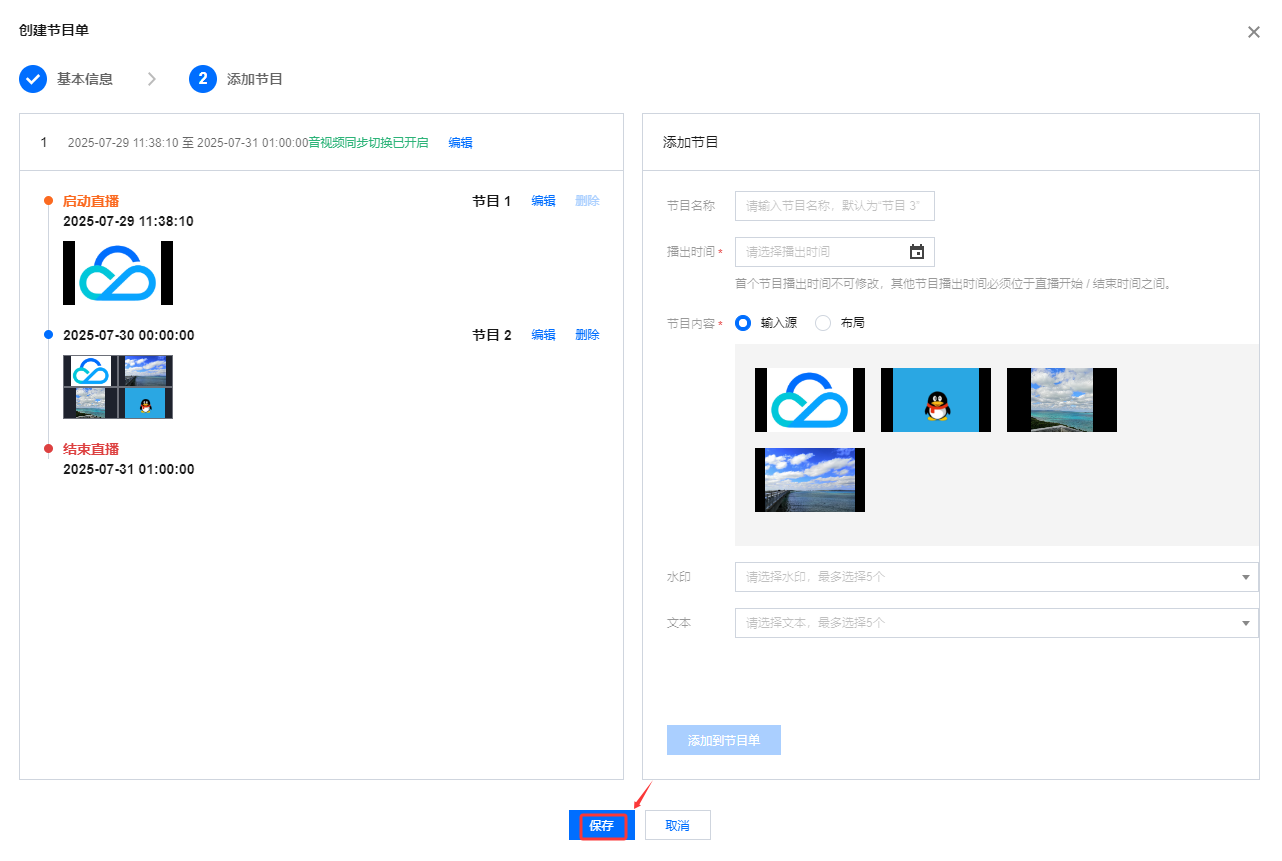
4. Click Add to schedule to add the program. You can add multiple programs to a single schedule.

5. After adding programs, click Save to complete the creation of the schedule.

Note:
The stream time you set for an inserted program should be later than the current time.

Editing a Schedule

1. In the Live Video Caster list, find the target caster and click its ID or click Open on the right to enter the caster editing page.

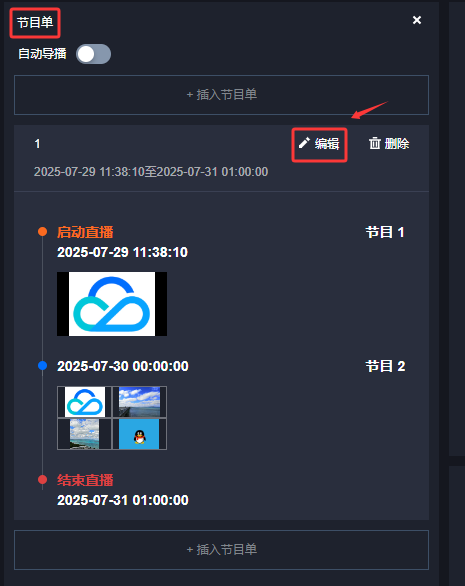
2. Select a successfully created schedule, and click Edit on the right to enter the schedule editing page.

Note:
Expired schedules cannot be edited.
If scheduled broadcasting is enabled, the ongoing schedule's start time cannot be changed, though the end time can be changed.
Click Schedule to navigate to the ongoing program.
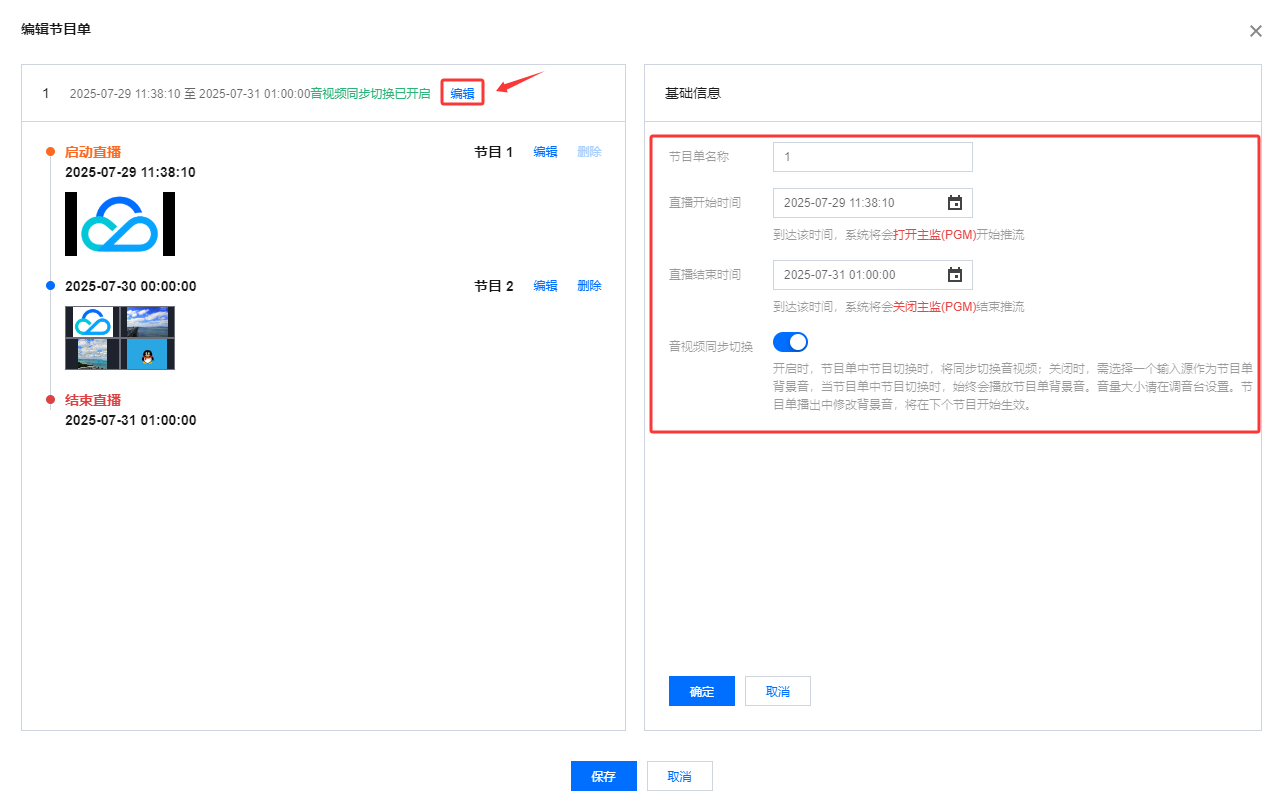
3. Click Edit on the right side of Schedule.
3.1 The schedule live broadcast start time and live broadcast end time can be modified.
3.2 The Switch audio and video together feature is enabled by default. You can choose to manually disable this feature based on your business needs.
3.3 Click Confirm to save the changes.

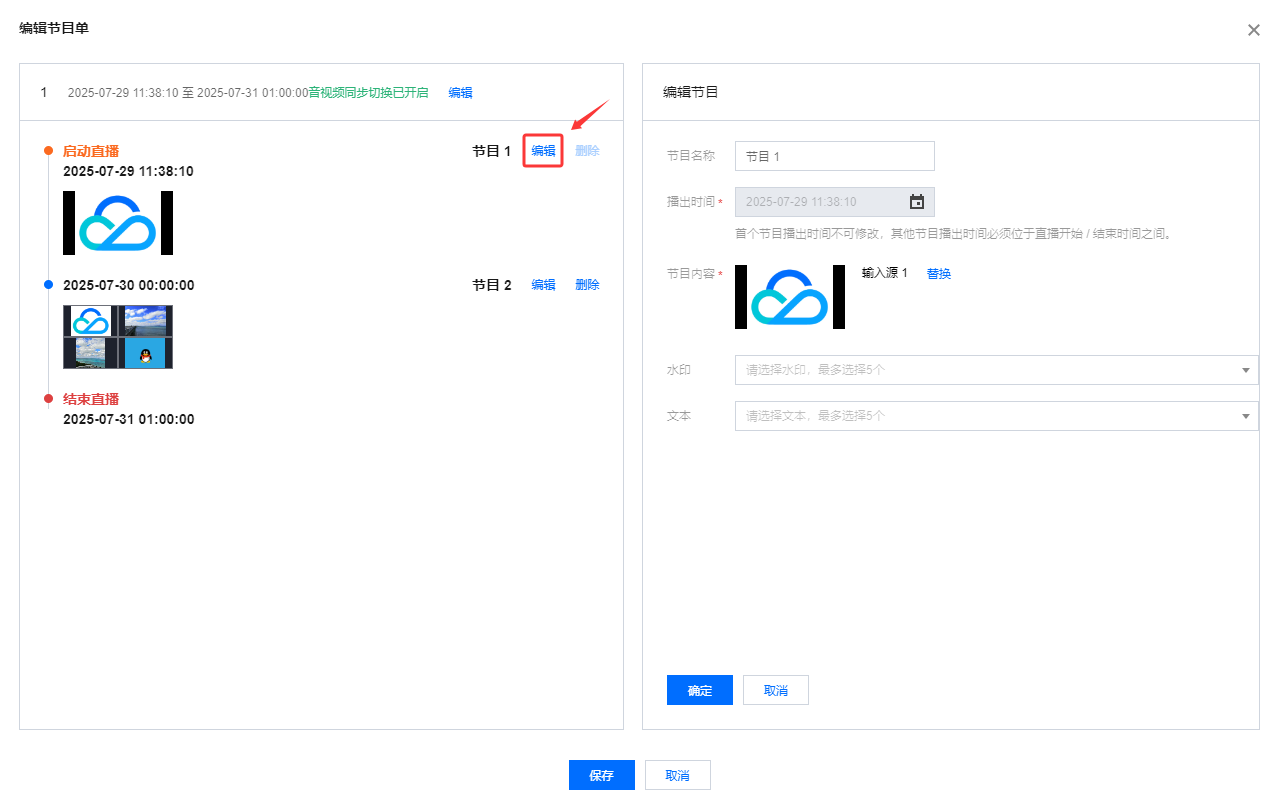
4. Select the program you want to edit, and click Edit on the right to edit the program.

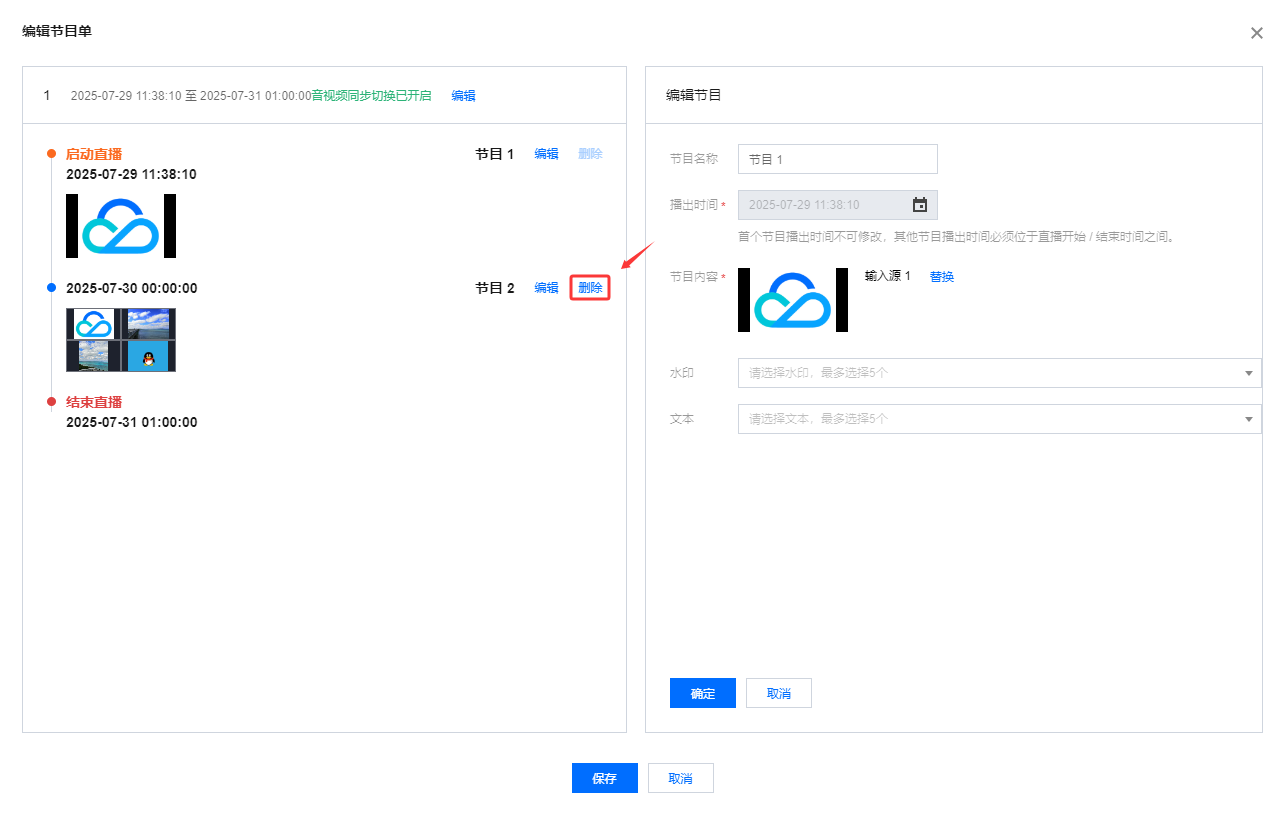
5. Select the program you want to delete, and click Delete on the right to delete the program.

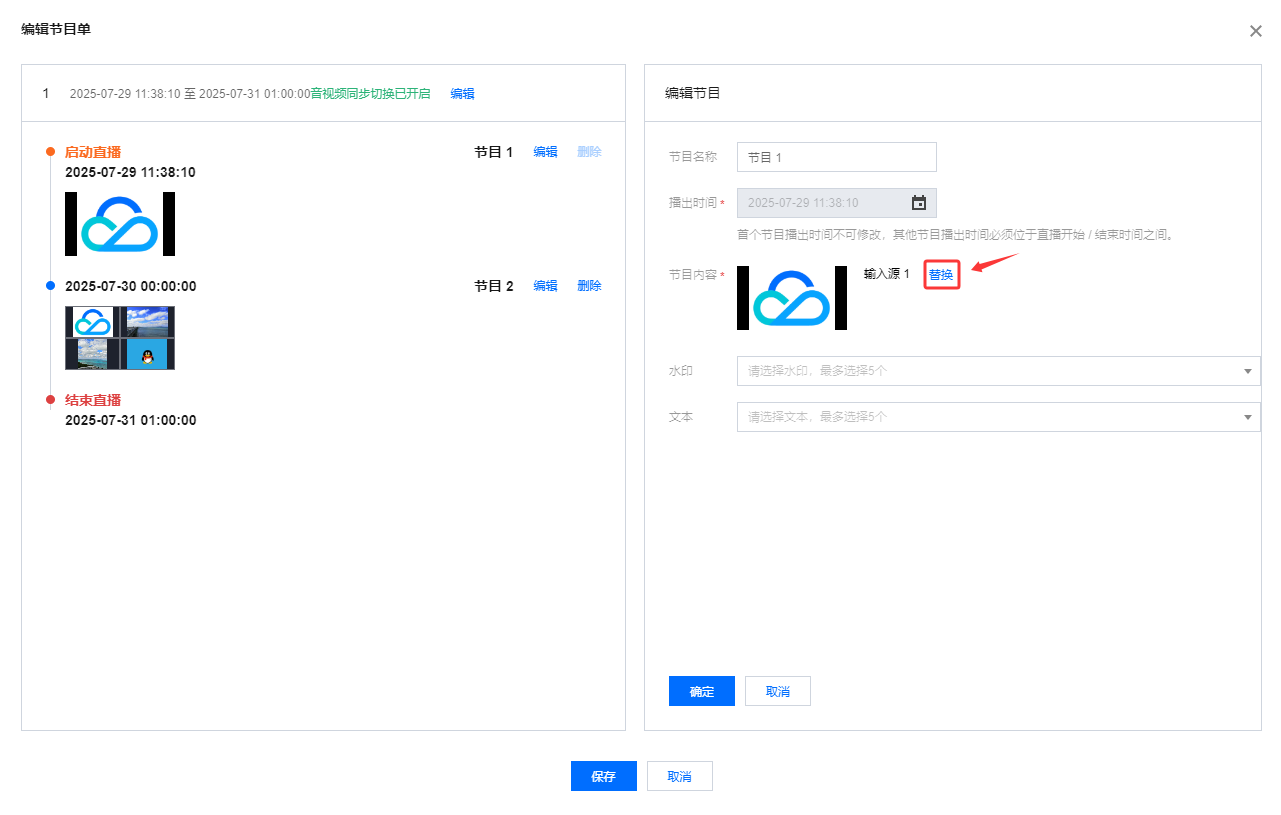
6. Click Change to change the program content.

7. After the editing, click Save to save the modifications.

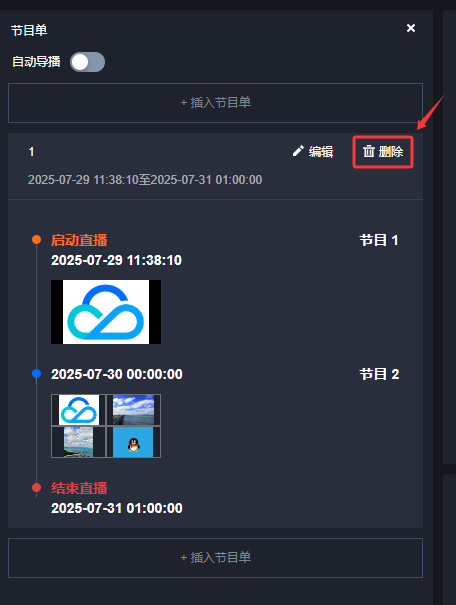
Deleting a Schedule

Note:
Schedules cannot be recovered once deleted. Exercise utmost caution when deleting a schedule.
The system automatically clears each schedule seven days after its end time.
1. On the Schedule tab page, select the target schedule, and click Delete on the right.

2. Click Confirm to delete the schedule.


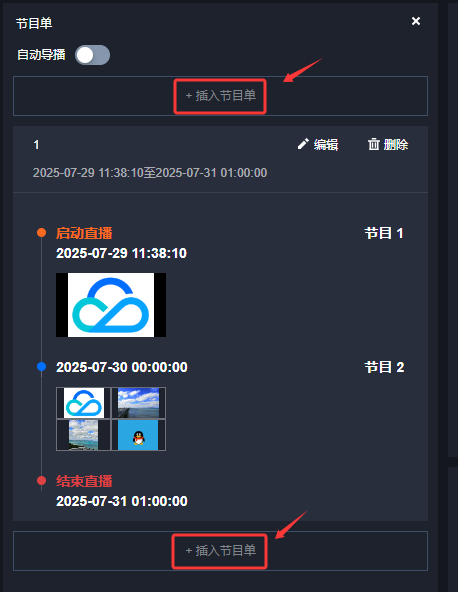
Inserting a Schedule

1. Click

to insert a newly created schedule.

Note:
The time period you set for an inserted schedule should not be earlier than the current time.
2. Repeat the previous step to insert more schedules, or edit or delete existing schedules.

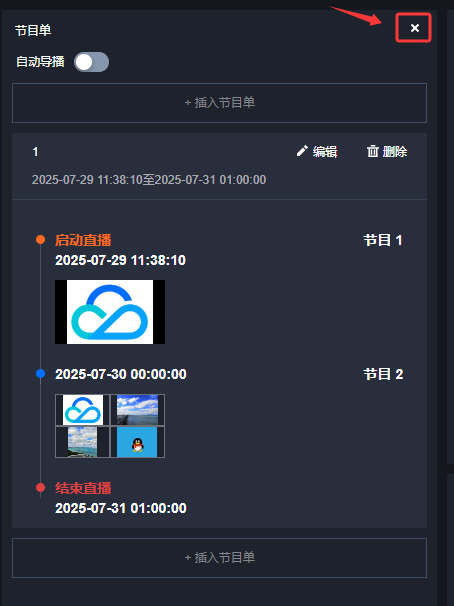
Close a Schedule

1. According to your business needs, you can click

to close the schedule.

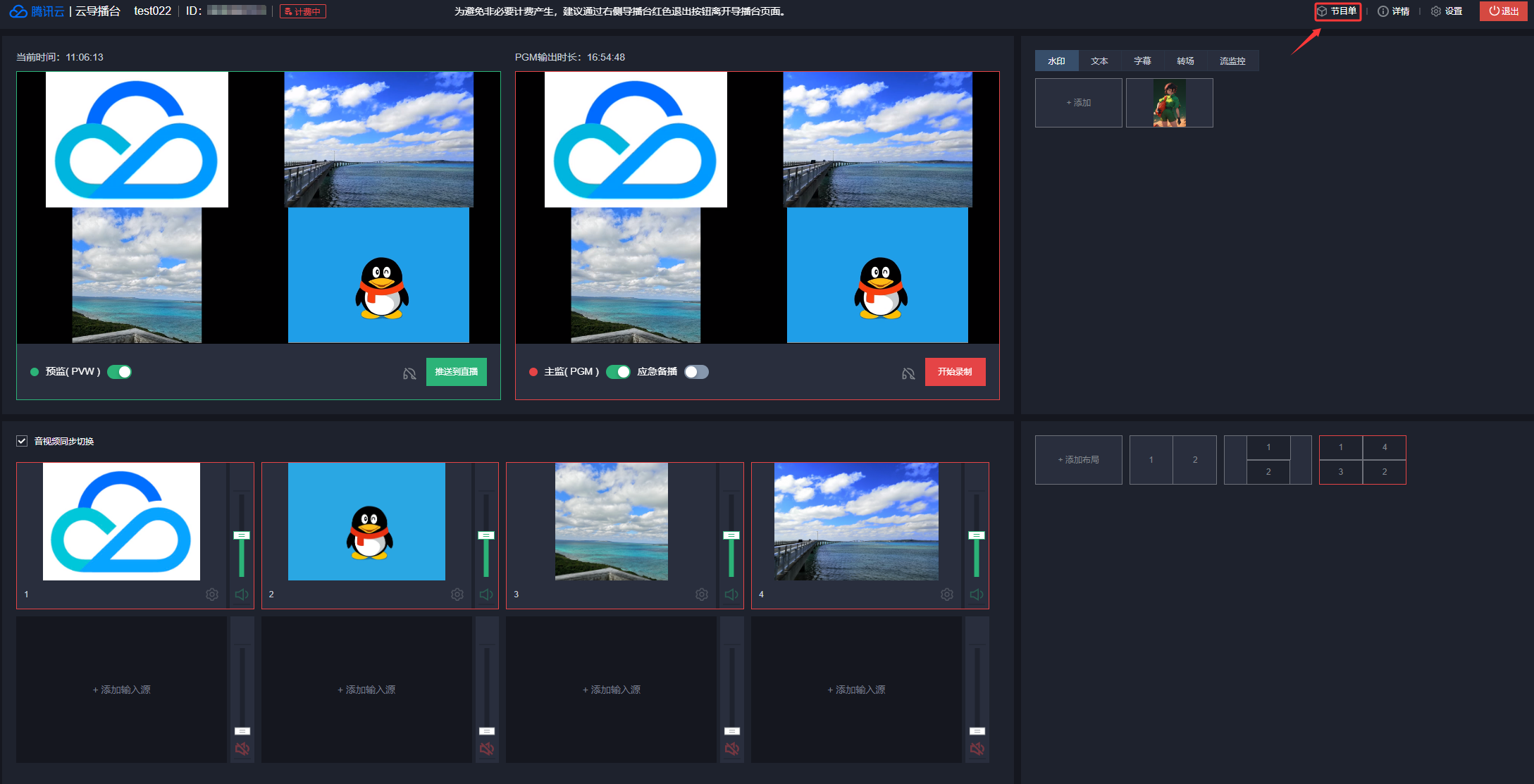
2. After closing, you can click Schedule in the upper right corner to reopen it.


Configuring Scheduled Broadcasting

Enabling Scheduled Broadcasting

1. After configuring schedules, you can enable scheduled broadcasting.
2. Click

to enable scheduled broadcasting. If this function is enabled, LVC will automatically start and stop the PGM output according to the start and end time of the schedules. The caster will run and incur charges while the PGM output is on. To stop the current and future billing, ensure that both scheduled broadcasting and PGM are turned off.

3. Click Enable to enable scheduled broadcasting.


Schedule start time (when live broadcast starts): If scheduled broadcasting is enabled, at the schedule start time, LVC automatically turns on the PGM to start streaming the first program and billing begins.
Program stream time (excluding the first program): If scheduled broadcasting and the PGM are both enabled, at the stream time of a program, LVC automatically switches to the program and pushes it to the PGM.
Note:
If the PGM or scheduled broadcasting is disabled during a scheduled broadcast, programs will no longer switch automatically.
Schedule end time (when live broadcast ends): If scheduled broadcasting is enabled, at the schedule end time, LVC automatically stops the PGM and billing ends.

Disabling scheduled Broadcasting

Note:
After scheduled broadcasting is disabled, LVC will no longer start and end live broadcasts according to the schedules' start and end time. To avoid incurring unnecessary charges, ensure that the main monitor (PGM) is also turned off.
1. To end scheduled broadcasting, click

.

2. Consider your actual business needs before deciding to stop scheduled broadcasting; proceed with caution. Click Disable to stop scheduled broadcasting.


Help and Support

Was this page helpful?

Help us improve! Rate your documentation experience in 5 mins.

Feedback