tencent cloud

Cloud Streaming Services

Release Notes and Announcements
Announcements
User Guide
Product Introduction
Overview
CSS Products
Concepts
Features
Use Cases
Strengths
Use Limits
Purchase Guide
Billing Overview
Basic Service Fee
Value-Added Service Fee
Prepaid plan
Purchase Process
Changing Billing Modes
Refund Policy
Viewing Bills
Renewal
Processing for Overdue Payments
Billing FAQs
Live Video Broadcasting (LVB)
Overview
Use Cases
Getting Started
SDK Integration
Live Event Broadcasting (LEB)
Overview
LEB Versus LVB
Use Cases
Getting Started
SDK Integration
Live Video Caster
Overview
Application Scenarios
Feature Area Introduction
Managing Live Video Caster
General Cloud Director
Configuring Program Lists and Automated Broadcasting
Console Guide
Console Overview
Overview
Domain Management
Stream Management
Package Management
AI Features
Feature Configuration
Relay
Billing Usage Statistics
Monitoring
Toolkit
OOTB live
CAM-Based Access Control
Feature Guide
Push and Playback
Features
Practices in Typical Scenarios
Cloud Native Recording
Live Streaming Security
Global CSS Service
Callback Notifications
User Guides for Common Third-Party Tools
SDK Guide
0. SDK Integration Guide
1. Stream Push
2. Playback
3. Advanced Features
API Documentation
History
Introduction
API Category
Making API Requests
Live Pad APIs
Live Stream Mix APIs
Time Shifting APIs
Monitoring Data Query APIs
Billing Data Query APIs
Live Transcoding APIs
Delayed Playback Management APIs
Domain Name Management APIs
Watermark Management APIs
Certificate Management APIs
Stream Pulling APIs
Recording Management APIs
Live Callback APIs
Screencapturing and Porn Detection APIs
Authentication Management APIs
Live Stream Management APIs
Data Types
Error Codes
Ops Guide
Video Stuttering
Troubleshooting Push Failure
Troubleshooting Playback Failure
CLS Assists in Live Stream Troubleshooting
Troubleshooting High Latency
Troubleshooting Poor Quality of Pulled Video
Authorizing CSS to Store Screenshots in a COS Bucket
Troubleshooting
Live Stream Mixing Error `InvalidParameter.OtherError`
About Pushing
Generating Push URLs
PC Push
Playing Method
Web Player
Live Streaming Quiz
FAQs
Service Region
Live Streaming Basics
Push and Playback
CSS Billing
Global CSS Service
Live Recording
On-Cloud Stream Mix
Domain Configuration
Related to Live Video Caster
Compatibility with Apple ATS
Difference Between Stream Interruption and Stream Suspension
SLA
CSS Service Level Agreement
CSS Policy
Privacy Policy
Data Processing And Security Agreement
Glossary

Time Shifting Details

PDF
Focus Mode
Font Size
Last updated: 2025-08-13 15:35:47
Tencent Cloud Live Broadcast supports time-shift management through index information, including functions such as viewing time-shift details, configuring time-shift playback, and live broadcast editing.

Prerequisites

You have logged in to the CSS console.
You have created a time shifting template, bound it to a push domain, and successfully pushed a stream.
To use the live video editing and solidification capability, please make sure that you have activated the Tencent Cloud MPS. The solidified content will be stored in the COS service, and activating the MPS service will automatically activate the COS service.

Index Information Operation Guide

Directions

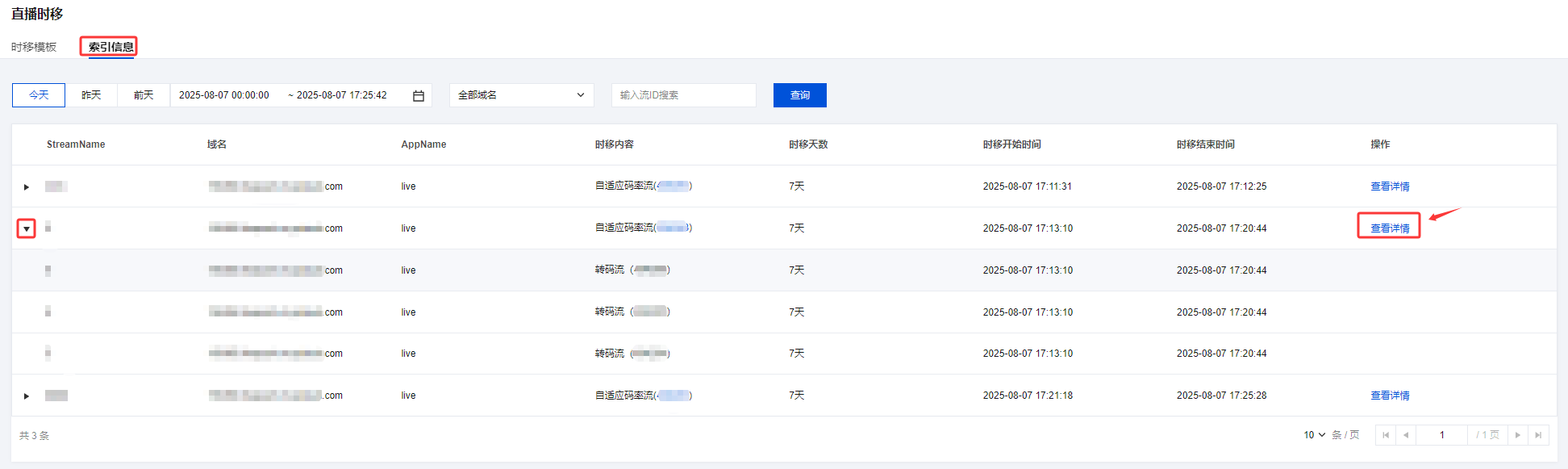
1. Click Feature Configuration > Time Shifting on the left sidebar and select the Time shifting details tab.
2. Select a domain or enter a stream ID, specify the time period (cannot be longer than 24 hours), and click Query.
3. Click Details to enter the details page.

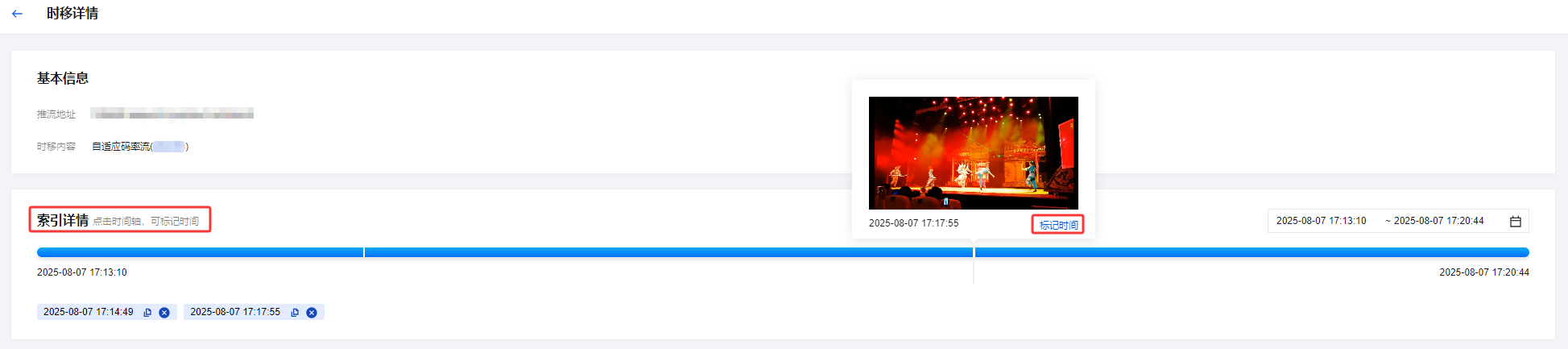
4. View the push URL and stream type in the Basic Info area.
5. You can move the mouse over the timeline in the Index Details page to view the position and time. By clicking on the timeline, you can mark the time.
6. Click the timeline to preview the video at a specific time point and mark that point.

Note:
To preview time-shifted content, the domain used for playback must have an HTTPS certificate. If your playback domain does not have an HTTPS certificate yet, add one in Domain Management> Certificate Management. Using the time shifting feature will incur playback traffic/bandwidth fees.
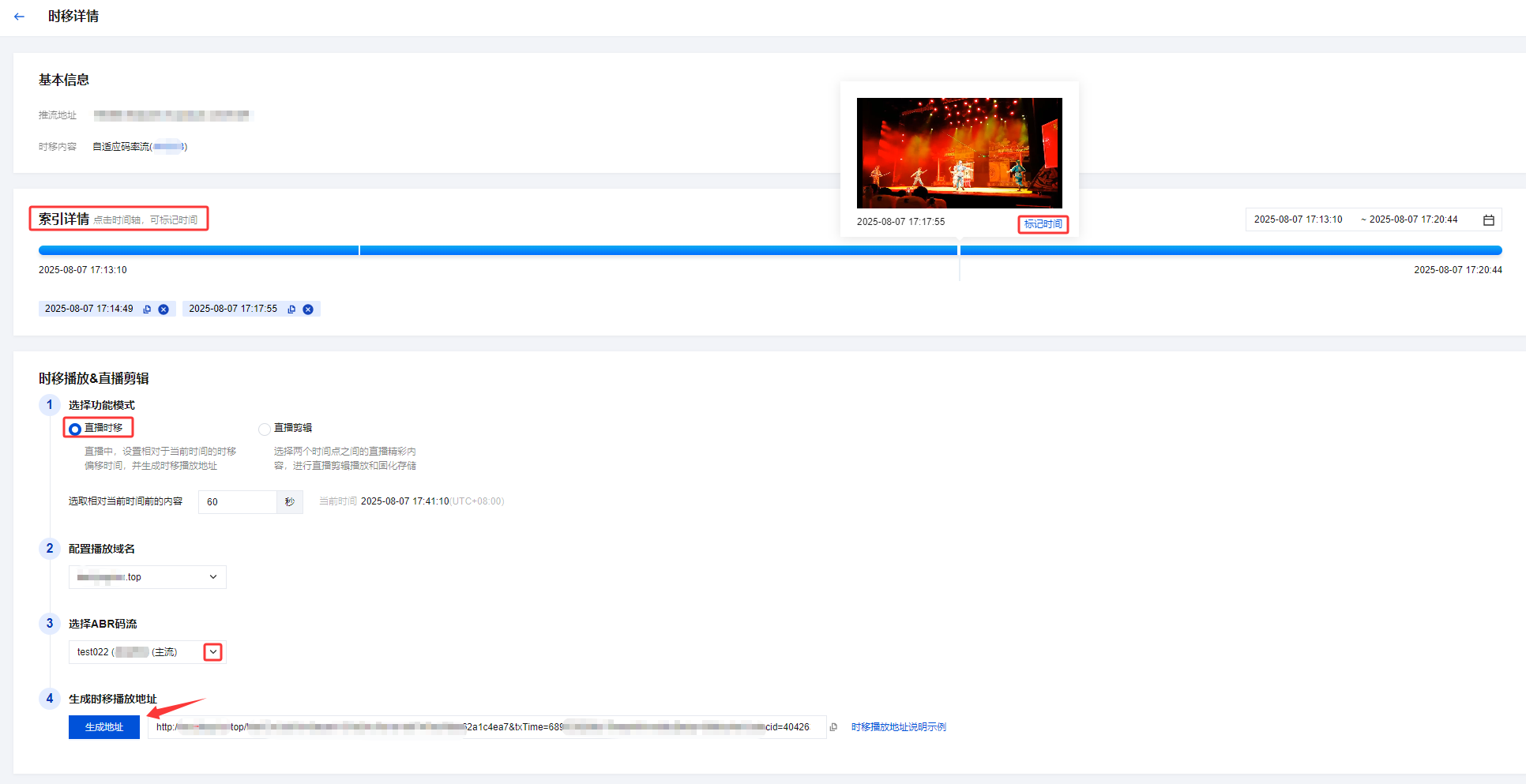
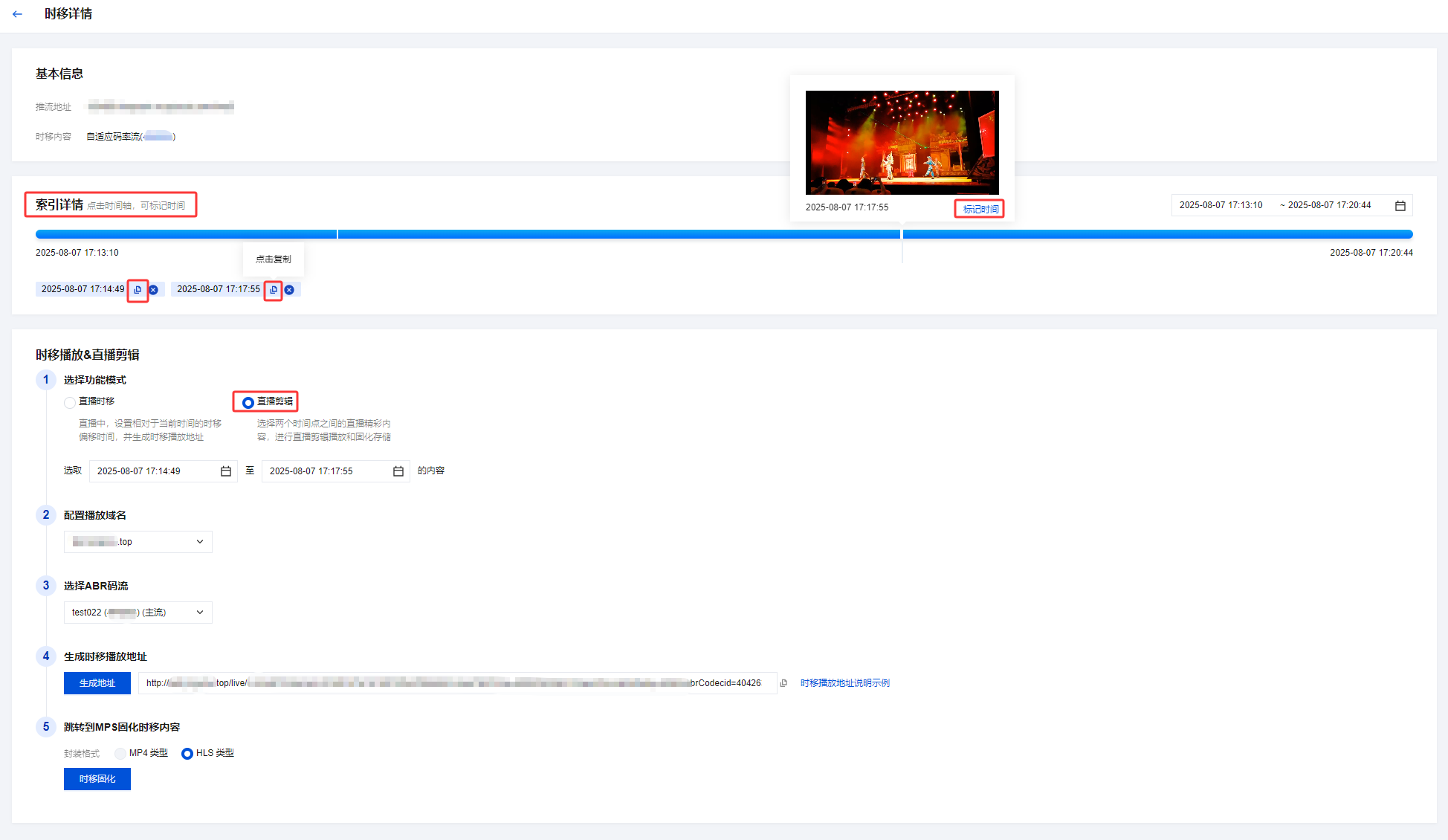
7. Time Shifting and Live Clipping can be configured as follows:
Item

Description
Select a feature
Time shifting
Generate a time shifting URL that delays live streaming playback by a specific time
Live clipping
Generate a clip from a live stream at the specified start and end time and store it permanently
Playback domain
Select a playback domain you added to CSS.
Select ABR Stream: (Adaptive Bitrate Streaming)
Mainstream is selected by default, and substream can be selected through the drop-down menu.
Generate time-shifting playback URL
Click Generate Address to generate a time-shifting playback URL and copy it.
If you select the ABR stream as the main stream, the address will be generated based on the main stream. If you select the substream, the address will be generated based on the substream.
Navigate to the MPSfor fixed time-shifting content
The encapsulation format can be selected as either MP4 type or HLS type.
When Live clipping is selected as the function mode, the mainstream encapsulation format is set to HLS type by default, and the substream encapsulation format is set to MP4 type by default.
Time shifting
Live clipping
Generate a time shifting URL that delays live streaming playback by a specific time

Generate a clip from a live stream at the specified start and end time and store it permanently

8. Select the function mode as Live Clipping. When you have chosen to navigate to the MPS for fixed time-shifting content, click Configure storage to enter MPS > Tasks > VOD. For more details, please refer to the Live Streaming Highlights Clipping document > Create Clip Persistence Task.

Help and Support

Was this page helpful?

Help us improve! Rate your documentation experience in 5 mins.

Feedback