CLB is mainly suitable for the following scenarios:
Traffic distribution. CLB can distribute the traffic of business with a large number of access requests to multiple real servers.
Elimination of single point of failure. When some CVM instances become unavailable, CLB automatically blocks them to ensure the normal operation of the application system.
Horizontal scalability. You can scale out the service capability of web servers and app servers as needed.
Global load balancing. With DNSPod, CLB supports global and multi-regional load balancing for remote disaster recovery.
Traffic Distribution and Elimination of Single Point of Failure
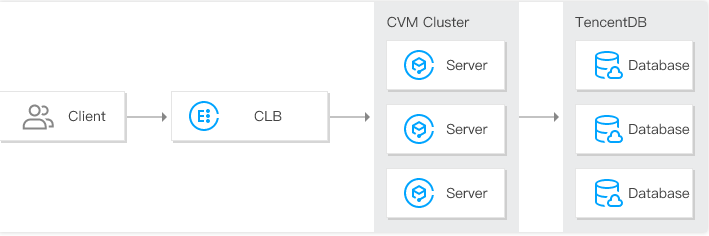
You can use CLB to distribute business traffic to multiple real servers.
A business client accesses CLB.
Multiple real servers form a high-performance and high-availability service pool to which CLB forwards the business traffic.
When one or more real servers become unavailable, CLB automatically blocks them and distribute the requests to healthy CVM instances, ensuring the operation of the application system.
If your business is deployed in multiple availability zones, it is recommended that you bind a CLB instance to CVM instances in multiple availability zones at the same time to ensure multi-availability zone disaster recovery at the real server layer.
The session persistence feature ensures that requests from a client are sent to the same real server, which improves the access efficiency.
Horizontal Scalability
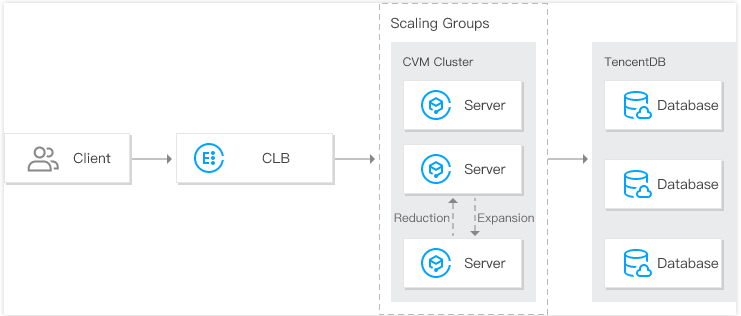
With Auto Scaling (AS), CLB automatically creates and releases CVM instances based on your business needs.
You can configure auto scaling policies to manage the number of CVM instances, deploy the instance environment, and ensure the operation of your business. CLB can automatically add CVM instances when demands peak to keep high performance, while removing CVM instances when demands drop to reduce costs.
For example, during major sales campaigns in ecommerce such as Black Friday, web traffic may suddenly increase by 10 times and lasts only for a few hours. In this case, CLB and AS can be used to maximize IT cost savings.
Global Load Balancing
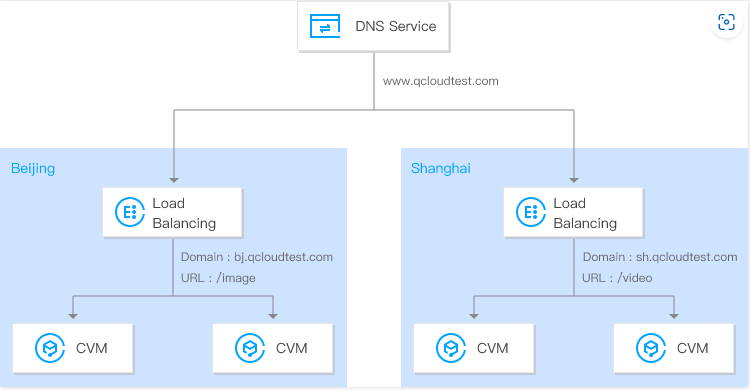
With DNSPod, CLB supports global load balancing for you to resolve business traffic to CLB instances in various regions, ensuring multi-site active-active disaster recovery.
You can deploy CLB instances in different regions and bind them to real servers in corresponding regions.
You can use DNSPod to resolve domain names to CLB VIPs in various regions.
Business traffic will be forwarded to multiple real servers in multiple regions via DNSPod and CLB, achieving global load balancing.
When a region becomes unavailable, you can suspend resolution of the VIP of the CLB instance in that region to ensure that your business is not affected.