tencent cloud

Cloud Load Balancer

Release Notes and Announcements
CLB Release Notes
Product Announcements
Product Introduction
Overview
Strengths
Use Cases
Principles
Product Comparison
Use Limits
Service Regions and Service Providers
Purchase Guide
Billing Overview
Billing
CLB Resource Package
Purchase Methods
Payment Overdue
Product Attribute Selection
Getting Started
Getting Started with Domain Name-Based CLB
Getting Started with CLB
Getting Started with IPv6 CLB
Deploying Nginx on CentOS
Deploying Java Web on CentOS
Operation Guide
CLB Instance
CLB Listener
Real Server
Health Check
Certificate Management
Log Management
Monitoring and Alarm
Cloud Access Management
Classic CLB
Practical Tutorial
Deploy certificate to CLB (mutual authentication)
Enabling Gzip Compression & Testing
HTTPS Forwarding Configurations
Obtaining Real Client IPs
Best Practices for Configuring Load Balancing Monitoring Alerts
Implementing HA Across Multiple AZs
Load Balancing Algorithm Selection and Weight Configuration Examples
Configuring WAF protection for CLB listening domain names
Configure IAP to authenticate web access to the CLB domain and path
Configure IAP to authenticate programmatic access to CLB's domain and path
Ops Guide
Solution to Excessive Clients in TIME_WAIT Status
Load Balancer HTTPS Service Performance Test
Stress Testing FAQ
CLB Certificate Operation Permissions
Troubleshooting
UDP Health Check Exception
API Documentation
History
Introduction
API Category
Instance APIs
Listener APIs
Backend Service APIs
Target Group APIs
Redirection APIs
Other APIs
Classic CLB APIs
Load Balancing APIs
Making API Requests
Data Types
Error Codes
CLB API 2017
FAQs
Billing
CLB Configuration
Troubleshooting Health Check Issues
HTTPS
WS/WSS Protocol Support
HTTP/2 Protocol Support
Default Domain Name Blocking Prompt
Service Level Agreement
Contact Us
Glossary
DocumentationCloud Load BalancerPractical TutorialImplementing HA Across Multiple AZs

Implementing HA Across Multiple AZs

PDF
Focus Mode
Font Size
Last updated: 2026-01-04 10:32:52
CLB guarantees high availability (HA) from multiple dimensions such as system architecture and product configuration. Based on the business scenario and requirements, you can select one from a variety of HA solutions for cross-region disaster recovery or intra-region cross-AZ disaster recovery.

CLB Cluster HA

CLB instances adopt a cluster deployment mode that supports session synchronization, eliminating the single point of failure for servers, enhancing system redundancy, and ensuring service stability. All CLB instances have cluster-level high availability.
At Layer-4, load balancing is implemented based on the unified Tencent Gateway (TGW), which features high availability, strong scalability, high performance, and strong anti-attack capability. It supports high-performance forwarding based on Data Plane Development Kit (DPDK). With TGW, a single cluster can support hundreds of millions of concurrent requests and tens of millions of packets per second (PPS). Many Tencent businesses, such as Tencent Games, Tencent Video, WeChat, and QQ, use TGW for service access.
At Layer-7, load balancing is implemented based on Secure Tencent Gateway (STGW), which is a load balancing service developed by Tencent based on Nginx. It supports large-scale concurrency and carries a large amount of Tencent's Layer-7 business traffic.

Single CLB Instance HA

Non-Domain Name-Based Public Network CLB

The non-domain name-based public network CLB provides services in the form of VIP addresses, with the SLA of 99.95%. There are two deployment schemes for associated clusters of the VIP addresses:
Deployment Mode
Cluster Disaster Recovery
Cross-AZ Disaster Recovery
Single-AZ
Supported
Not supported
Multi-AZ
Supported
Supported. The primary/secondary AZ mode is adopted. In case of a failure in the primary AZ, the CLB can automatically switch to the secondary AZ and restore services within a very short time.

Domain Name-Based Public Network CLB

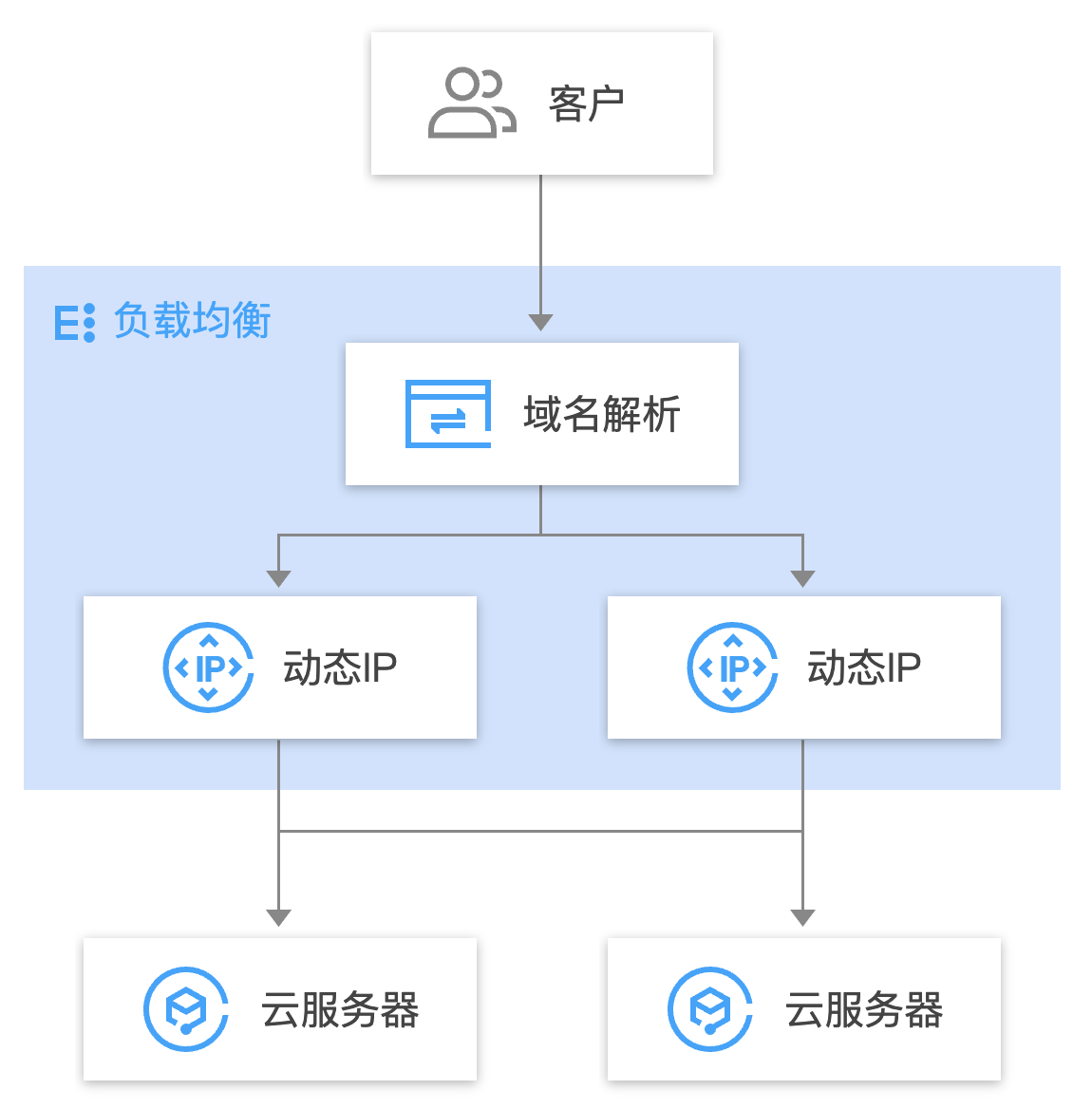
The "domain name-based public network CLB" builds upon the "non-domain-name-based public network CLB" mentioned above by adding an additional DNS service layer. The SLA is increased from 99.95% to 99.99%, and it supports the replacement of faulty VIP addresses to enhance availability. For details, see Announcement on the Launch of Domain Name-Based Public Network CLB.


Private Network CLB

Private network CLB instances are deployed with the nearby access architecture, which means that one CLB instance is deployed to one or more AZs. When a client accesses such a CLB instance, the cluster with the lowest latency in these AZs is selected automatically to forward the access traffic to a backend server. If the selected CLB cluster in an AZ becomes unavailable, the system can switch to the CLB cluster in another AZ.

Multi-CLB Instance HA

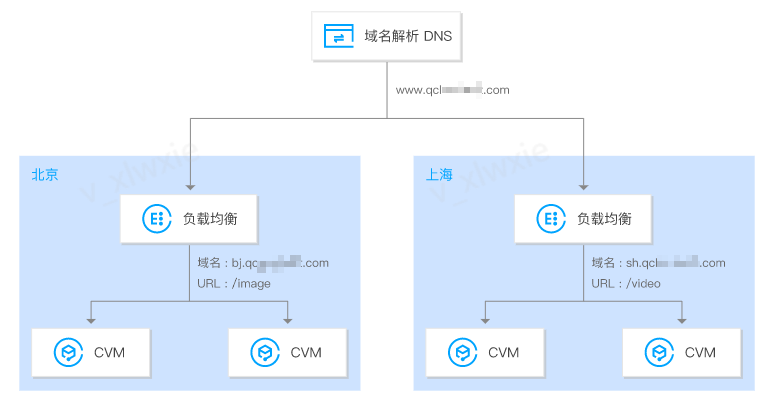
If you have very high availability requirements, the availability mechanism of a CLB instance itself may not meet your needs in scenarios such as network attacks, cross-region switching, and configuration errors. You can create multiple CLB instances and use Tencent Cloud DNS to schedule the access traffic.


Comparison Between the Multi-CLB Instance HA and Domain Name-Based Public Network CLB:
Comparison Item
Domain Name-Based Public Network CLB
Multi-CLB Instance HA
SLA
99.99%
99.95%
Input Failover
Provide link detection and disaster recovery switch capabilities, eliminating concerns about a single IP address entry interruption. When a single IP address experiences a failure, the faulty IP address can be switched to reduce business impact.
Depends on your configured DNS resolution and switching policies. Prompt detection and switching is required for your business.
Ops Management
Only a single instance needs to be configured.
Multiple CLB instances and corresponding DNS resolution policies need to be configured.
Cost
The cost is lower for only CLB-related fees are charged.
Deployment of multiple CLB instances and components such as DNS resolution leads to higher costs.
Region
The associated cluster of the CLB instance is deployed in a single region.
You can select CLB instances across multiple regions.
Best Practices:
If your business is deployed within a single region, it is recommended to choose the domain name-based public network CLB solution first, which supports the switch of faulty IP addresses.
If your business is deployed across multiple regions and has very high disaster recovery requirements, it is recommended to select the multi-CLB instance HA solution.
When a client accesses the same port of a real server via different intermediate nodes at the same time, these nodes cannot be specifically determined. For details, see the issue description.

Real Server HA

CLB determine the availability of real servers through health checks to avoid real server exceptions from affecting frontend businesses, thereby improving the overall availability of businesses.
After the health check feature is enabled, CLB instances will perform health checks regardless of the real server weight (including 0). You can view the health check status in the Health Status column on the instance list page or on the details page of the real server bound to the listener. For details of the health check mechanism, see Health Check Overview.


Help and Support

Was this page helpful?

Help us improve! Rate your documentation experience in 5 mins.

Feedback