tencent cloud

Key Management Service

Product Introduction
Product Overview
Product Strengths
Use Cases
Concepts
Purchase Guide
Billing Overview
Purchase Method
Renewal Instructions
Payment Overdue
Console Guide
Getting Started
Key Management
Access Control
Audit
TCCLI Management Guide
Operation Overview
Creating Key
Viewing Key
Editing Key
Enabling/Disabling Key
Key Rotation
Encryption and Decryption
Asymmetric key decryption
Deleting Key
Practical Tutorial
Symmetrical Encryption and Decryption
Asymmetric Encryption and Decryption
Post-Quantum Cryptography Practice In KMS
Importing External Key
Implementing Exponential Backoff to Deal with Service Frequency
Cloud Product Integration with KMS for Transparent Encryption
API documentation
History
Introduction
API Category
Key APIs
Making API Requests
Asymmetric Key APIs
Data Types
Error Codes
Service Level Agreement
FAQS
FAQs
General
KMS Policy
Privacy Policy
Data Processing And Security Agreement
Contact Us
Glossary

Overview

PDF
Focus Mode
Font Size
Last updated: 2024-01-11 16:31:21
Sensitive information encryption is a core capability of KMS, which is mainly used to protect small pieces of sensitive data (less than 4 KB) such as keys, certificates, and configuration files. A CMK is used to encrypt sensitive data instead of storing it in plaintext. During decryption, the data ciphertext is decrypted to the memory, so that the plaintext does not get stored in the disk. HTTPS requests are used in the entire interaction and transfer process, ensuring the security of sensitive data.
If you need to use KMS for high-performance encryption/decryption of massive amounts of data, please see Envelope Encryption scenario.

Examples of sensitive information

-
Key/Certificate
Backend Configuration File
Usage
Encrypts business data, communication channels, and digital signatures.
Stores system architecture and other business information, such as database IP and password.
Risk of data loss
Confidential information is stolen; encrypted tunnels are monitored; signatures are faked.
Business data is breached and used to attack other systems.

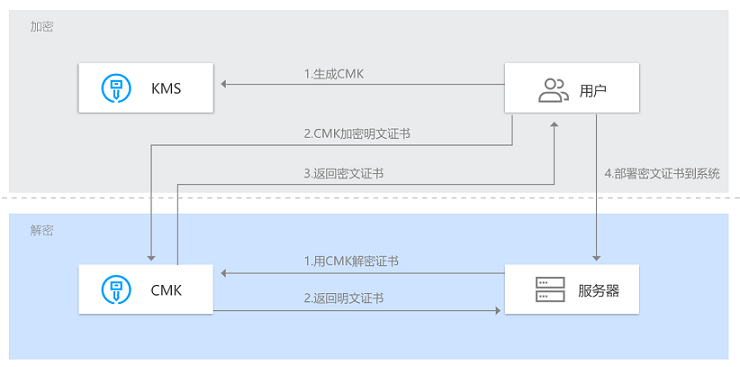
Schematic diagram

In this scenario, sensitive data is encrypted/decrypted through a CMK, which is protected by a third-party certified hardware security module (HSM). The CMK performs encryption/decryption inside the HSM, and any unauthorized party, including Tencent Cloud, has no access to the CMK in plaintext.

Features

Permission control: Fully integrated with CAM, KMS can control which accounts have access to your CMK through identity and policy management.
Built-in audit: KMS is integrated with CloudAudit to record all API requests for detailed statistics of key management activities and key usage, ensuring that all data operations can be traced and audited.
Integrated key management: KMS enables centralized management of keys from various applications.
Security and compliance: KMS leverages a State Cryptography Administration of China or FIPS-140-2 certified hardware security module (HSM) to generate and protect keys, thereby ensuring their confidentiality, integrity, and availability.
Sensitive data encryption: KMS supports encryption/decryption of small pieces of sensitive data (less than 4 KB), such as keys, certificates, and configuration files.

Precautions

Secure storage of SecretId and SecretKey:
Tencent Cloud API authentication mainly relies on SecretId and SecretKey, which are your unique credentials. Tencent Cloud's service systems need such credentials to call Tencent Cloud APIs.
Permission control over SecretId and SecretKey:
It is recommended to use a sub-account and manage risks by means of API authorization as needed.
Plaintext data storage:
Data has already encrypted through sensitive data encryption. To ensure data security, please make sure that the original plaintext data is deleted.

Help and Support

Was this page helpful?

Help us improve! Rate your documentation experience in 5 mins.

Feedback