Optimizer Hints
Download
Mode fokus
Ukuran font
Overview
TDSQL extends specialized parallel Hints based on compatibility with MySQL's official Hint standards, tailored for distributed parallel execution characteristics. These Hints primarily serve as optimizer directives, enabling users to exercise finer-grained control over policies for parallel execution of queries and enhance the performance of complex queries.
Parallelism Control of the PARALLEL/NO_PARALLEL Hint
The
PARALLEL Hint is used to specify the table for parallel scanning (Parallel Scan), the degree of parallelism, and the parallel scanning method.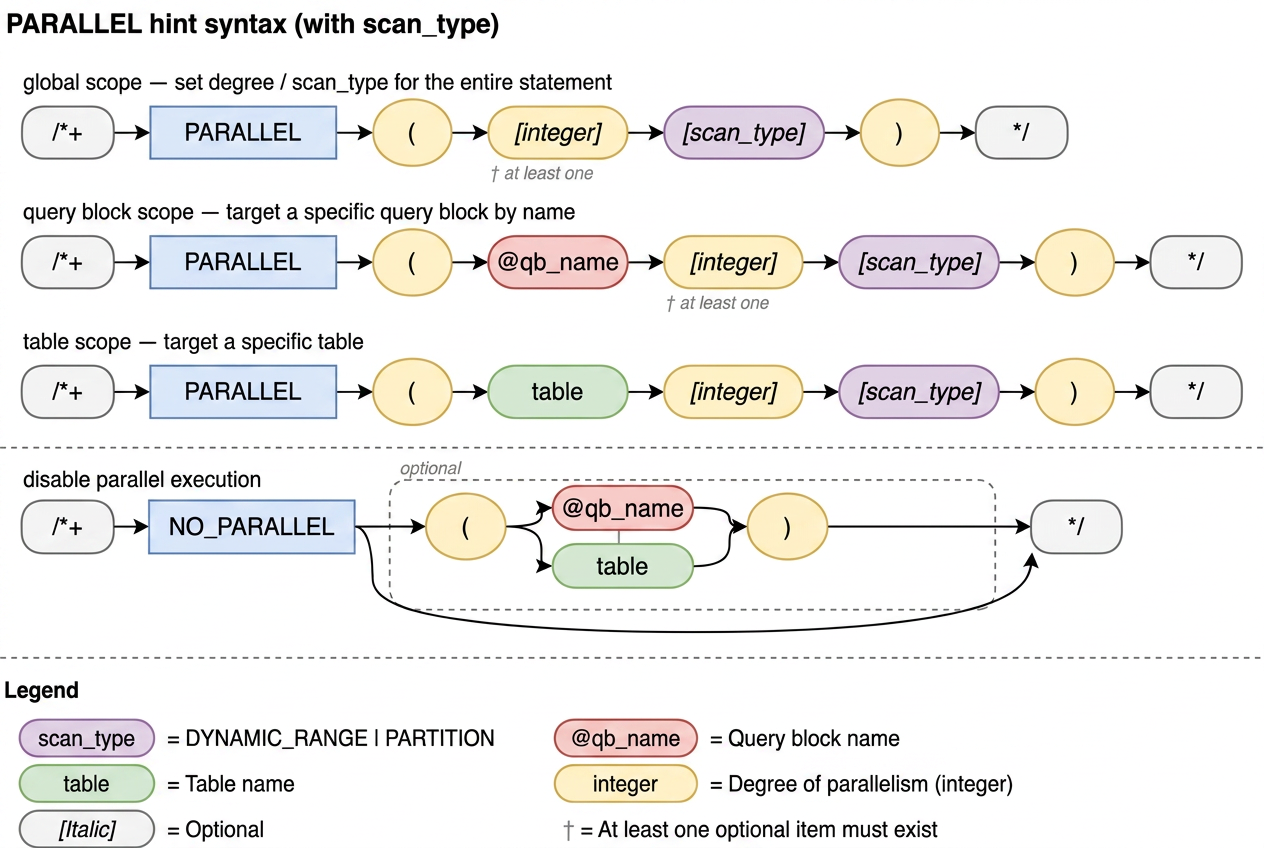
The
PARALLEL Hint is a three-level Hint: Global, Query Block, and Table. An optional degree of parallelism (integer) can be specified at each level. The NO_PARALLEL Hint is used to disable parallelism. For MySQL standard Hint syntax, see Optimizer Hints.The
PARALLEL Hint also supports appending an optional scan policy parameter, parallel_scan_type, after the degree of parallelism. This parameter explicitly declares the partitioning method for parallel scanning, facilitating the generation of more stable parallel execution plans when data distribution or access path characteristics are known. If this parameter is not specified, the optimizer automatically selects the method.Three Levels of Semantics
Level | Trigger Condition | Action |
Global Level | Specified in the main query, and no query block name or table name is given. | integer serves as the default parallelism for the entire query. Subqueries can override this value with their own PARALLEL Hint. |
Query Block level | Specified in a non-main query, or explicitly given a query block name but no table name. | integer serves as the default parallelism for this subquery. |
Table level | A table name is specified in the Hint. | If only the table name is specified without integer, the parallelism is inherited upward (in the order of Query Block level, Global level, and the max_parallel_degree variable). If no parallelism is ultimately obtained (that is, max_parallel_degree is 0), no parallel execution occurs. |
Note:
The Query Block level and the Global level (when the Query Block level is unspecified) determine whether the current Query Block uses a parallel plan. For example, when
NO_PARALLEL is specified, that Query Block will not enter the parallel optimization phase. The table-level Hint only affects whether the current table undergoes parallel scanning. If no Hint is specified at the Query Block and Global levels and max_parallel_degree is greater than 0, the parallel optimizer will still select a table for parallel scanning, even if all tables use NO_PARALLEL.The Hint forces or disables the use of parallelism, overrides the
max_parallel_degree variable, and no longer checks whether the cost and table records meet the configured threshold.Examples
-- Global levelEXPLAIN SELECT /*+ PARALLEL(4) */ * FROM t1 WHERE a > 4;-- Query Block level (effective only for the top-level query)EXPLAIN SELECT /*+ QB_NAME(q1) PARALLEL(@q1 4) */ * FROM t1 WHERE a > 4;-- Query Block level (effective only in subqueries)EXPLAIN SELECT * FROM t3 WHERE a = (SELECT /*+ PARALLEL(2) */ COUNT(a) FROM t3);-- Table levelEXPLAIN SELECT /*+ PARALLEL(t1 4) */ * FROM t1 WHERE a > 4;EXPLAIN SELECT /*+ PARALLEL(t3@q2 4) */ * FROM t3 WHERE a = (SELECT /*+ QB_NAME(q2) */ COUNT(a) FROM t3);EXPLAIN SELECT /*+ PARALLEL(@q2 t3 4) */ * FROM t3 WHERE a = (SELECT /*+ QB_NAME(q2) */ COUNT(a) FROM t3);
By combining the
PARALLEL Hint with a fixed query plan, you can enable parallelism for specific statements without modifying them:CALL dbms_admin.statement_outline_add_rule('test', 'select /*+ PARALLEL(4) */ sum(c),b from t1 group by b');
Parallel Scan Policy
An optional
parallel_scan_type can be appended to the end of the PARALLEL Hint parameter list to declare the partitioning policy for parallel scanning. The syntax is as follows:/*+ PARALLEL([@query_block | tbl_name] [integer] [parallel_scan_type]) *//*+ PARALLEL(parallel_scan_type) *//*+ PARALLEL(@query_block parallel_scan_type) */
The optional values for
parallel_scan_type are shown in the following table:Value | Applicable Scope | Description |
DYNAMIC_RANGE | Partition tables and non-partition tables | Dynamically splits data based on continuous ranges of indexes or primary keys, with each Worker dynamically obtaining unscanned sub-ranges during execution. Suitable for scenarios with large data volumes where the access path is index range scan or full table scan. |
PARTITION | Partition tables only | Splits data by partition, with each Worker responsible for scanning one or more partitions. The actual parallelism automatically takes the smaller value between the parallelism parameter and the number of partitions. Applies only to partition tables; the optimizer automatically ignores this policy when this policy is used on non-partition tables. |
Note:
When
parallel_scan_type is not specified, the optimizer automatically selects a parallel scanning policy based on the table type, access path, and cost. The semantics of the original PARALLEL(n) syntax remain unchanged.parallel_scan_type only affects the partitioning method for parallel scanning and does not alter the parallelism degree enforcement rules for the three levels (Global, Query Block, and Table) of the PARALLEL Hint.When
PARTITION is specified via a Hint but the target table is not a partition table, this policy does not take effect for the current table, and the optimizer falls back to other feasible parallel scanning policies.Example:
-- Global level: Declares only the scanning policy, with the optimizer using the default or session-level parallelism degree.EXPLAIN SELECT /*+ PARALLEL(DYNAMIC_RANGE) */ * FROM t1 WHERE a > 4;-- Global level: Specifies both the parallelism degree and the scanning policy.EXPLAIN SELECT /*+ PARALLEL(4 DYNAMIC_RANGE) */ * FROM t1 WHERE a > 4;-- Query Block level: Enables partition-based parallel scanning within the specified query block.EXPLAIN SELECT /*+ QB_NAME(q1) PARALLEL(@q1 4 PARTITION) */ *FROM t_partitioned WHERE created_date >= '2024-01-01';-- Table level: Enables partition-based parallel scanning only for the partition table t_part.EXPLAIN SELECT /*+ PARALLEL(t_part 8 PARTITION) */ *FROM t_part JOIN t1 ON t_part.id = t1.id;-- Table level: Specifies dynamic range partitioning only for table t1 and inherits the upper-level parallelism degree.EXPLAIN SELECT /*+ PARALLEL(t1 DYNAMIC_RANGE) */ * FROM t1 WHERE a > 4;
PQ_DISTRIBUTE Hint Data Distribution Strategy of the Hint
The
PQ_DISTRIBUTE Hint instructs the parallel query optimizer on how to add data redistribution operations to the query plan, as well as the parallel execution policy for GROUP BY, ORDER BY, and window functions (WINDOW). The syntax is as follows: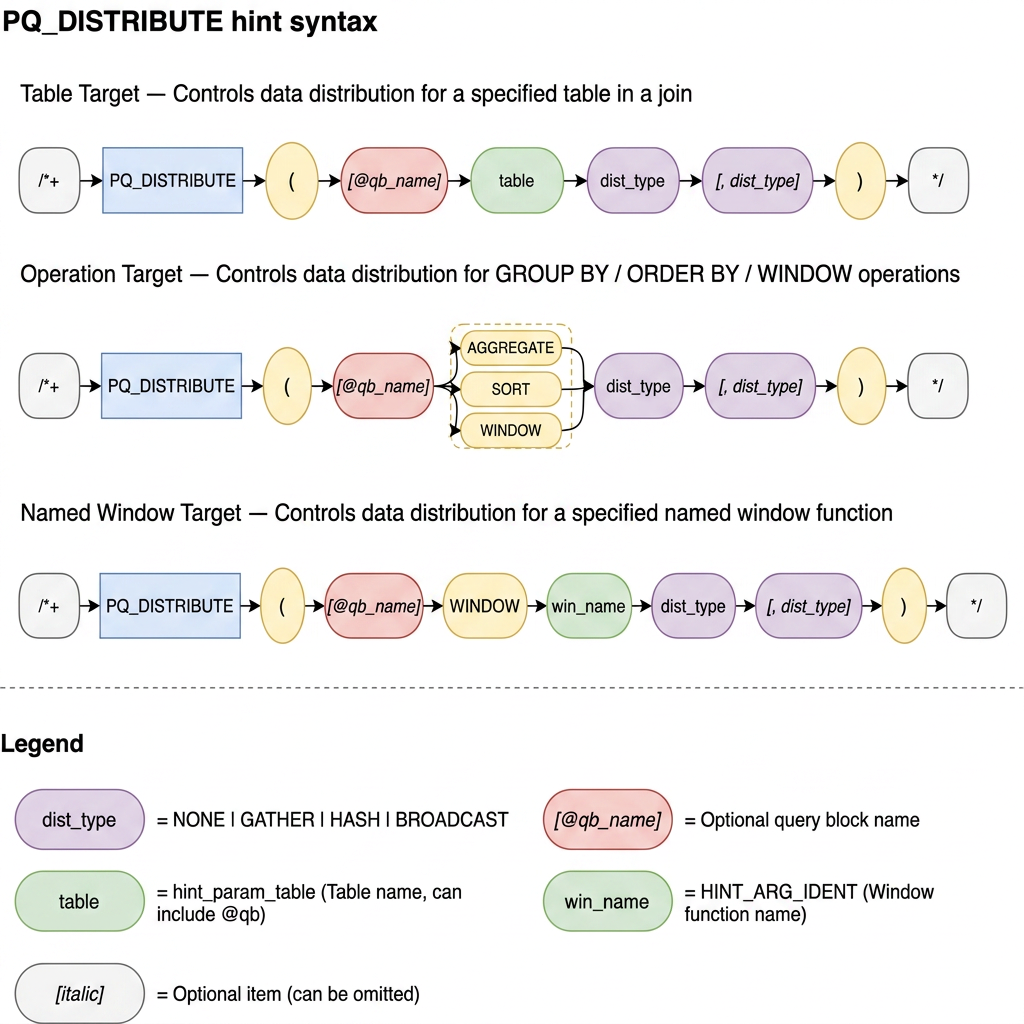
Semantics of dist_type
Table target (table target)
Syntax | Meaning |
PQ_DISTRIBUTE(t1 NONE) | Single dist_type: Controls the distribution of this table. NONE = No redistribution (keep local data). |
PQ_DISTRIBUTE(t1 GATHER) | Single dist_type: Controls the distribution of this table. GATHER = Add a collector (gather to the leader). |
PQ_DISTRIBUTE(t1 d1, d2) | Two dist_type: The first one = the peer table (the other side of the join), the second one = this table. Their values are the same as above. |
Note:
Currently, only NONE and GATHER are actually effective. HASH / BROADCAST can be parsed but are treated as unspecified.
Operation target (operation target: AGGREGATE / SORT / WINDOW)
Syntax | Meaning |
PQ_DISTRIBUTE(AGGREGATE GATHER) | Single-stage aggregation: gather all data to the leader first, then perform aggregation. |
PQ_DISTRIBUTE(AGGREGATE NONE) | Push-down single-stage aggregation: aggregate directly on each worker, without redistributing data. |
PQ_DISTRIBUTE(AGGREGATE NONE, GATHER) | Two-stage aggregation: workers perform partial aggregation → gather → the leader performs final aggregation. |
PQ_DISTRIBUTE(SORT GATHER) | Sort not pushed down: gather all data to the leader first, then perform sorting. |
PQ_DISTRIBUTE(SORT NONE, GATHER) | Sort pushed down: workers perform partial sorting → gather → the leader performs merge sorting. |
Syntax
/*+ PQ_DISTRIBUTE([@query_block] target dist_type[, dist_type]) */
The
target has three types:Target Type | Syntax | Description |
Table target | PQ_DISTRIBUTE([@qb] tbl_name dist_type[, dist_type]) | Controls the data distribution method of tables in a Join. |
Operation target | PQ_DISTRIBUTE([@qb] AGGREGATE|SORT dist_type[, dist_type]) | Controls the parallel execution policy for aggregation or sorting operations. |
Named window target | PQ_DISTRIBUTE([@qb] WINDOW win_name dist_type[, dist_type]) | Controls the parallel execution policy for specified named window functions. |
@qb is an optional query block name (for example, @qb1) used to specify the query block on which the Hint acts.The
dist_type can be set to: NONE or GATHER. Currently, HASH and BROADCAST are not effective and are treated as unspecified.Target Table Semantics
When
target is a table name, the Hint controls the data distribution method of that table in Join operations.Syntax | Meaning |
PQ_DISTRIBUTE(t1 NONE) | The t1 table does not have a Collector added (data remains on each Worker). |
PQ_DISTRIBUTE(t1 GATHER) | The t1 table has a Collector added (data is gathered to the Leader). |
PQ_DISTRIBUTE(t1 d1, d2) | d1 controls the distribution method of the peer side in a Join, and d2 controls the distribution method of this table (t1). |
When two
dist_type values are specified, the first parameter d1 applies to the remote table in the Join, and the second parameter d2 applies to the local table. For example:-- Do not add a Collector for t1 (it remains on the Worker), but add a Collector at the remote side of the Join (to aggregate to the Leader)SELECT /*+ PQ_DISTRIBUTE(t1 GATHER, NONE) */ * FROM t1 JOIN t2 ON t1.id = t2.id;
Target Operation Semantics
When
target is AGGREGATE or SORT, the Hint controls the parallel execution policy for aggregation or sorting operations.Aggregation (AGGREGATE)
Syntax | Meaning |
PQ_DISTRIBUTE(AGGREGATE GATHER) | Single-stage aggregation: gather data from all workers to the Leader first, then perform aggregation. |
PQ_DISTRIBUTE(AGGREGATE NONE) | Push-down single-stage aggregation: each Worker performs the complete aggregation directly (no redistribution required). |
PQ_DISTRIBUTE(AGGREGATE NONE, GATHER) | Two-stage aggregation: each Worker performs partial aggregation first, then the results are gathered to the Leader for final aggregation. |
-- Fully pushed down single-phase aggregationSELECT /*+ PQ_DISTRIBUTE(AGGREGATE NONE) */department, AVG(salary)FROM employeesGROUP BY department;-- Two-phase aggregation between Worker and LeaderSELECT /*+ PQ_DISTRIBUTE(AGGREGATE NONE, GATHER) */department, AVG(salary)FROM employeesGROUP BY department;-- Single-phase aggregation performed solely on the LeaderSELECT /*+ PQ_DISTRIBUTE(AGGREGATE GATHER) */department, AVG(salary)FROM employeesGROUP BY department;
Sorting (SORT)
Syntax | Meaning |
PQ_DISTRIBUTE(SORT GATHER) | Sort not pushed down: data from all Workers is gathered to the Leader before sorting is performed. |
PQ_DISTRIBUTE(SORT NONE, GATHER) | Sort pushed down: each Worker first performs partial sorting, then gathers to the Leader for merge sorting. |
-- Partial sorting by Workers + Merge sort by the LeaderSELECT /*+ PQ_DISTRIBUTE(SORT NONE, GATHER) */ *FROM large_tableORDER BY create_time DESC;-- Global sorting performed solely on the LeaderSELECT /*+ PQ_DISTRIBUTE(SORT GATHER) */ *FROM large_tableORDER BY create_time DESC;
Target Semantics of Named Windows
When
target is WINDOW win_name, the Hint controls the parallel policy for the specified named window function, and its semantics are similar to those of SORT.SELECT /*+ PQ_DISTRIBUTE(WINDOW w NONE, GATHER) */ SUM(val) OVER wFROM t1 WINDOW w AS (ORDER BY id);
Examples
-- Table target: Prevent a Collector from being added to t1 during the Join.SELECT /*+ PQ_DISTRIBUTE(t1 NONE) */ * FROM t1 JOIN t2 ON t1.id = t2.id;-- Table target (specified query block): Add a Collector to t1, but do not add one to the remote side.SELECT /*+ PQ_DISTRIBUTE(@qb1 t1 NONE, GATHER) */ * FROM t1 JOIN t2 ON t1.id = t2.id;-- Operation target: Use two-phase aggregation.SELECT /*+ PQ_DISTRIBUTE(AGGREGATE NONE, GATHER) */ dept, SUM(salary) FROM emp GROUP BY dept;-- Operation target: Push down sorting.SELECT /*+ PQ_DISTRIBUTE(SORT NONE, GATHER) */ * FROM t1 ORDER BY col1;-- Combined use: Specify both table distribution and aggregation policies simultaneously.SELECT /*+ PQ_DISTRIBUTE(t1 NONE) PQ_DISTRIBUTE(AGGREGATE NONE, GATHER) */ dept, COUNT(*) FROM t1 GROUP BY dept;
Note:
1.
HASH and BROADCAST are currently not supported as values for dist_type. If they are used, they are treated as unspecified, which is equivalent to omitting the Hint.2. When only one
dist_type is specified for a table target, it determines the distribution method for the local table, while the remote side of the JOIN is not constrained.3. When two
dist_type values are specified for a table target, the first parameter controls the remote side, and the second parameter controls the local table.4. The Hint takes effect only when parallel query (PQ) is enabled.
5. Multiple
PQ_DISTRIBUTE Hints can be combined within a single SQL statement to control different targets respectively.SUBQUERY Hint Policy for Parallel Subqueries
The MySQL SUBQUERY Hint for parallel queries introduces two additional parallelization strategies that can be used in combination with MySQL's native strategies.
PQ_PRE_EVALUATION: Specifies that a subquery is executed in advance before the parent query that references it runs, enabling parallel workers to directly read the subquery result.
PQ_INLINE_EVALUATION: Enforces non-advance execution of subqueries, that is, executes on demand according to the parent query's requirements following MySQL's logic.
Example:
-- Specify that this IN subquery uses the MATERIALIZATION policy and does not use the pre-evaluation policy in the parallel plan.EXPLAIN FORMAT=TREESELECT * FROM t1WHERE t1.a IN (SELECT /*+ SUBQUERY(MATERIALIZATION, PQ_INLINE_EVALUATION) */ aFROM t2);-- Specify that the Derived Table subquery t uses the pre-evaluation policy.EXPLAIN FORMAT=TREESELECT /*+ NO_MERGE(t) PQ_DISTRIBUTE(t1 NONE) */ t1.aFROM t1, (SELECT /*+ SUBQUERY(PQ_INLINE EVALUATION) */ aFROM t2) tWHERE t1.a = t.a;
SET_VAR Method
Use the
SET_VAR Hint to temporarily modify a variable value within a single SQL statement, without requiring a global or session-level SET operation:-- Temporarily lower the threshold to enable parallel execution for this query.SELECT /*+ SET_VAR(parallel_scan_records_threshold=1000) */ * FROM t1;-- Temporarily enable Parallel Hash Join.SELECT /*+ SET_VAR(tdsql_enable_parallel_hash_join=ON) */* FROM t1, t2 WHERE t1.b = t2.b;
Bantuan dan Dukungan
Apakah halaman ini membantu?
Anda juga dapat Menghubungi Penjualan atau Mengirimkan Tiket untuk meminta bantuan.
masukan