Using the 4.x SDK to Send and Receive Normal Messages for 4.x Clusters
Baixar
Modo Foco
Tamanho da Fonte
Scenarios
TDMQ for RocketMQ supports SDKs in multiple languages for sending and receiving different types of messages. This document describes how to use the 4.x SDK (taking the Java SDK as an example) to connect to the TDMQ for RocketMQ server for normal message sending and receiving.
Prerequisites
You have created TDMQ for RocketMQ cluster resources.
You have prepared the Linux server and configured the environment by referring to Preparations.
Operation Steps
Step 1: Installing the Java Dependency Library
Introduce related dependencies into the Java project. Taking the Maven project as an example, add the following dependencies to pom.xml:
Note:
The dependency version should be 4.9.3 or later.
<!-- in your <dependencies> block --><dependency><groupId>org.apache.rocketmq</groupId><artifactId>rocketmq-client</artifactId><version>4.9.3</version></dependency><dependency><groupId>org.apache.rocketmq</groupId><artifactId>rocketmq-acl</artifactId><version>4.9.3</version></dependency>
Step 2: Producing Messages
1. Creating a Message Producer
// Instantiate a message producer.DefaultMQProducer producer = new DefaultMQProducer(namespace,groupName,new AclClientRPCHook(new SessionCredentials(accessKey, secretKey))// ACL permissions.);// Set the NameServer address.producer.setNamesrvAddr(nameserver);// Start the producer instance.producer.start();
Parameter | Description |
namespace | Namespace name. You can copy the name from the Namespace tab in the console. If you are using a TDMQ for RocketMQ 4.x general cluster, enter the cluster ID for this parameter.  |
groupName | Producer group name. You can copy the name from the Group tab on the Cluster Management page in the console. |
nameserver | Cluster access address. You can obtain the access address from the Access Information module on the Cluster Basic Information page in the console. 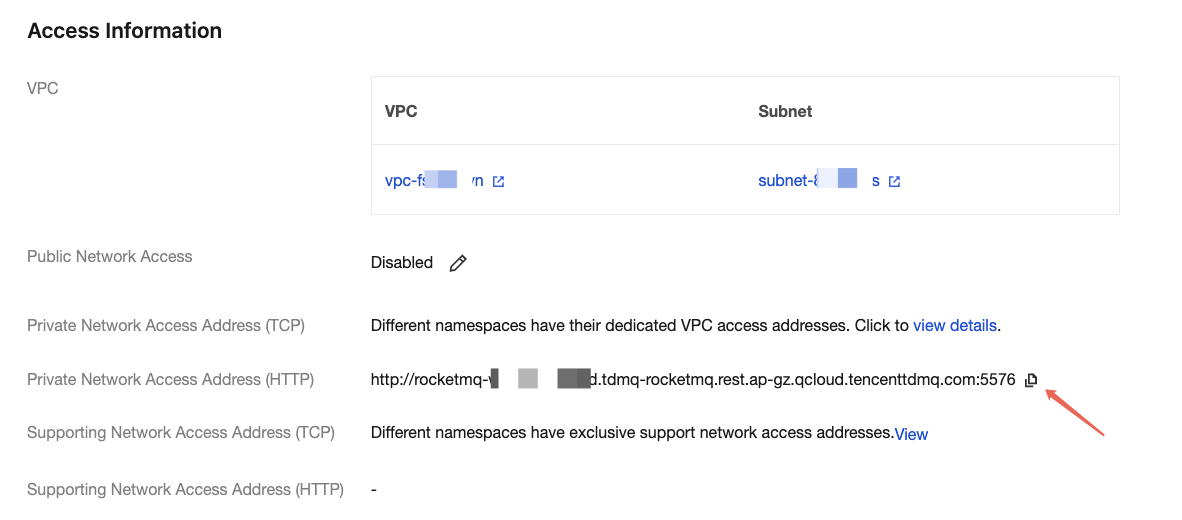 |
secretKey | Role name. You can copy the role name from the SecretKey column on the Role Management page in the console.  |
accessKey | Role token. You can copy it from the AccessKey column on the Role Management page in the console. |
2. Sending Messages
You can send messages by using the following methods: synchronous sending, asynchronous sending, and one-way sending.
for (int i = 0; i < 10; i++) {// Create a message instance and set the topic and message content.Message msg = new Message(topic_name, "TAG", ("Hello RocketMQ " + i).getBytes(RemotingHelper.DEFAULT_CHARSET));// Send a message.SendResult sendResult = producer.send(msg);System.out.printf("%s%n", sendResult);}
Parameter | Description |
topic_name | Topic name. You can copy the name from the Topic Management page in the console.  |
TAG | Tags associated with the message. |
// Disable retries on message sending failure.producer.setRetryTimesWhenSendAsyncFailed(0);// Set the number of messages to send.int messageCount = 10;final CountDownLatch countDownLatch = new CountDownLatch(messageCount);for (int i = 0; i < messageCount; i++) {try {final int index = i;// Create a message instance and set the topic and message content.Message msg = new Message(topic_name, "TAG", ("Hello rocketMq " + index).getBytes(RemotingHelper.DEFAULT_CHARSET));producer.send(msg, new SendCallback() {@Overridepublic void onSuccess(SendResult sendResult) {// Logic for successful message sending.countDownLatch.countDown();System.out.printf("%-10d OK %s %n", index, sendResult.getMsgId());}@Overridepublic void onException(Throwable e) {// Logic for failed message sending.countDownLatch.countDown();System.out.printf("%-10d Exception %s %n", index, e);e.printStackTrace();}});} catch (Exception e) {e.printStackTrace();}}countDownLatch.await(5, TimeUnit.SECONDS);
Parameter | Description |
topic_name | Topic name. You can copy the name from the Topic Management page in the console.  |
TAG | Tags associated with the message. |
for (int i = 0; i < 10; i++) {// Create a message instance and set the topic and message content.Message msg = new Message(topic_name, "TAG", ("Hello RocketMQ " + i).getBytes(RemotingHelper.DEFAULT_CHARSET));// Send a one-way message.producer.sendOneway(msg);}
Parameter | Description |
topic_name | Topic name. You can copy the name from the Topic Management page in the console.  |
TAG | Tags associated with the message. |
Note:
Step 3: Consuming Messages
1. Creating a Consumer
TDMQ for RocketMQ supports two consumption modes: push and pull.
// Instantiate a consumer.DefaultMQPushConsumer pushConsumer = new DefaultMQPushConsumer(namespace,groupName,new AclClientRPCHook(new SessionCredentials(accessKey, secretKey))); // ACL permissions.// Set the NameServer address.pushConsumer.setNamesrvAddr(nameserver);
Parameter | Description |
namespace | Namespace name. You can copy the name from the Namespace tab in the console. If you are using a TDMQ for RocketMQ 4.x general cluster, enter the cluster ID for this parameter.  |
groupName | Producer group name. You can copy the name from the Group tab on the Cluster Management page in the console. |
nameserver | Cluster access address. You can obtain the access address from the Access Information module on the Cluster Basic Information page in the console. 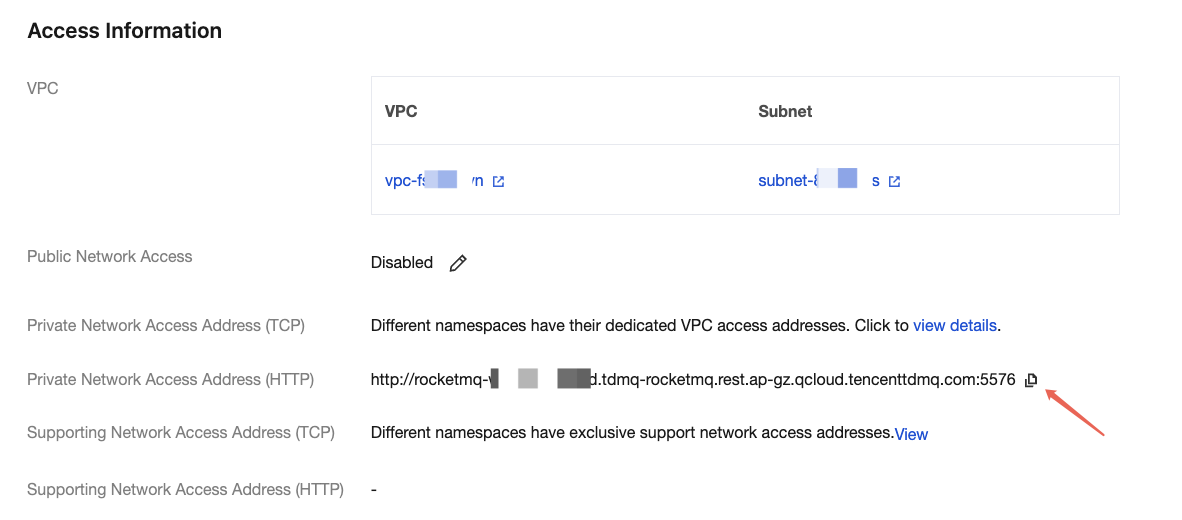 |
secretKey | Role name. You can copy the role name from the SecretKey column on the Role Management page in the console.  |
accessKey | Role token. You can copy it from the AccessKey column on the Role Management page in the console. |
// Instantiate a consumer.DefaultLitePullConsumer pullConsumer = new DefaultLitePullConsumer(namespace,groupName,new AclClientRPCHook(new SessionCredentials(accessKey, secretKey)));// Set the NameServer address.pullConsumer.setNamesrvAddr(nameserver);// Set to start consumption from the first offset.pullConsumer.setConsumeFromWhere(ConsumeFromWhere.CONSUME_FROM_FIRST_OFFSET);
Parameter | Description |
namespace | Namespace name. You can copy the name from the Namespace tab in the console. If you are using a TDMQ for RocketMQ 4.x general cluster, enter the cluster ID for this parameter.  |
groupName | Producer group name. You can copy the name from the Group tab on the Cluster Management page in the console. |
nameserver | Cluster access address. You can obtain the access address from the Access Information module on the Cluster Basic Information page in the console. 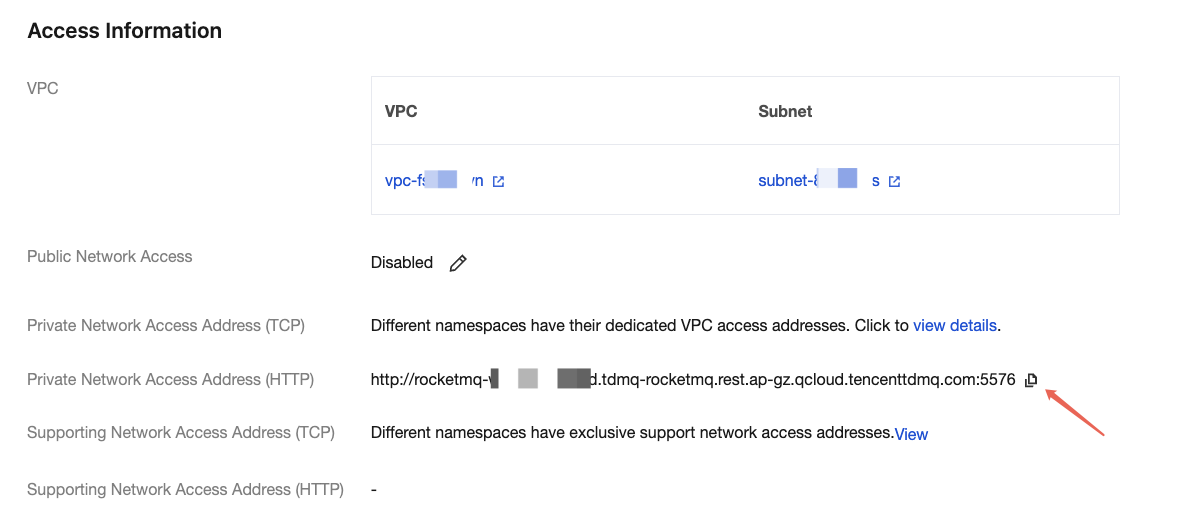 |
secretKey | Role name. You can copy the role name from the SecretKey column on the Role Management page in the console.  |
accessKey | Role token. You can copy it from the AccessKey column on the Role Management page in the console. |
Note:
2. Subscribing to a Message
The subscription method varies depending on the consumption mode.
// Subscribe to a topic.pushConsumer.subscribe(topic_name, "*");// Register a callback implementation class to handle messages pulled from the broker.pushConsumer.registerMessageListener((MessageListenerConcurrently) (msgs, context) -> {// Message processing logic.System.out.printf("%s Receive New Messages: %s %n", Thread.currentThread().getName(), msgs);// Mark the message as successfully consumed and return an appropriate status.return ConsumeConcurrentlyStatus.CONSUME_SUCCESS;});// Start the consumer instance.pushConsumer.start();
Parameter | Description |
topic_name | Topic name. You can copy the name from the Topic Management page in the console.  |
"*" | If the subscription expression is null or uses the * wildcard, it indicates subscribing to all messages. It also supports the format "tag1 || tag2 || tag3" to subscribe to multiple types of tags. |
// Subscribe to a topic.pullConsumer.subscribe(topic_name, "*");// Start the consumer instance.pullConsumer.start();try {System.out.printf("Consumer Started.%n");while (true) {// Pull messages.List<MessageExt> messageExts = pullConsumer.poll();System.out.printf("%s%n", messageExts);}} finally {pullConsumer.shutdown();}
Parameter | Description |
topic_name | Topic name. You can copy the name from the Topic Management page in the console.  |
"*" | If the subscription expression is null or uses the * wildcard, it indicates subscribing to all messages. It also supports the format "tag1 || tag2 || tag3" to subscribe to multiple types of tags. |
Ajuda e Suporte
Esta página foi útil?
Você também pode entrar em contato com a Equipe de vendas ou Enviar um tíquete em caso de ajuda.
comentários