tencent cloud

Tencent Real-Time Communication

Release Notes and Announcements
Release Notes
Recent Product Announcement
TRTC Live (TUILiveKit) Product Launch Announcement
TRTC Conference Official Editions Launched
The commercial version of Conference is coming soon
Terms and Conditions Applicable to $9.9 Starter Package
Rules for the "First Subscription $100 Discount" Promotion
Announcement on the Start of Beta Testing for Multi-person Audio and Video Conference
TRTC Call Official Editions Launched
License Required for Video Playback in New Version of LiteAV SDK
TRTC to Offer Monthly Packages
Product Introduction
Overview
Concepts
Features
Strengths
Use Cases
Performance Statistics
Tencent RTC Quickplay: Experience Ultimate Real-Time Audio and Video Interaction!
Purchase Guide
Billing Overview
Free Minutes
Monthly subscription
Pay-as-you-go
TRTC Overdue and Suspension Policy
FAQs
Refund Instructions
User Tutorial
Free Demo
Call
Overview
Activate the Service
Run Demo
Integration
Offline Call Push
Conversational Chat
On-Cloud Recording
AI Noise Reduction
UI Customization
Calls integration to Chat
Additional Features
No UI Integration
Server APIs
Client APIs
Solution
ErrorCode
Release Notes
FAQs
Conference
Overview(TUIRoomKit)
Activate the Service (TUIRoomKit)
Run Demo(TUIRoomKit)
Integration(TUIRoomKit)
Screen Sharing (TUIRoomKit)
Schedule a meeting (TUIRoomKit)
In-meeting Call (TUIRoomKit)
UI Customization(TUIRoomKit)
Virtual Background (TUIRoomKit)
Conference Control (TUIRoomKit)
Cloud Recording (TUIRoomKit)
AI Noise Reduction (TUIRoomKit)
In-Conference Chat (TUIRoomKit)
Robot Streaming (TUIRoomKit)
Enhanced Features (TUIRoomKit)
Client APIs (TUIRoomKit)
Server APIs (TUIRoomKit)
FAQs (TUIRoomKit)
Error Code (TUIRoomKit)
SDK Update Log (TUIRoomKit)
Live
Billing of Video Live Component
Overview
Activating the Service (TUILiveKit)
Run Demo
No UI Integration
UI Customization
Live Broadcast Monitoring
Video Live Streaming
Voice Chat Room
Advanced Features
Client APIs
Server APIs
Error Codes
Release Notes
FAQs
RTC Engine
Activate Service
SDK Download
API Examples
Usage Guidelines
API Reference Manual
Advanced Features
AI Integration
Overview
Configure MCP Server
Install Skills
Integration Guide
FAQ
RTC RESTFUL API
History
Introduction
API Category
Room Management APIs
Stream mixing and relay APIs
On-cloud recording APIs
Data Monitoring APIs
Pull stream Relay Related interface
Web Record APIs
AI Service APIs
Cloud Slicing APIs
Cloud Moderation APIs
Making API Requests
Call Quality Monitoring APIs
Usage Statistics APIs
Data Types
Appendix
Error Codes
Console Guide
Application Management
Package Management
Usage Statistics
Monitoring Dashboard
Development Assistance
Solution
Real-Time Chorus
FAQs
Migration Guide
Billing
Features
UserSig
Firewall Restrictions
How to Downsize Installation Package
Android and iOS
Web
Flutter
Electron
TRTCCalling for Web
Audio and Video Quality
Others
Legacy Documentation
RTC RoomEngine SDK(Old)
Integrating TUIRoom (Web)
Integrating TUIRoom (Android)
Integrating TUIRoom (iOS)
Integrating TUIRoom (Flutter)
Integrating TUIRoom (Electron)
TUIRoom APIs
On-Cloud Recording and Playback (Old)
RTC Analytics Monthly Packages (Previous Version)
Protocols and Policies
Compliance
Security White Paper
Notes on Information Security
Service Level Agreement
Apple Privacy Policy: PrivacyInfo.xcprivacy
TRTC Policy
Privacy Policy
Data Processing And Security Agreement
Glossary

Multi-Device Login

PDF
Focus Mode
Font Size
Last updated: 2026-03-30 15:09:12

Feature Introduction

By default, each user ID (UserID) can only receive incoming calls on one device at a time. For example, if a user first logs in on a PC client and then logs in on a mobile client, only the mobile device will receive subsequent incoming call notifications.

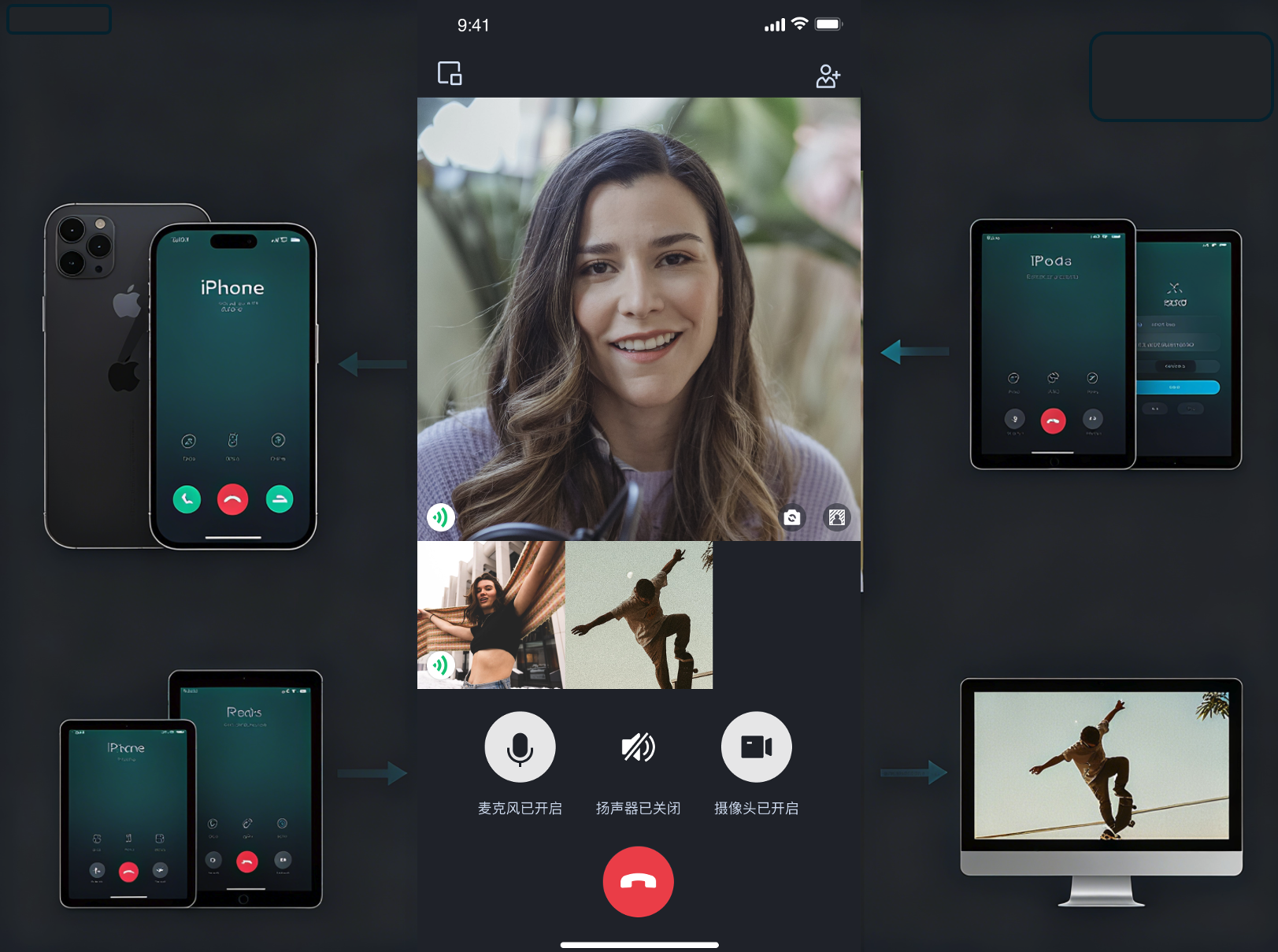
Typically, a user ID (UserID) is restricted to a single device login at any given time. However, in environments like offices or healthcare facilities, users often need to switch between phones and computers to chat or make calls without interruption. To address this need, TUICallKit provides a multi-device login feature. When enabled, users can log in to multiple clients simultaneously using the same UserID—for example, an iPhone, an iPad, and a Windows PC. When an incoming call arrives, all logged-in devices will receive the call invitation and ring at the same time. Once the user answers the call on any device, the incoming call screen will automatically disappear from the other devices, and the call will connect on the device that answered.
Note:
Multi-device login is a premium feature. To use it, you must purchase or claim a group call edition package for TUICallKit's audio and video call capability. Alternatively, you can activate the trial edition for free. For details on editions and activation instructions, see Audio and Video Call Capability Editions.

Getting Started

1. Complete the steps in the Quick Access guide to integrate TUICallKit into your project. You should be able to initiate and answer basic audio and video calls.
2. To enable multi-device login, call the enableMultiDeviceAbility API after successfully logging in to TUICallKit. See the following examples:
Android
iOS
Flutter
Web
uni-app (Mini Program)
native mini program
// Take Kotlin as an example
// true: enable multi-device login false: disable multi-device login (default)
TUICallEngine.createInstance(context).enableMultiDeviceAbility(true, null)
// Take Swift as an example
// true: enable multi-device login false: disable multi-device login (default)
TUICallEngine.createInstance().enableMultiDeviceAbility(enable: true) {
} fail: { code, message in
}
// true: enable multi-device login false: disable multi-device login (default)
final result = await TUICallEngine.instance.enableMultiDeviceAbility(true);
// true: enable multi-device login false: disable multi-device login (default)
TUICallKitServer?.getTUICallEngineInstance()?.enableMultiDeviceAbility(true);
// true: enable multi-device login false: disable multi-device login (default)
TUICallKitServer?.getTUICallEngineInstance()?.enableMultiDeviceAbility(true);
// true: enable multi-device login false: disable multi-device login (default)
TUICallKitServer?.getTUICallEngineInstance()?.enableMultiDeviceAbility(true);
3. After completing these steps, your application will support multi-device login. No additional configuration is required.

Key Logic

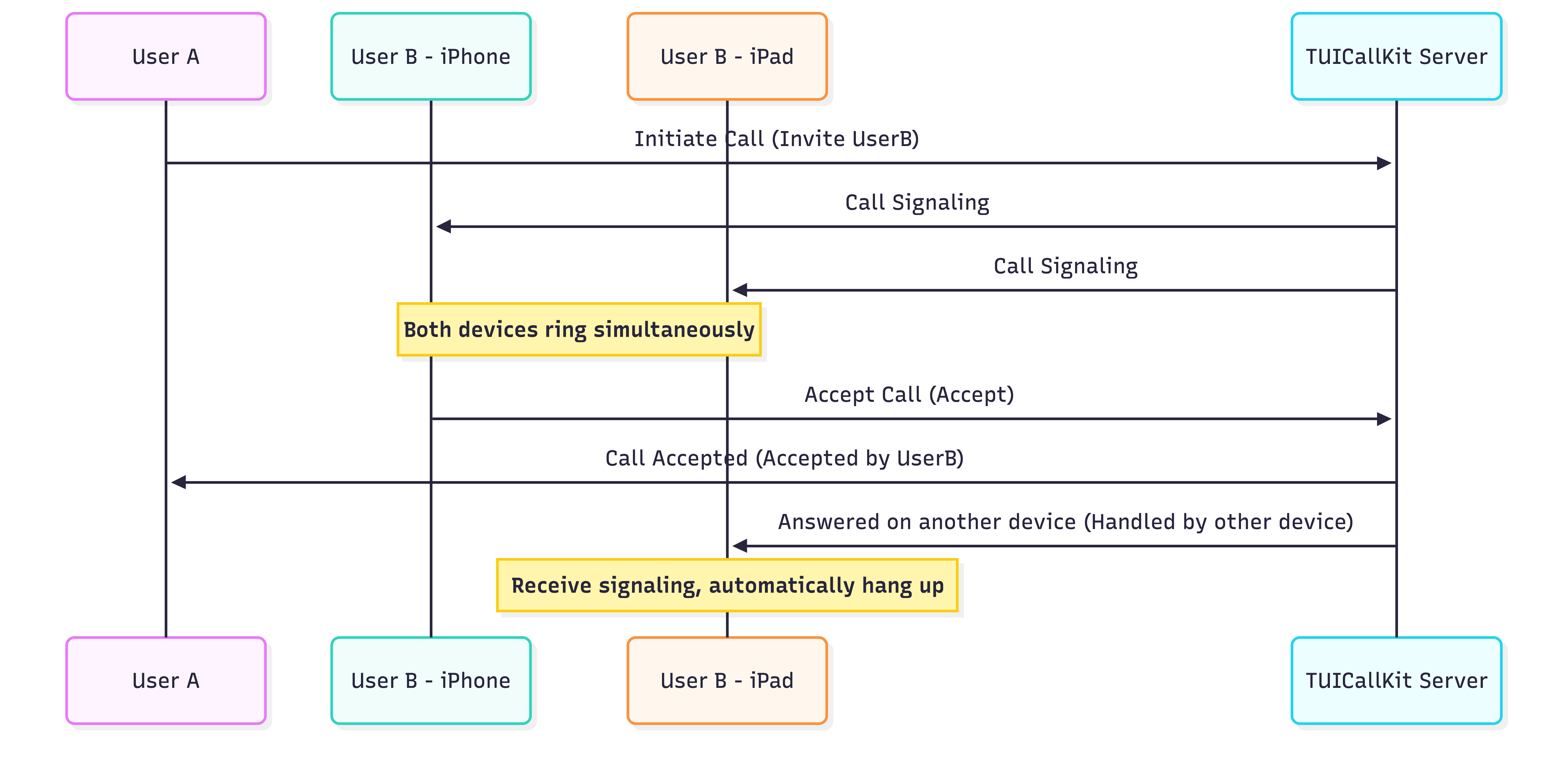
To help you better understand the feature and troubleshoot potential issues, here is a brief overview of the signaling interaction logic behind the scenes.


FAQs

Default Behavior Without Calling enableMultiDeviceAbility

Multi-device login is disabled by default in TUICallKit. In this mode, only the most recently logged-in device with the same UserID will receive incoming calls. For example, if a user logs in on a PC client first and then on a mobile client, only the mobile device will receive calls.

Handling Unstable Network Conditions

No. TUICallKit’s signaling backend uses atomic processing to accept only the first "answer" request received. Once a device answers, TUICallKit immediately sends a "cancel" instruction to all other devices, ensuring that only one device connects to the call.

Help and Support

Was this page helpful?

Help us improve! Rate your documentation experience in 5 mins.

Feedback