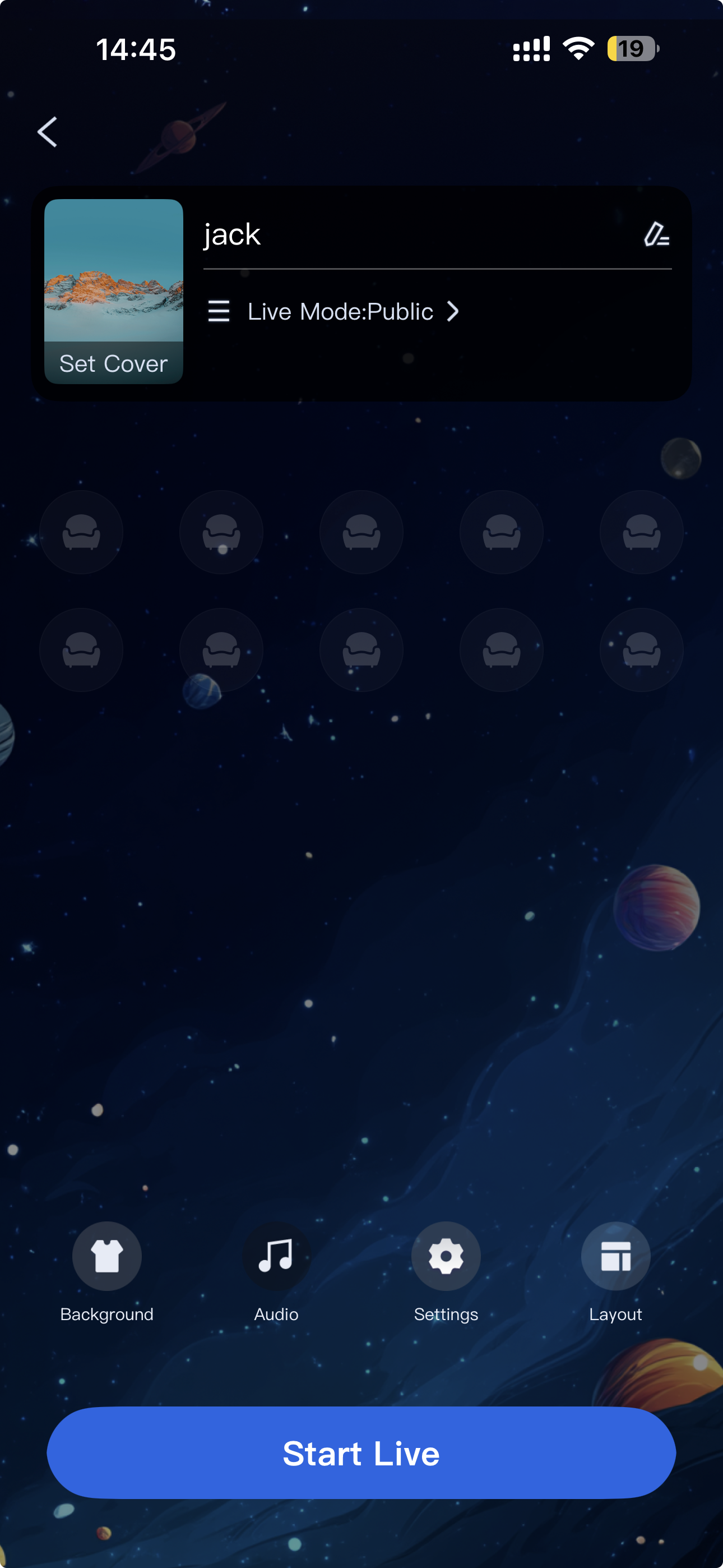
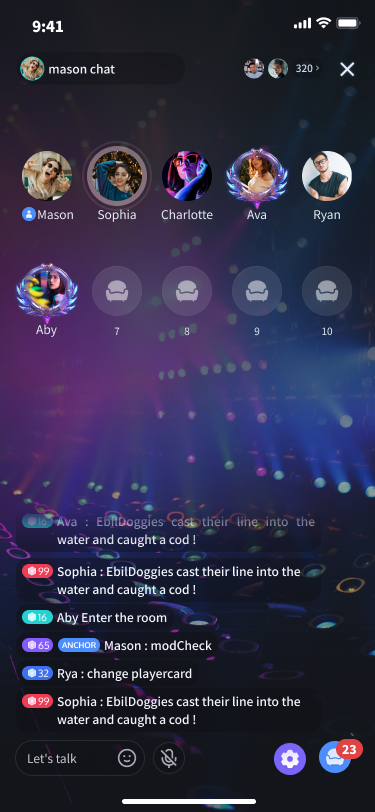
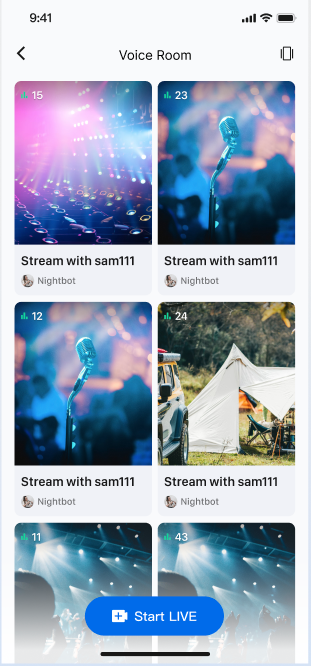
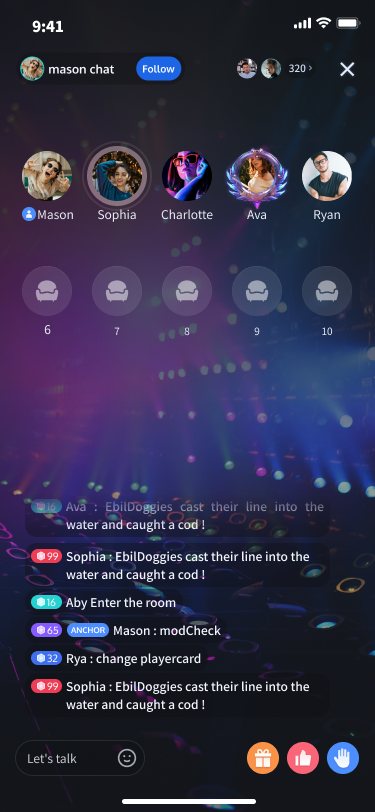
Feature Overview
TUILiveKit is a comprehensive voice chat room component. After integration, you can quickly implement the following key modules:
Prerequisites
Activate Service
Before using TUILiveKit, please refer to Activate Service to get the TUILiveKit trial version or activate the paid version. Environment Requirements
Xcode: Requires Xcode 15 or a later version.
iOS: Supports devices running iOS 13.0 or a later version.
CocoaPods environment: A CocoaPods environment must be installed. If you haven't installed it, please refer to the CocoaPods installation guide, or follow these steps: Install CocoaPods using gem: execute the sudo gem install cocoapods command in the terminal to install.
Note:
During the sudo gem install cocoapods installation process, you may be prompted to enter your computer's password. Enter the administrator password as prompted.
Integrate TUIKit
Step 1: Add the Component via CocoaPods
1. Add Pod Dependency:
If your project already has a Podfile:
Add the pod 'TUILiveKit' dependency to your project's Podfile. For example:
target 'YourProjectTarget' do
pod 'TUILiveKit'
end
If your project does not have a Podfile:
Use the cd command in the terminal to navigate to your .xcodeproj directory, then run pod init to create a Podfile. After creation, add the pod 'TUILiveKit' dependency. For example:
# If your project directory is /Users/yourusername/Projects/YourProject
# 1. cd to your .xcodeproj project directory
cd /Users/yourusername/Projects/YourProject
# 2. Run pod init. After this command completes, a Podfile will be generated.
pod init
# 3. Edit the generated Podfile to add the dependency
target 'YourProjectTarget' do
# Add pod 'TUILiveKit' dependency
pod 'TUILiveKit'
end
2. Install the Component:
In the terminal, cd to the directory containing your Podfile, then run:
Step 2: Project Configuration
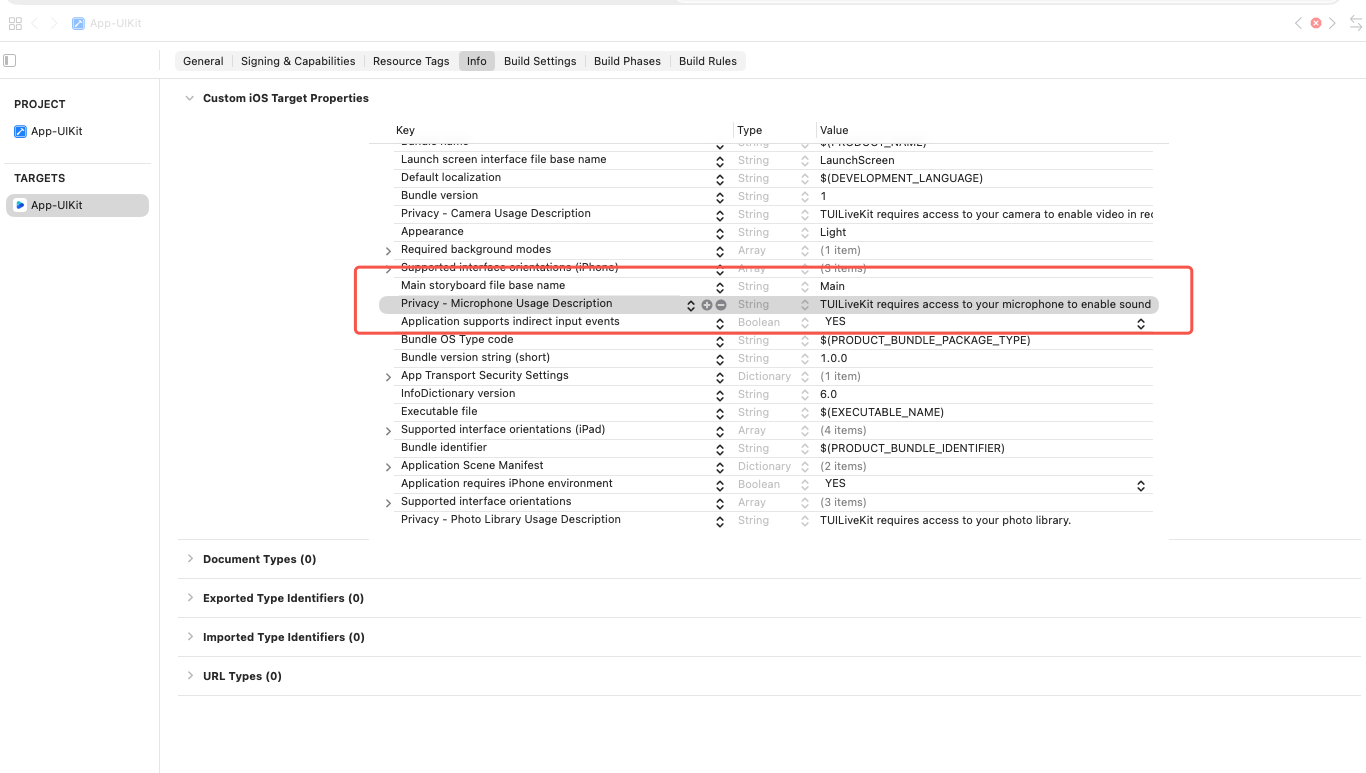
To use audio features, your app must request microphone permission. Add the following entries to your app's Info.plist file with appropriate usage descriptions. These descriptions are shown to users when the system requests permissions:
<key>NSMicrophoneUsageDescription</key>
<string>TUILiveKit requires access to your microphone. Enabling this allows recorded videos to have sound.</string>
Complete Login
After code integration, the next step is to complete the login. All TUILiveKit features require a successful login to function properly, so ensure your parameters are configured correctly.
Note:
In the example code, the login API is called directly. However, in a real-world application, it is highly recommended that you call the TUILiveKit login service only after your own user authentication and other internal login processes are complete. This prevents potential business logic confusion or data inconsistency caused by calling the login service too early, and it better aligns with your existing user management system.
import TUICore
func application(_ application: UIApplication, didFinishLaunchingWithOptions launchOptions: [UIApplication.LaunchOptionsKey: Any]?) -> Bool {
TUILogin.login(1400000001,
userID: "denny",
userSig: "xxxxxxxxxxx") {
print("login success")
} fail: { (code, message) in
print("login failed, code: \\(code), error: \\(message ?? "nil")")
}
return true
}
#import <TUICore/TUILogin.h>
- (BOOL)application:(UIApplication *)application didFinishLaunchingWithOptions:(NSDictionary *)launchOptions {
[TUILogin login:1400000001
userID:@"denny"
userSig:@"xxxxxxxxxxx"
succ:^{
NSLog(@"login success");
} fail:^(int code, NSString * _Nullable msg) {
NSLog(@"login failed, code: %d, error: %@", code, msg);
}];
return YES;
}
Login API Parameter Description
Parameter | Type | Description |
SDKAppID | Int | |
UserID | String | The unique ID for the current user. Must contain only English letters, numbers, hyphens, and underscores. |
userSig | String | A ticket for Tencent Cloud authentication. Please note: Development Environment: You can use the local GenerateTestUserSig.genTestSig function to generate a UserSig or generate a temporary UserSig via the UserSig Generation Tool. |
Handling Login Exception Status [Optional]
TUILogin provides a login status callback mechanism to help you handle possible login exceptions, mainly including "kicked offline" and "signature expired" callbacks:
Kicked Offline: If a user is kicked offline while online, the SDK will notify you via the onKickedOffline callback. At this point, you can display a UI prompt to the user and call TUILogin.login to login again.
Signature Expired: If a user receives the onUserSigExpired callback while online, it means the userSig previously issued for that user has expired. If the user's login session on your backend is still valid, you can have your app request a new userSig from your backend and call TUILogin.login to renew the login session.
class YourLoginService: NSObject {
func addLoginListener() {
TUILogin.add(self)
}
func removeLoginListener() {
TUILogin.remove(self)
}
}
extension YourLoginService: TUILoginListener {
func onKickedOffline() {
}
func onUserSigExpired() {
}
}
@interface YourLoginService() <TUILoginListener>
- (void)addLoginListener;
- (void)removeLoginListener;
@end
@implementation YourLoginService
- (void)addLoginListener {
[TUILogin add:self];
}
- (void)removeLoginListener {
[TUILogin remove:self];
}
#pragma mark - TUILoginListener
- (void)onKickedOffline {
}
- (void)onUserSigExpired {
}
@end
Next Steps
Congratulations! You have successfully integrated the Voice Chat Room component and completed login. Next, implement features such as Host Live, Audience Viewing, and Live Room List. See the table below for more details:
Feature | Description | Integration Guide |
Host Live Streaming | The complete process for hosts to create a voice chat room, including preparation and all live interactions. | |
Audience Viewing | Audience members can listen, request to join the mic, view bullet comments, and more after entering a voice chat room. | |
Live Stream List | Displays the list of available voice chat rooms and their details. | |
FAQs
After executing pod install, why can't I find the latest version of TUILiveKit locally?
If you are unable to install the latest version of TUILiveKit, please follow these steps:
1. In the directory where the Podfile is located, delete Podfile.lock and Pods. You can choose to delete them manually or execute the following command in the terminal:
// cd to the directory where Podfile is located
rm -rf Pods/
rm Podfile.lock
2. In the directory where Podfile is located, execute pod install --repo-update
// cd to the directory where Podfile is located
pod install --repo-update
Do I need to call the login method every time I enter a room?
No. You usually only need to complete one TUILogin.login call. We recommend associating TUILogin.loginand TUILogin.logout with your own application's login business logic.
Is there a sample configuration for the Podfile that I can refer to?
Contact Us