tencent cloud

Game Multimedia Engine

Release Notes
Product Introduction
Overview
Strengths
Features
Scenarios
Compliance
User Tutorial
Billing
Free Plan
Purchase Guide
SDK Download Guide
Product Feature Demo
Basic Feature Demo
Scenario-Specific Demo
Console Guide
Usage Querying
Activating Services
Getting Started
Quick Integration of SDK
Quick Integration of Sample Project
Basic Feature Development Guide
Authentication Key
Voice Chat Role Configuration
Sound Quality
Advanced Feature Development Guide
Server-Side Recording
Range Voice
3D Sound Effect
Sound Effect and Accompaniment
Network Audio Stream Forwarding Routing
Custom Message Channel
How to deal with the restrictions of corporate firewall
Language Parameter Reference List
Integrating GME Chat Room Management
Client API
SDK for Unity
SDK for Unreal Engine
Cocos2D SDK
SDK for Windows
SDK for iOS
SDK for Android
SDK for macOS
H5 SDK
Electron SDK
SDK for Flutter
SDK Version Upgrade Guide
Error Codes
Toolchain
Server APIs
History
Introduction
API Category
Usage APIs
Recording APIs
Making API Requests
Voice Chat APIs
Application APIs
Data Types
Error Codes
FAQ
Product Features
Troubleshooting Guide
Billing
Sample Project Usage
General
Authentication
Voice Chat Room Entry Failure
Sound and Audio
Network
Speech-to-text Conversion
Program Export
Service Agreement
Service Level Agreement
Contact Us
Glossary
GME Policy
Data Privacy and Security Agreement
Privacy Policy

Scenario-Specific Demo

PDF
Focus Mode
Font Size
Last updated: 2023-04-27 17:06:31
Tencent Cloud Game Multimedia Engine (GME) is a one-stop voice solution for the gaming industry, featuring top-of-the-line audio quality and supporting a variety of use cases. GME provides various features such as group voice chat, 3D positional voice chat, voice messaging, and speech-to-text conversion. This demo simulates a simple game scenario and showcases the features of GME, including voice chat, 3D voice, range voice, voice changing, and howling suppression.

Directions

Step 1. Download the demo

For Android or iOS, scan the QR code below
Windows


Step 2. Install the demo

Decompress the downloaded package and open the software named GMEDemo.

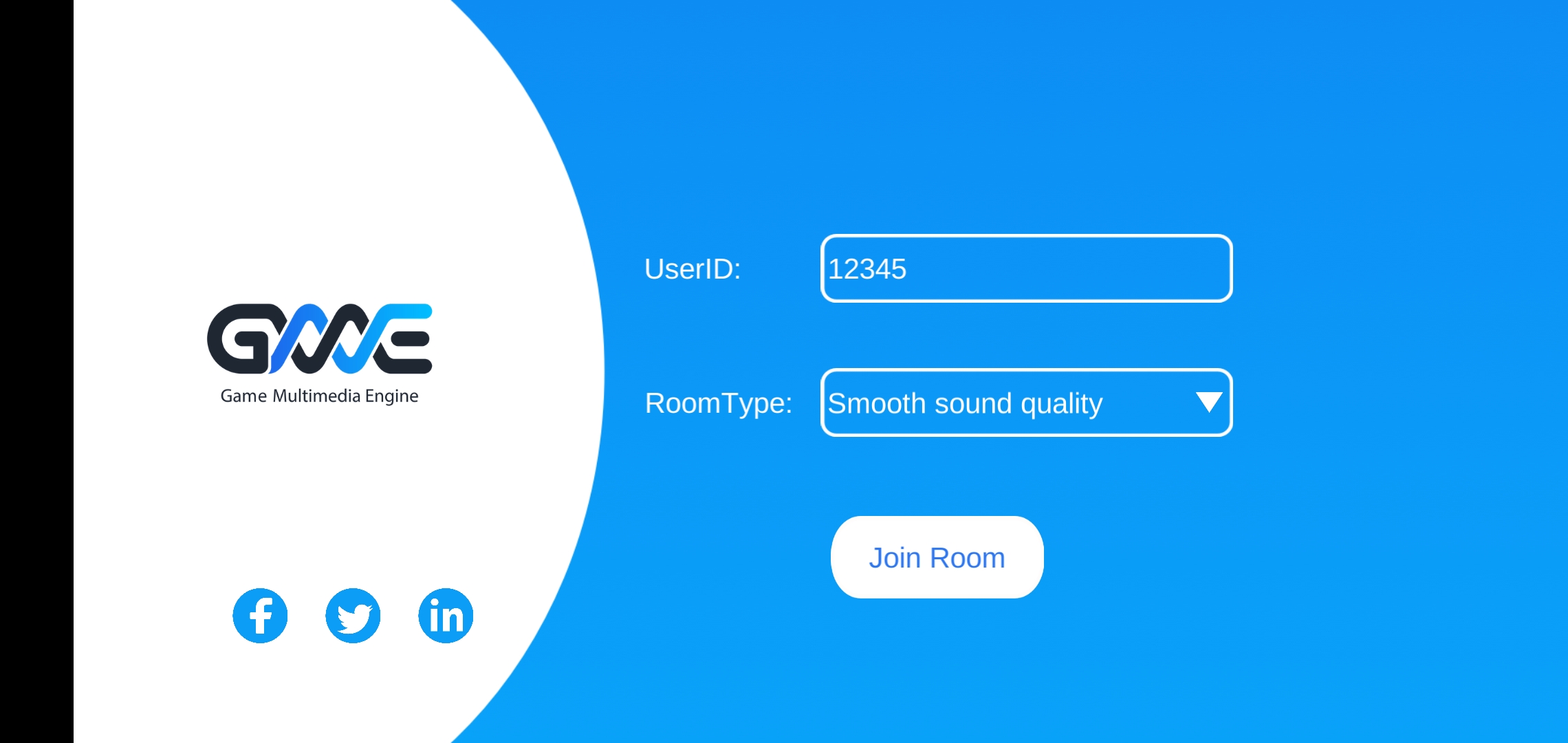
Step 3. Enter a voice chat room

Open the demo and select a voice chat room to enter.

UserID: It is automatically generated in the demo and can be set as needed. It must be unique.
RoomType: Choose the sound quality of the room. Players who select the same RoomType option will enter the same room. The options are as follows:
Smooth sound quality
Standard sound quality
High sound quality (HD)
Click JoinRoom to enter the voice chat room.

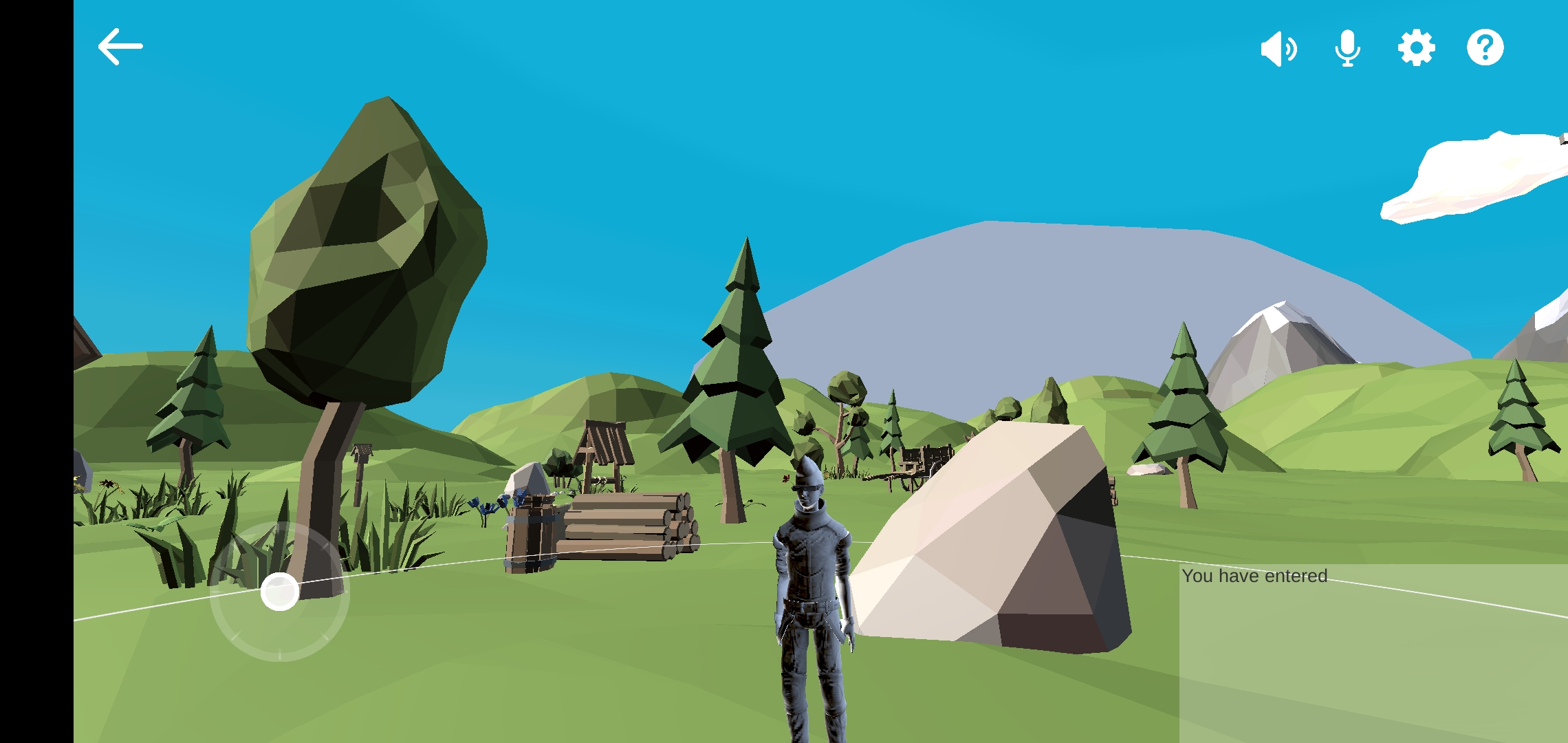
Step 4. Main UI of the game

You will see the main UI of the game upon entering the voice chat room.

Instructions:
Back button: Click the arrow in the upper left corner to return to the page for selecting a voice chat room.
Microphone button: By default, the microphone is on when you enter the room. At this point, you can speak in the room.
Speaker button: By default, the speaker is on when you enter the room. At this point, you can hear other members in the room.
Settings button: Click the button to set the language, and enable or disable the following features: 3D voice, range voice, voice changing, and howling suppression.
Help button: Click the button to read the game guide.
Bottom left corner of the interface: The virtual joystick used to control the movement of the character.
Bottom right corner of the interface: Room logs showing users who entered and exited the voice chat room.
Information for determining whether the connection succeeds:
1. The game character of the other player can be seen on the game UI.
2. The logs in the bottom right corner of the UI display the room entry records of the other player's game character, indicated by their userID.

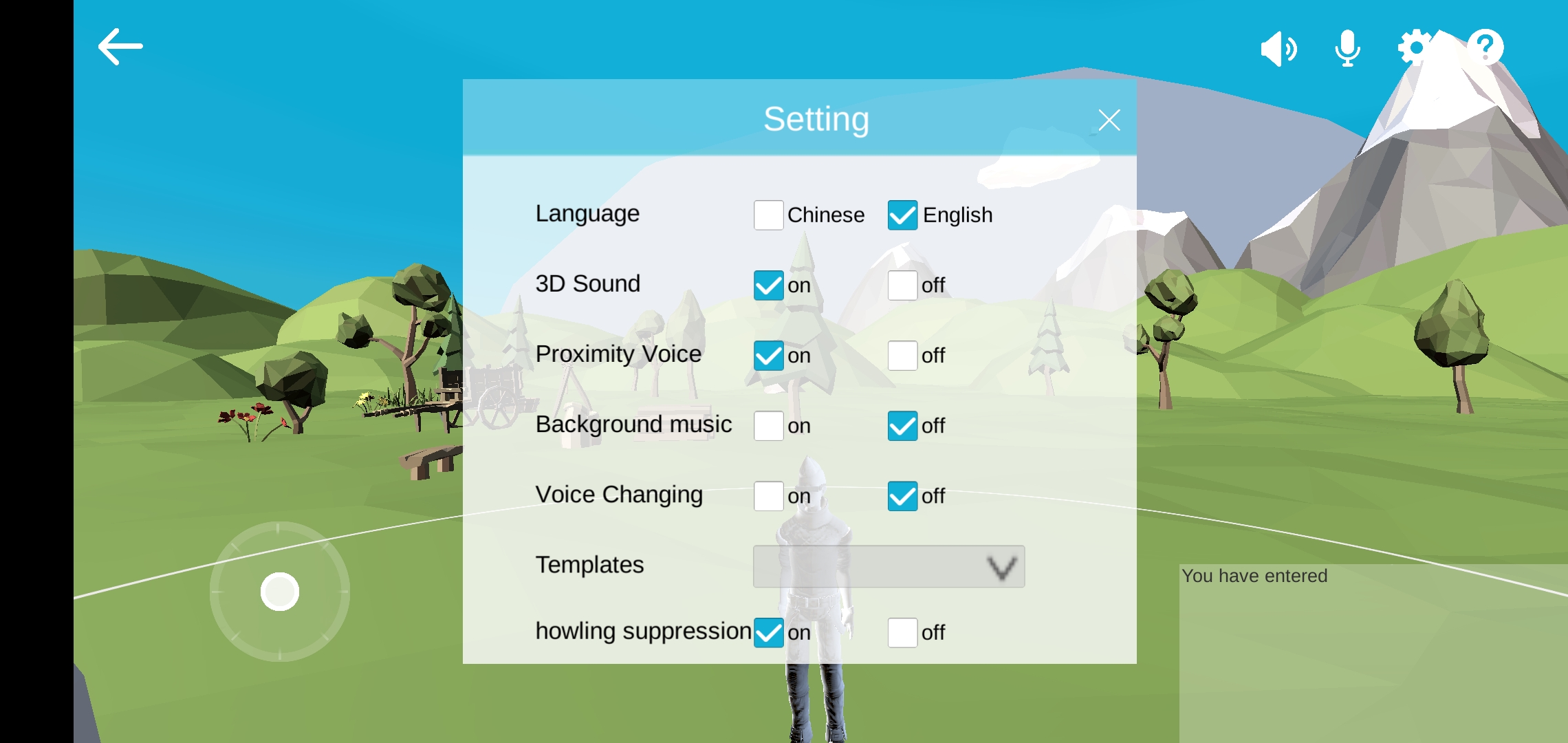
Step 5. Settings page of the game

Click the settings button to go to the game settings page.

Language: Select Chinese or English.
3D Sound: After enabling the 3D voice feature, you can experience stereo sound effects and the volume change as a speaking character moves. For more information, see 3D Sound Effect.
Proximity Voice: It is also called range voice. After enabling this feature, a circle is displayed around your character. You can communicate only with players whose characters are also within this circle. When this feature is disabled, communication is not affected by the range. For more information, see Range Voice.
Background Music: After this feature is enabled, the background music will be played back.
Voice Changing: After enabling this feature, you can change your voice to the selected tone. For details, see Voice Changing.
Templates: You can select your preferred voice changing template from the drop-down list.
Howling Suppression: After this feature is enabled, howling generated in the call will be suppressed.

Step 6. Operations

1. You can turn on the microphone and speaker by clicking corresponding buttons to chat with other players in a room.
2. You can go to the settings page to enable or disable the following features: 3D voice, range voice, and voice changing.
3. On mobile devices, you can use the virtual joystick to control the movement of your character, and adjust the view by moving your finger on the screen. On Windows PCs, you can press the "W", "S", "A", and "D" keys to move forward, backward, left, and right respectively, and adjust the view by moving your mouse.
4. Assume that there are two players, namely player A and player B, in the game. Player A can experience the 3D voice effect when player B moves around player A and keeps speaking in this process. When player B moves to a position beyond the range set for the 3D voice effect, player A can hardly hear player B.

Help and Support

Was this page helpful?

Help us improve! Rate your documentation experience in 5 mins.

Feedback