tencent cloud

Cloud Workload Protection Platform

Release Notes and Announcements
Release Notes
Announcements
Getting Started
Product Introduction
Overview
Advantages
Basic Concepts
Scenarios
Associated Products
Features in Different Editions
Purchase Guide
Purchase Security Protection Licenses
Purchasing Log Analysis Service
Quick Start
Operation Guide
Security Dashboard
Asset Overview
Server List
Asset Fingerprint
Vulnerability Management
Baseline Management
Malicious File Scan
Unusual Login
Password Cracking
Malicious Requests
High-risk Commands
Local Privilege Escalation
Reverse Shell
Java Webshell
Critical File Monitor
Network Attack
A Ransomware Defense
Log Analysis
License Management
Alarm Setting
Cloud Access Management
Hybrid Cloud Installation Guide
FAQs for Beginners
Cloud Workload Protection Description
Feature Description
Agent Process Description
A Security Baseline Detection List
Parsing of JSON Format Alarm Data
Log Field Data Parsing
Agent Installation Guide
Security Score Overview
Practical Tutorial
Auto Fix of Vulnerabilities
Malicious File Processing
Troubleshooting
Intrusions on Linux
Intrusions on Windows
Offline Agent on Linux
Offline Agent on Windows
An Abnormal Log-in Notification
API Documentation
History
Introduction
API Category
Asset Management APIs
Virus Scanning APIs
Abnormal Log-in APIs
Password Cracking APIs
Malicious Request APIs
High-Risk Command APIs
Local Privilege Escalation APIs
Reverse Shell APIs
Vulnerability Management APIs
New Baseline Management APIs
Baseline Management APIs
Advanced Defense APIs
Security Operation APIs
Expert Service APIs
Other APIs
Overview Statistics APIs
Settings Center APIs
Making API Requests
Intrusion Detection APIs
Data Types
Error Codes
FAQs
Agreements
Terms of Service
Service Level Agreement
Data Processing And Security Agreement
Contact Us
Glossary

Asset Overview

PDF
Focus Mode
Font Size
Last updated: 2024-08-13 16:29:49
This document describes how to use Assets Dashboard.

Overview

Assets Dashboard presents the data of your servers and 16 key asset fingerprint items in a visualized form to give you a picture of your server assets.

Important Notes

Asset Dashboard is available to all Tencent Cloud users. The collected asset fingerprint items vary with different CWPP editions, so the data displayed in Assets Dashboard varies with the editions. Only hosts with the paid protection edition can collect asset fingerprint data. Basic edition hosts must first upgrade the version.
The asset fingerprints collected by each edition are as follows:
CWPP Edition
Supported Asset Types
CWPP Basic (free)
N/A
CWPP Pro
10 items: Resource Monitoring, Accounts, Ports, Processes, Software Applications, Databases, Web Applications, Web Services, Web Frameworks, and Websites
CWPP Ultimate
16 items: Resource Monitoring, Accounts, Ports, Processes, Software Applications, Databases, Web Applications, Web Services, Web Frameworks, Websites, JAR Archive Files, Startup Services, Scheduled Tasks, Environment Variables, Kernel Modules, and system installation packages
Note:
Asset fingerprint data is collected automatically every 8 hours (manual collection is supported).

Operation Guide

1. Log in to the CWPP console.
2. Click Assets Dashboard on the left sidebar. The fields and operations related to the feature are described as follows.

Assets Dashboard

The Assets Dashboard section displays the statistics of all assets and asset fingerprints.

The server overview and trending chart (total servers, online servers, offline servers, and risky servers) supports querying any time period within one year and supports downloading and exporting. Top 5 server tags allow you to view the five most frequently used tags across all hosts.You can view the statistics for the past 7/14/30 days, or a custom period . The data generated 3 months ago is not displayed.Click Download to export the daily data of the server for the selected date range.


Resource Monitoring

The Resource monitoring section displays the distribution of system load, memory usage, disk usage, and the top 5 servers ranked by these dimensions.

Note:
The statistics of system load are only available for Linux servers (Windows servers are not supported).

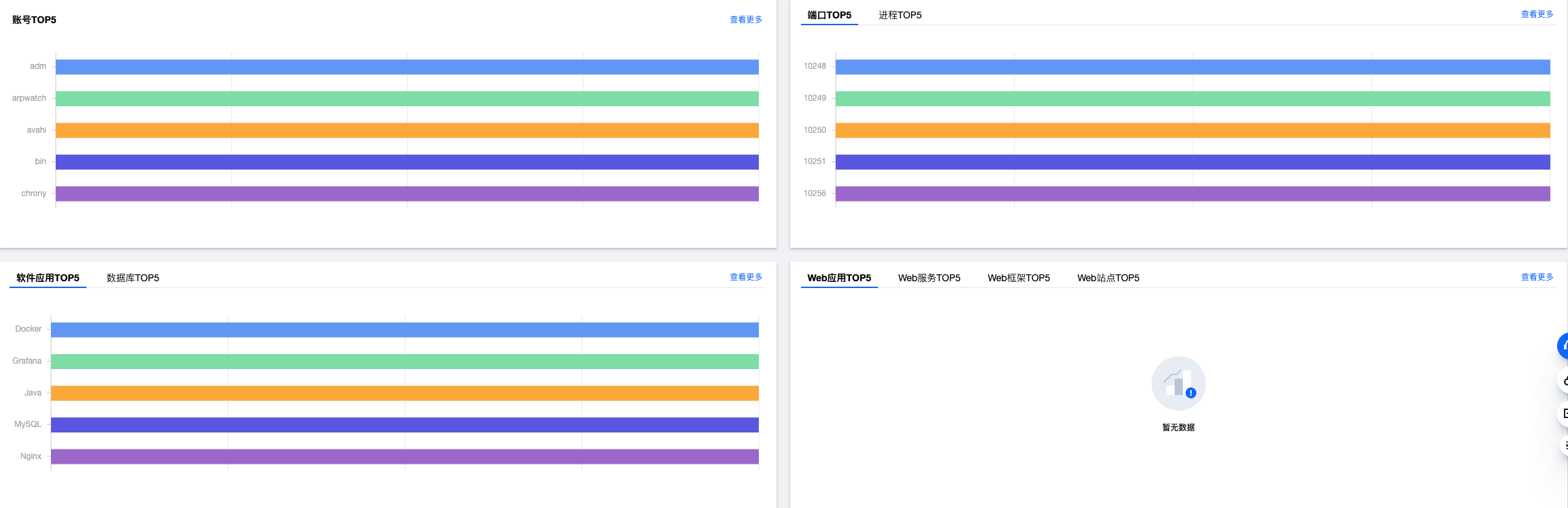
TOP 5 Asset Fingerprints

TOP 5 Asset Fingerprints displays the top 5 accounts, ports, processes, software applications, databases, Web applications, Web services, Web frameworks, and Web sites.


Help and Support

Was this page helpful?

Help us improve! Rate your documentation experience in 5 mins.

Feedback