tencent cloud

Content Delivery Network

Updates and Announcements
Release Notes
Announcements
User Tutorial
Product Introduction
Product Overview
Strengths
Use Cases
Term
Use Limits
CDN Performance Descriptions (Spot-check)
Purchase Guide
CDN Purchase Guide
ECDN Purchase Guide
Getting Started
Configuring CDN from Scratch
Adding Domain Names
CNAME Configuration
Domain Name Ownership Verification
FAQs about Domain Name Connection
Configuration Guide
Domain Management
Domain Name Configurations
Statistical Analysis
Purge and Prefetch
Log Management
EdgeOne
Service Query
Offline Cache
Permission Management
Permission Configuration
Console Permissions
Activate Real-time Logging as Sub-account/Collaborator
Use Cases
Accelerating Resources on COS with CDN
Practical Tutorial
Guide to Using the EdgeOne Tool for Migrating Content Delivery Network (CDN) Related Services
CDN - CVM
CDN - COS
Configuring CNAME via DNSPod
Regularly Storing CDN Logs
API Documentation
History
Introduction
API Category
Content Management APIs
Real-time Log APIs
Service Query APIs
Data Query APIs
Making API Requests
Log Query APIs
StopCdnDomain
Configuration Management APIs
Obsoleted APIs
Other APIs
Data Types
Error Codes
FAQ
Features
Billing
FAQs about Domain Name Connection
Cache Configuration FAQs
Purge and Prefetch
Statistical Analysis
FAQs about HTTPS
Connection
Errors
Troubleshooting Methods
Status Codes and Solutions
Node Cache Inconsistency
Slow Access Speed After CDN Activation
Low Traffic Hit Rate
404 Status Code
Page Display - CORS error
Resource Cache Failure
Service Level Agreement
Glossary

Overview

PDF
Focus Mode
Font Size
Last updated: 2025-01-25 14:58:03
This document describes how to use Tencent Cloud CDN to accelerate access to COS.

Content Delivery Network (CDN)

By delivering resources to high numbers of globally deployed cache nodes and leveraging Tencent's independently developed GSLB scheduling system, CDN enables nearby access to required resources for end users. This reduces access delays caused by network congestion, distance, and ISP issues and effectively improves the download speed, responsiveness, and user experience.

Cloud Object Storage (COS)

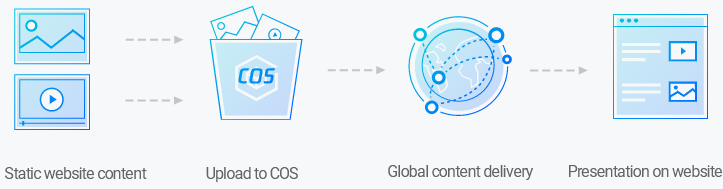
You can store all your static resources such as static scripts, audio/video files, images, and attachments in standard storage in COS, which features unlimited capacity and high-frequency reads/writes to provide scalable and reliable storage for static resources and reduce pressure on resource servers.

Content Delivery Practices

CDN can accelerate global delivery of static resources such as static scripts, audio/video files, images, and attachments stored in COS. With CDN's global cache nodes and scheduling capabilities, frequently requested resources can be delivered to edge servers in advance. When they are accessed or downloaded by end users, the cached resources on a nearby node will be returned. This reduces both pressure on the origin server as well as transfer delay, significantly improving the user experience.


Note:
Tencent Cloud Enterprise Content Delivery Network (ECDN) can be used to accelerate the delivery of dynamic/static resources or dynamic resources stored in COS.

Implementation

CDN acceleration can be implemented for COS in the following two ways. Choose either of them to complete acceleration:
Point the COS endpoint to the CDN acceleration domain name and bind your domain name to the CDN acceleration domain name (through CNAME). For detailed directions, please see Implementation via CDN Console.
Bind your domain name to the COS endpoint and enable CDN acceleration. For detailed directions, please see Implementation via COS Console.

Help and Support

Was this page helpful?

Help us improve! Rate your documentation experience in 5 mins.

Feedback