tencent cloud

Content Delivery Network

Updates and Announcements
Release Notes
Announcements
User Tutorial
Product Introduction
Product Overview
Strengths
Use Cases
Term
Use Limits
CDN Performance Descriptions (Spot-check)
Purchase Guide
CDN Purchase Guide
ECDN Purchase Guide
Getting Started
Configuring CDN from Scratch
Adding Domain Names
CNAME Configuration
Domain Name Ownership Verification
FAQs about Domain Name Connection
Configuration Guide
Domain Management
Domain Name Configurations
Statistical Analysis
Purge and Prefetch
Log Management
EdgeOne
Service Query
Offline Cache
Permission Management
Permission Configuration
Console Permissions
Activate Real-time Logging as Sub-account/Collaborator
Use Cases
Accelerating Resources on COS with CDN
Practical Tutorial
Guide to Using the EdgeOne Tool for Migrating Content Delivery Network (CDN) Related Services
CDN - CVM
CDN - COS
Configuring CNAME via DNSPod
Regularly Storing CDN Logs
API Documentation
History
Introduction
API Category
Content Management APIs
Real-time Log APIs
Service Query APIs
Data Query APIs
Making API Requests
Log Query APIs
StopCdnDomain
Configuration Management APIs
Obsoleted APIs
Other APIs
Data Types
Error Codes
FAQ
Features
Billing
FAQs about Domain Name Connection
Cache Configuration FAQs
Purge and Prefetch
Statistical Analysis
FAQs about HTTPS
Connection
Errors
Troubleshooting Methods
Status Codes and Solutions
Node Cache Inconsistency
Slow Access Speed After CDN Activation
Low Traffic Hit Rate
404 Status Code
Page Display - CORS error
Resource Cache Failure
Service Level Agreement
Glossary

FAQs about HTTPS

PDF
Focus Mode
Font Size
Last updated: 2024-12-30 22:02:47


What is HTTPS?

HTTPS refers to Hypertext Transfer Protocol Secure, a security protocol that encrypts and transfers data based on the HTTP protocol to ensure the security of data transfer. When configuring HTTPS, you need to provide a certificate for the domain name and deploy it on all CDN nodes to implement encrypted data transfer across the entire network.


Does CDN support HTTPS configuration?

Yes. Tencent Cloud CDN fully supports HTTPS configuration. You can either upload your own certificate for deployment or go to the SSL Certificate Service console to apply for a free third-party certificate provided by TrustAsia.


How do I configure an HTTPS certificate?

You can configure an HTTPS certificate in the CDN console. For detailed directions, please see HTTPS Configuration Guide.


Do the HTTPS certificates on CDN nodes need to be synchronized with HTTPS certificate updates on the origin server?

No. Updating the HTTPS certificate of your origin server does not affect the one configured on CDN. You only need to update the HTTPS certificate on CDN when it is or about to be expired.


Can I deny HTTP access and allow HTTPS access only?

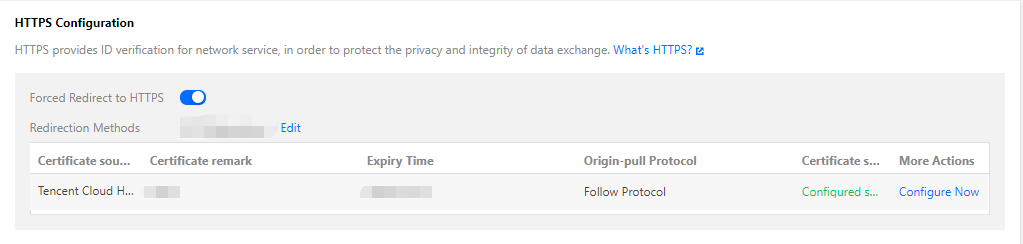
Yes. After successfully configuring an HTTPS certificate, you can use the Forced Redirection feature. HTTP requests from users will be forcibly redirected to HTTPS requests.


Why does HTTPS access not work after CDN is configured?

For HTTPS access, please configure it as instructed:
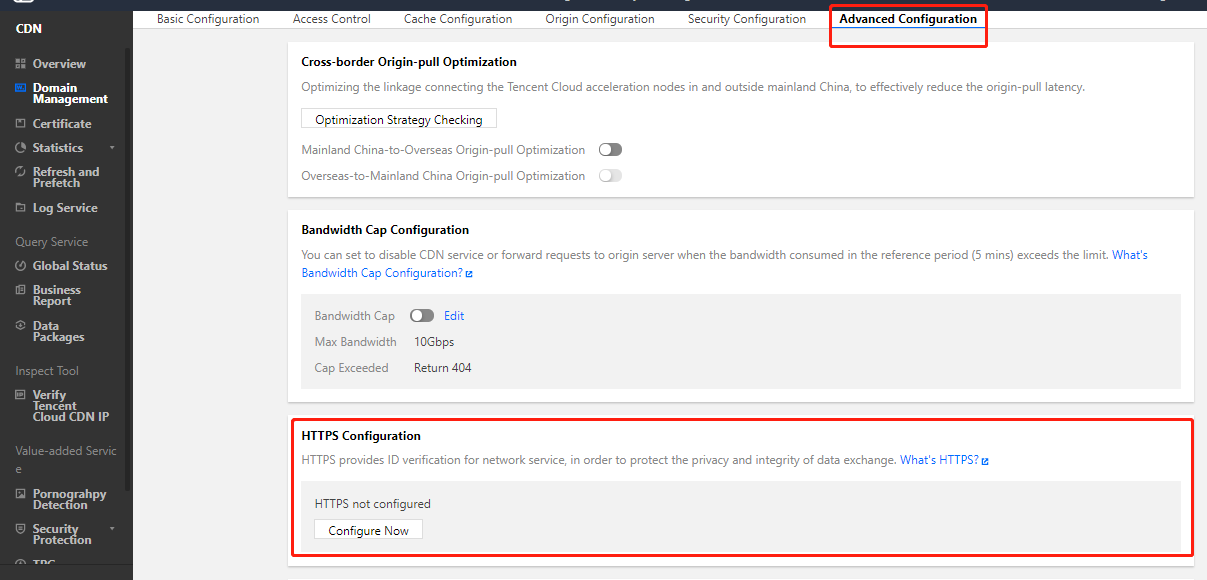
1. Log in to the CDN console, select Domain Management on the left sidebar, and click Manage on the right of a domain name to enter its management page.


2. Open the Advanced Configuration tab to find the HTTPS Configuration section, and click Configure Now to go to the Certificate Management page. For configuration directions, please see HTTPS Configuration Guide.

HTTPS access can be enabled after the certificate is successfully configured.
Help and Support

Was this page helpful?

Help us improve! Rate your documentation experience in 5 mins.

Feedback