tencent cloud

Cloud Virtual Machine

Release Notes and Announcements
Release Notes
Public Image Release Notes
Official End of Support Plan for the Operating System
Announcements
Product Introduction
CVM Overview
Strengths
Basic Concepts
Regions and Zones
Tutorial
Service Regions and Service Providers
Billing
Billing Overview
Billing Modes
Billing Items
Billing Mode Conversion Overview
Purchasing Instances
Configuration Adjustment Billing Guide
Overdue Payments
Getting Started
Purchasing a Customized Linux Instance
Purchasing a Customized Windows Instance
User Guide
Operation Guide Overview
Use Limits
Instances
Spot Instances
Reserved Instances
Images
Storage
Backup and Restoration
Network
Security
Passwords/Keys
Monitoring and Alarms
Ops Management
Convenience Features
Migrating a Server
Online Migration
Migration Consultation
Troubleshooting
CVM Login Failures
Windows Instance Login Failures
Linux Instance Login Failures
Other Login Failures
Instance Running Failures
Linux Instance Memory Failures
Network Failures
Use Cases
Suggestions on CVM Model Selection
Environment Building
Website Building
Application Building
Visual GUI Building
Uploading Local Files to CVM
Network Performance Test
Other Practical Tutorials
API Documentation
History
Introduction
API Category
Making API Requests
Region APIs
Instance APIs
Cloud Hosting Cluster APIs
Image APIs
Instance Launch Template APIs
Placement Group APIs
Key APIs
Security Group APIs
Network APIs
Data Types
Error Codes
Security and Compliance
CAM
Network
FAQs
Regions and Zones
Billing
Instances
Storage
Images
Server Migration
Network
Security
Operating Systems
Ops and Monitoring
CAM
NTP Service
Scenarios
Agreements
CVM Service Level Agreements
Red Hat Enterprise Linux Image Service Agreement
Public IP Service Level Agreement
Glossary

Storage Overview

PDF
Focus Mode
Font Size
Last updated: 2024-01-08 09:12:28
Tencent Cloud provides a wide range of flexible and cost-effective data storage devices for CVM instances. The performance and price varies by the type of storage device, which is suitable for different scenarios.

Storage Devices

Storage devices can be divided into the following categories by dimension:
Dimension
Category
Description
Storage Medium
HDD disk
Uses hard disk drive (HHD) as the storage medium. It features a low price and fast read/write speeds.
SSD disk
Uses solid state drive (SSD) as the storage medium. It features excellent IOPS and read/write speeds, with an IOPS and throughput of up to 20 times and 16 times higher than those of the HDD disk. It is more expensive than the HDD disk.
Use Cases
System disk
Used to store the collection of systems that control and schedule the operation of CVM. It uses images.
Data disk
Used to store all user data.
Architecture
Cloud Block Storage (CBS) is an elastic, highly available, highly reliable, low-cost, and customizable network block device that can be used as a standalone scalable disk for CVM. It provides data storage at a data block level and employs a 3-copy distributed mechanism to ensure data reliability.
You can adjust the hardware, disk, and network of a CVM with CBS.
Cloud Object Storage (COS) is a data storage device on the Internet. It allows data retrieval from any location on the CVM instance or the Internet, reducing storage costs. It is unsuitable for low-latency and high-IO scenarios.

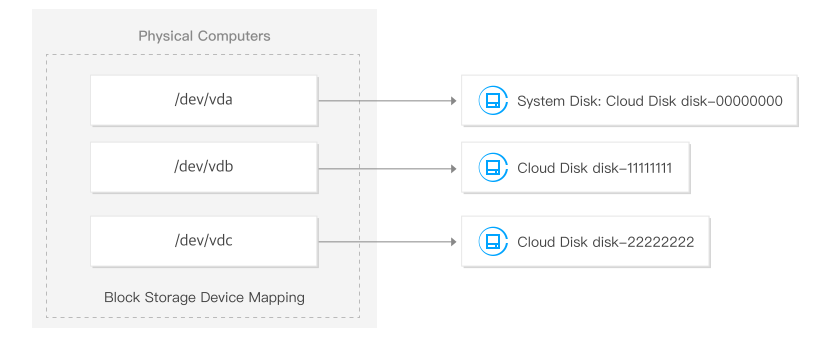
Block storage device mapping

Each instance has a system disk to ensure basic data operations, and may mount more data disks. An instance uses block storage device-mapping to map the storage devices to locations it can identify. CBS puts data into blocks in bytes and allows random access. Tencent Cloud supports two types of CBS devices: local disk and cloud disk.

This figure shows how CBS maps the block storage device to the CVM: it maps /dev/vda to the system disk and maps the two data disks to /dev/vdb and /dev/vdc, respectively. The CVM instance can automatically create block storage device mapping for local disks and cloud disks mounted to itself.

Help and Support

Was this page helpful?

Help us improve! Rate your documentation experience in 5 mins.

Feedback