tencent cloud

Data Lake Compute

Release Notes
Product Introduction
Overview
Strengths
Use Cases
Purchase Guide
Billing Overview
Refund
Payment Overdue
Configuration Adjustment Fees
Getting Started
Complete Process for New User Activation
DLC Data Import Guide
Quick Start with Data Analytics in Data Lake Compute
Quick Start with Permission Management in Data Lake Compute
Quick Start with Partition Table
Enabling Data Optimization
Cross-Source Analysis of EMR Hive Data
Standard Engine Configuration Guide
Configuring Data Access Policy
Operation Guide
Console Operation Introduction
Development Guide
Runtime Environment
SparkJar Job Development Guide
PySpark Job Development Guide
Query Performance Optimization Guide
UDF Function Development Guide
System Restraints
Client Access
JDBC Access
TDLC Command Line Interface Tool Access
Third-party Software Linkage
Python Access
Practical Tutorial
Accessing DLC Data with Power BI
Table Creation Practice
Using Apache Airflow to Schedule DLC Engine to Submit Tasks
Direct Query of DLC Internal Storage with StarRocks
Spark cost optimization practice
DATA + AI
Using DLC to Analyze CLS Logs
Using Role SSO to Access DLC
Resource-Level Authentication Guide
Implementing Tencent Cloud TCHouse-D Read and Write Operations in DLC
DLC Native Table
SQL Statement
SuperSQL Statement
Overview of Standard Spark Statement
Overview of Standard Presto Statement
Reserved Words
API Documentation
History
Introduction
API Category
Making API Requests
Data Table APIs
Task APIs
Metadata APIs
Service Configuration APIs
Permission Management APIs
Database APIs
Data Source Connection APIs
Data Optimization APIs
Data Engine APIs
Resource Group for the Standard Engine APIs
Data Types
Error Codes
General Reference
Error Codes
Quotas and limits
Operation Guide on Connecting Third-Party Software to DLC
FAQs
FAQs on Permissions
FAQs on Engines
FAQs on Features
FAQs on Spark Jobs
DLC Policy
Privacy Policy
Data Privacy And Security Agreement
Service Level Agreement
Contact Us

Use Cases

PDF
Focus Mode
Font Size
Last updated: 2025-01-03 15:27:27

Agile and Real-Time Data Lake Analysis

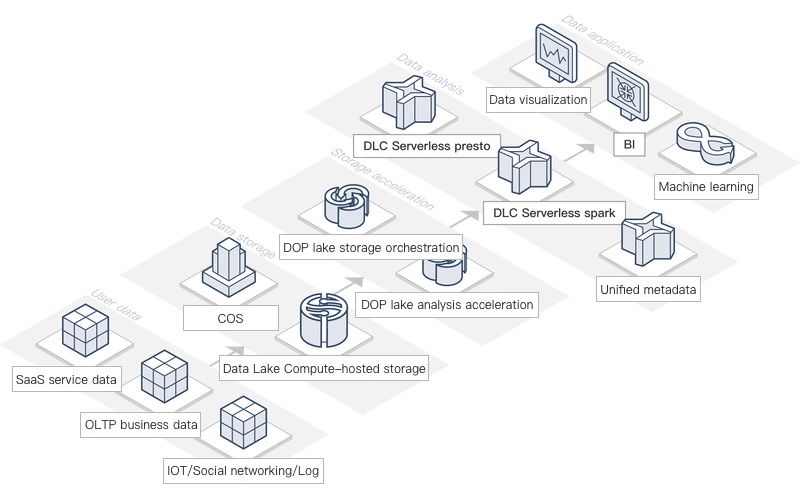
Data Lake Compute leverages a big data analysis architecture with separated storage and computing. It enables fast and flexible deployments based on big data component containerization and implements unlimited expansions on top of cloud object storage. Its advanced cloud-native elastic model fits virtually any type of business to reduce your costs. As a cost-effective and highly elastic cloud data lake solution, it helps you unify data assets and maximize performance for agile and innovative business applications.


Typical use cases

Batch log query Unlike the typical practice of storing enterprise log data as JSON and text files, you can store data in COS and then use standard SQL statements through Data Lake Compute to batch query and analyze massive amounts of data, with data reports generated quickly. In this way, Data Lake Compute visualizes your data and boosts your productivity. With a few simple configurations, you can also import cloud-based log service data into a data lake for agile analysis.

Service benefits

Cost-effective: Data Lake Compute is pay-as-you-go, allowing you to precisely control costs through its cloud-native data lake architecture with separated storage and computing.
Easy-to-use: You can easily get started with Data Lake Compute for faster queries through the unified SQL syntax.

Agile Setup of a Data Middleend

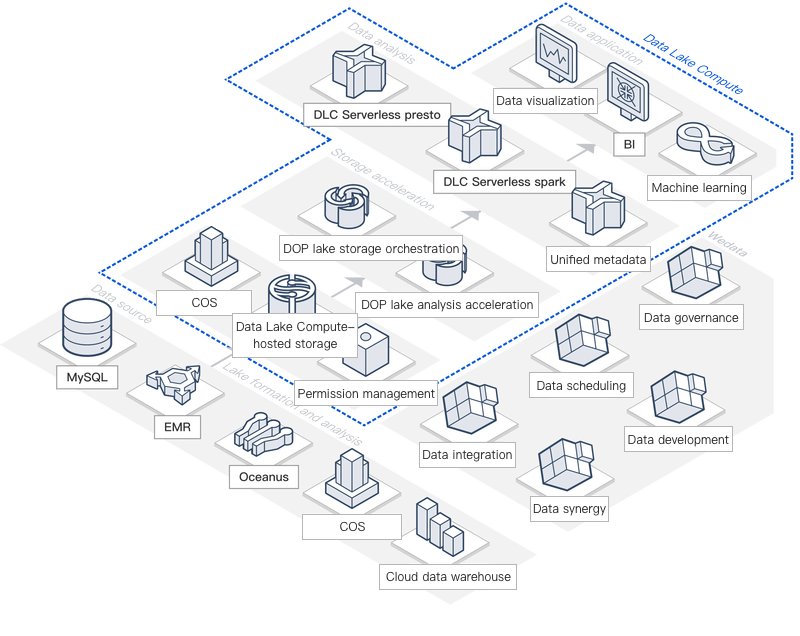
Data Lake Compute is a new data architecture with closed-loop big data analysis that is lightweight, agile, easy-to-use, and cost-effective. It has a unified metadata management view that allows you to break through data silos. It combines the strengths of many cloud-based big data services to accommodate real-time and offline data analysis scenarios and comprehensively solve a wide range of data problems. Moreover, with convenient and swift data flows, it features many of the capabilities and advantages of different cloud services, making it an ideal option for enterprises setting up a data middleend.


Typical use cases

Unified metadata view Data Lake Compute enables you to unify all of your different metadata views such as EMR and other data sources into one. In this way, you can manage and use metadata from different sources in a centralized manner, build your metadata center with agility, and switch between products and versions seamlessly. Specifically, you can easily reuse the same metadata across products like Data Lake Compute and EMR.
Agile and versatile data analysis In the big data ecosystem, Presto excels in performing interactive analysis while Spark does well in ETL tasks. Data Lake Compute provides unified syntax and lightweight clustering capabilities, so the same data can go seamlessly between engines in different scenarios. It also works with WeData so data can be imported from and exported to dozens of products and data sources, such as EMR, CDW, ES, TencentDB, and CLS. This makes the most out of the strengths of each product through convenient data flows.

Service benefits

Out-of-the-box service: Unnecessary Ops tasks and costs are saved.
Metadata management: Multiple data sources are supported to unify metadata management and break through data silos.
Full coverage: Data Lake Compute comprehensively covers data analysis and application scenarios, specifically, data integration, synergy, scheduling, development, and governance.

Agile and Federated Data Lake Analysis

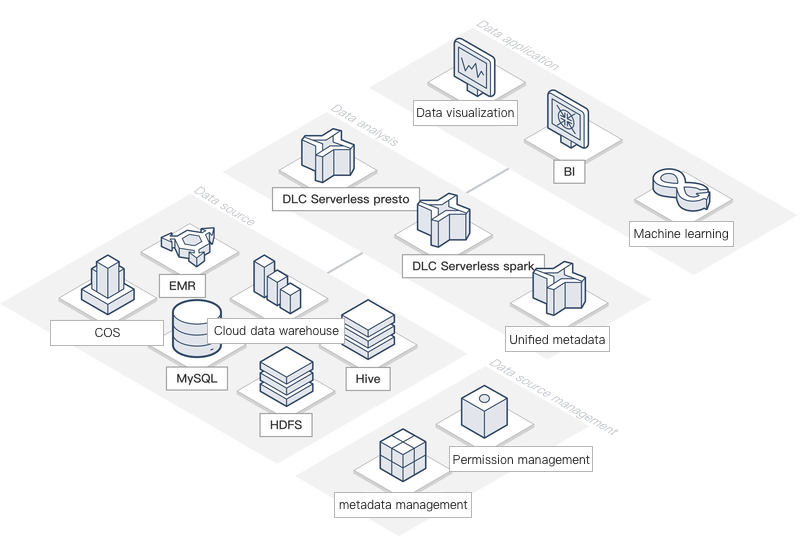
Data Lake Compute helps you seamlessly transition from database to big data scenarios, where you can query and analyze multi-source heterogeneous data in the cloud from object storage, database, and other services. Its unified data view and standard SQL capabilities speed up federated data query and analysis, breaking down data silos while fully tapping into the value of data.


Typical use cases

Cross-business federated data query Enterprise departments and business lines often use different data architectures for their specific business systems. This means business data is dispersed in different storage systems, for example, transaction data in relational databases, active data in Redis, and historical records in object storage. With Data Lake Compute, you can align and analyze heterogeneous data from multiple sources to utilize your cross-business data more quickly.

Service benefits

Out-of-the-box: There is no need to set up data transfer pipelines, so unnecessary Ops and costs are saved.
Secure and efficient: The permission management system is unified and refined to the column level, making queries super fast.
Easy-to-use: Cross-business analysis can be easily implemented without programming language adaptation.

Rich and Diversified Data Lake Portfolio

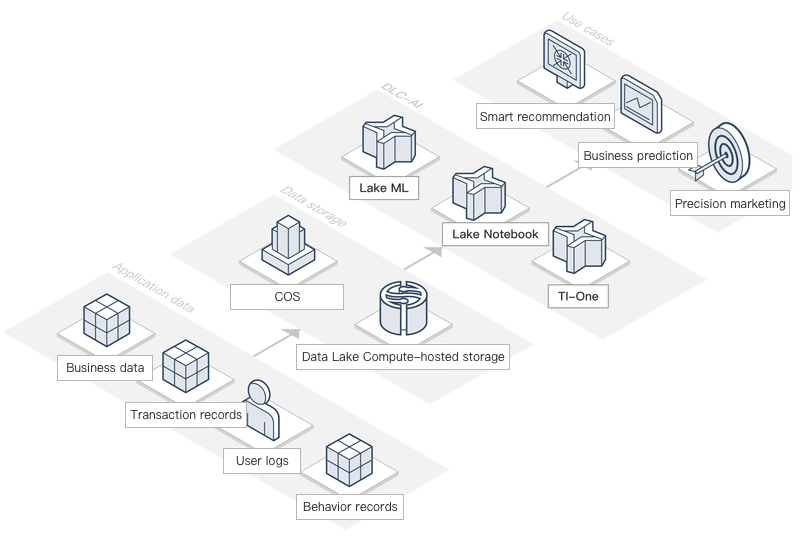
A data lake is the foundation for big data in AI scenarios, including machine learning and deep learning. Connected to a wealth of AI capabilities and platforms, Data Lake Compute readily supports a multitude of machine learning capabilities and delivers comprehensive solutions to various smart data lake analysis applications. It opens up multiple industry databases free of charge so that you can perform data analysis without data acquisition and cleansing. It also provides strong BI capabilities to help you gain data insights through predictive analysis.


Typical use cases

Business growth empowered by data Data Lake Compute offers native machine learning capabilities based on a sophisticated machine learning platform to provide a complete smart analysis solution. It helps solve your real-world business issues, such as smart recommendation and recall policies, and empower your business growth. Machine learning scenarios are often susceptible to problems like large data volumes, slow model training, and poor algorithm results. With this solution, you can enjoy out-of-the-box machine learning algorithm models to create data-driven models and predict business outcomes. You can also use its BI capabilities for efficient business analysis and improved operational efficiency.

Service benefits

Ease of use: The service is seamlessly connected to Tencent Cloud's machine learning platform, giving you access to a wealth of models and APIs.
Data standardization: Unified data management and governance provide more standardized data for data operations.

Help and Support

Was this page helpful?

Help us improve! Rate your documentation experience in 5 mins.

Feedback