tencent cloud

Tencent Cloud EdgeOne

Release Notes and Announcements
Release Notes
Security Announcement
Announcements
Product Introduction
Overview
Strengths
Use Cases
Comparison Between EdgeOne and CDN Products
Use Limits
Purchase Guide
Description of Trial Plan Experience Benefits
Free Plan Guide
Billing Overview
Billing Items
Subscriptions
Renewals
Instructions for overdue and refunds
Comparison of EdgeOne Plans
About "clean traffic" billing instructions
DDoS Protection Capacity Description
Getting Started
Choose business scenario
Quick access to website security acceleration
Quick deploying a website with Pages
Domain Service&Origin Configuration
Domain Service
HTTPS Certificate
Origin Configuration
Site Acceleration
Overview
Access Control
Smart Acceleration
Cache Configuration
File Optimization
Network Optimization
URL Rewrite
Modifying Header
Modify the response content
Rule Engine
Image&Video Processing
Speed limit for single connection download
DDoS & Web Protection
Overview
DDoS Protection
Web Protection
Bot Management
API Discovery(Beta)
Edge Functions
Overview
Getting Started
Operation Guide
Runtime APIs
Sample Functions
Best Practices
Pages
L4 Proxy
Overview
Creating an L4 Proxy Instance
Modifying an L4 Proxy Instance
Disabling or Deleting an L4 Proxy Instance
Batch Configuring Forwarding Rules
Obtaining Real Client IPs
Data Analysis&Log Service
Log Service
Data Analysis
Alarm Service
Site and Billing Management
Billing Management
Site Management
Version Management
General Policy
General Reference
Configuration Syntax
Request and Response Actions
Country/region and Corresponding Codes
Terraform
Overview
Installing and Configuring Terraform
Practical Tutorial
EdgeOne Skill User Guide
Automatic Warm-up/Cache Purge
Resource Abuse/hotlinking Protection Practical
HTTPS Related Practices
Acceleration Optimization
Scheduling Traffic
Data Analysis and Alerting
Log Platform Integration Practices
Configuring Origin Servers for Cloud Object Storage (Such As COS)
CORS Response Configuration
API Documentation
History
Introduction
API Category
Making API Requests
Site APIs
Acceleration Domain Management APIs
Site Acceleration Configuration APIs
Edge Function APIs
Alias Domain APIs
Security Configuration APIs
Layer 4 Application Proxy APIs
Content Management APIs
Data Analysis APIs
Log Service APIs
Billing APIs
Certificate APIs
Origin Protection APIs
Load Balancing APIs
Diagnostic Tool APIs
Custom Response Page APIs
API Security APIs
DNS Record APIs
Content Identifier APIs
Legacy APIs
Ownership APIs
Image and Video Processing APIs
Multi-Channel Security Gateway APIs
Version Management APIs
Data Types
Error Codes
FAQs
Product Features FAQs
DNS Record FAQs
Domain Configuration FAQs
Site Acceleration FAQs
Data and Log FAQs
Security Protection-related Queries
Origin Configuration FAQs
Troubleshooting
Reference for Abnormal Status Codes
Troubleshooting Guide for EdgeOne 4XX/5XX Status Codes
520/524 Status Code Troubleshooting Guide
521/522 Status Code Troubleshooting Guide
Tool Guide
Agreements
Service Level Agreement
Origin Protection Enablement Conditions of Use
TEO Policy
Privacy Policy
Data Processing And Security Agreement
Contact Us
Glossary

Plan Destruction Guide

PDF
Focus Mode
Font Size
Last updated: 2025-08-25 17:41:05
When you no longer need the Tencent Cloud EdgeOne (EdgeOne) service, you can destroy the EdgeOne plan. Once the plan is in the destroyed state, no further charges related to EdgeOne will be incurred. There are two ways to destroy a plan:
Automatic destruction upon expiration/overdue payment: If the account is in arrears or the plan has expired, the plan will enter the isolated state. Your resources will be retained for 60 days during the isolation period. If no renewal or reversal is made within 60 days, the system will automatically destroy the plan.
Manual destruction: For prepaid plans or Enterprise edition plans that have expired and entered the isolated state, you can choose to manually destroy them.
Note:
Plan destruction is a sensitive and high-risk operation. Once a plan is destroyed, the system will reclaim your resources and delete related configurations, and this is irreversible. If you need re-access, you will have to reconfigure everything.
Enterprise plan must be terminated completely to stop billing. If you only disable sites without terminating the plan, you will continue to be charged for the plan fee. If you are sure you no longer need it, please terminate the plan promptly.

Destroying a Prepaid Plan (Trial/Personal/Basic/Standard)

1. Go to EdgeOne console > Service Dashboard, select the site corresponding to the plan to be destroyed, and click Disable to make the site enter the disabled state.


2. After the site enters the disabled state, click Delete and confirm the deletion in the pop-up confirmation window.


3. Go to EdgeOne console > Billing Management > Plan Management to check the state of the plan. Different plan states require different handling methods:
3.1 If the plan is in the enabled state and meets the refund rules, click Self-Service Refund first. After the refund is completed, proceed to destroy the plan.


3.2 If the plan is in the enabled state but does not meet the refund rules, simply disable the auto-renewal switch. The plan will be automatically destroyed upon expiration.


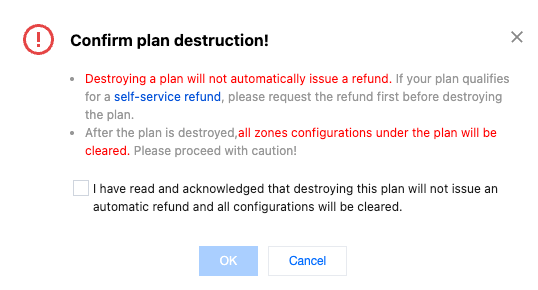
3.3 If the plan has entered the isolated state, click Destroy Plan directly. Confirm in the pop-up confirmation window to complete the plan destruction.


Destroying an Enterprise Edition Plan

Automatically Destroying a Plan by Deleting All Sites
Manually Destroying a Plan by Disabling All Sites
1. Go to EdgeOne console > Service Dashboard, select the site corresponding to the plan to be destroyed, and click Disable to make the site enter the disabled state.


2. After the site enters the disabled state, click Delete and confirm the deletion in the pop-up confirmation window.


3. After you disable and delete all sites under the Enterprise edition plan one by one according to Step 1 and Step 2, the Enterprise edition plan will be automatically destroyed.
1. Go to EdgeOne console > Service Dashboard, select the site corresponding to the plan to be destroyed, and click Disable to make the site enter the disabled state.


2. Disable all sites under the plan one by one according to Step 1. After confirming all sites are disabled, proceed to Step 3.
3. Go to EdgeOne console > Billing Management > Plan Management, find the Enterprise edition plan you want to destroy, click Destroy Plan, and confirm in the pop-up confirmation window to complete the plan destruction.






Help and Support

Was this page helpful?

Help us improve! Rate your documentation experience in 5 mins.

Feedback