tencent cloud

Tencent Cloud EdgeOne

Release Notes and Announcements
Release Notes
Security Announcement
Announcements
Product Introduction
Overview
Strengths
Use Cases
Comparison Between EdgeOne and CDN Products
Use Limits
Purchase Guide
Description of Trial Plan Experience Benefits
Free Plan Guide
Billing Overview
Billing Items
Subscriptions
Renewals
Instructions for overdue and refunds
Comparison of EdgeOne Plans
About "clean traffic" billing instructions
DDoS Protection Capacity Description
Getting Started
Choose business scenario
Quick access to website security acceleration
Quick deploying a website with Pages
Domain Service&Origin Configuration
Domain Service
HTTPS Certificate
Origin Configuration
Site Acceleration
Overview
Access Control
Smart Acceleration
Cache Configuration
File Optimization
Network Optimization
URL Rewrite
Modifying Header
Modify the response content
Rule Engine
Image&Video Processing
Speed limit for single connection download
DDoS & Web Protection
Overview
DDoS Protection
Web Protection
Bot Management
API Discovery(Beta)
Edge Functions
Overview
Getting Started
Operation Guide
Runtime APIs
Sample Functions
Best Practices
Pages
L4 Proxy
Overview
Creating an L4 Proxy Instance
Modifying an L4 Proxy Instance
Disabling or Deleting an L4 Proxy Instance
Batch Configuring Forwarding Rules
Obtaining Real Client IPs
Data Analysis&Log Service
Log Service
Data Analysis
Alarm Service
Site and Billing Management
Billing Management
Site Management
Version Management
General Policy
General Reference
Configuration Syntax
Request and Response Actions
Country/region and Corresponding Codes
Terraform
Overview
Installing and Configuring Terraform
Practical Tutorial
EdgeOne Skill User Guide
Automatic Warm-up/Cache Purge
Resource Abuse/hotlinking Protection Practical
HTTPS Related Practices
Acceleration Optimization
Scheduling Traffic
Data Analysis and Alerting
Log Platform Integration Practices
Configuring Origin Servers for Cloud Object Storage (Such As COS)
CORS Response Configuration
API Documentation
History
Introduction
API Category
Making API Requests
Site APIs
Acceleration Domain Management APIs
Site Acceleration Configuration APIs
Edge Function APIs
Alias Domain APIs
Security Configuration APIs
Layer 4 Application Proxy APIs
Content Management APIs
Data Analysis APIs
Log Service APIs
Billing APIs
Certificate APIs
Origin Protection APIs
Load Balancing APIs
Diagnostic Tool APIs
Custom Response Page APIs
API Security APIs
DNS Record APIs
Content Identifier APIs
Legacy APIs
Ownership APIs
Image and Video Processing APIs
Multi-Channel Security Gateway APIs
Version Management APIs
Data Types
Error Codes
FAQs
Product Features FAQs
DNS Record FAQs
Domain Configuration FAQs
Site Acceleration FAQs
Data and Log FAQs
Security Protection-related Queries
Origin Configuration FAQs
Troubleshooting
Reference for Abnormal Status Codes
Troubleshooting Guide for EdgeOne 4XX/5XX Status Codes
520/524 Status Code Troubleshooting Guide
521/522 Status Code Troubleshooting Guide
Tool Guide
Agreements
Service Level Agreement
Origin Protection Enablement Conditions of Use
TEO Policy
Privacy Policy
Data Processing And Security Agreement
Contact Us
Glossary

Maximum Upload Size

PDF
Focus Mode
Font Size
Last updated: 2025-07-29 15:27:21

Function Introduction

The maximum upload size is the maximum value of data that a client user can upload in a single request. If the set limit is exceeded, EdgeOne will respond to the client with a 413 (Request Entity Too Large).
Note:
1. Only EdgeOne Enterprise and Standard plans support disabling the upload size limit.
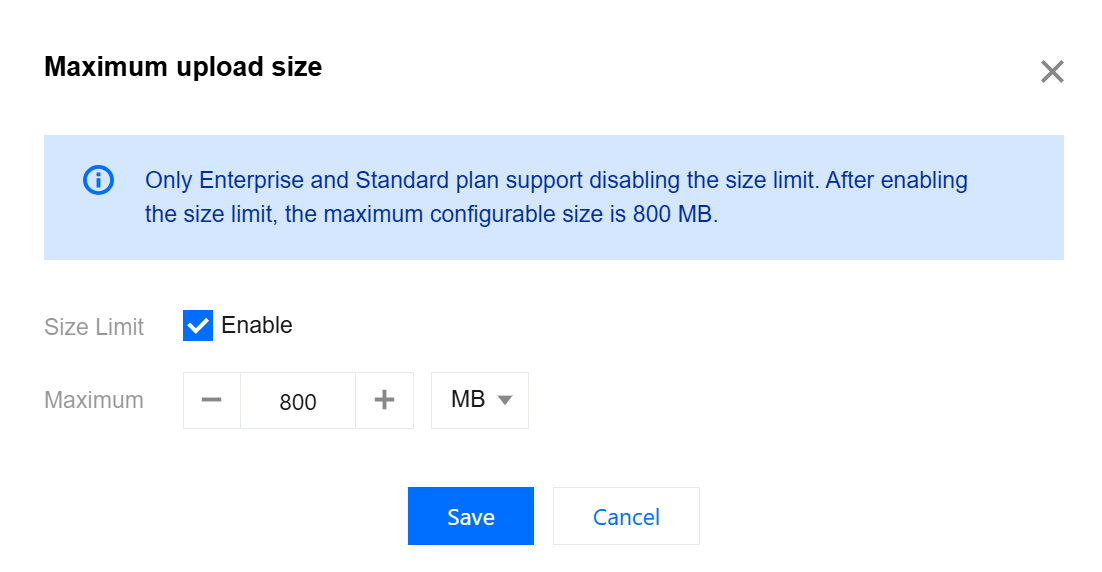
2. The maximum upload size limit is enabled by default, with a limit of 800MB.

Usage Scenarios

1. Large file upload: For businesses involving large file uploads, such as online video platforms, large-scale game distribution, and big data analysis, you can increase the upload size limit or disable it directly to allow your large files to be uploaded smoothly.
2. Defend against malicious uploads: For businesses with frequent user interactions, such as social media, forums or blogs, you may encounter malicious users uploading excessively large files. You can enable the size limit and reduce the limit to prevent large files from being uploaded to the origin, thereby alleviating the pressure on the origin, preventing potential security risks, and improving the user experience.
3. Save traffic: For traffic-sensitive businesses, such as online education, online meetings, and API services, you may want to save traffic by limiting the size of uploaded files. You can enable the size limit and adjust the limit to a smaller value to reduce unnecessary transmission traffic and lower traffic costs.
You can flexibly configure the "maximum upload size" to meet the needs of various business scenarios.

Directions

Scenario 1: Configure the maximum upload size for all domain names of the site

If you need to configure the same maximum upload size for the whole connected site or as a site-level fallback configuration, please refer to the following steps:
1. Log in to the Tencent Cloud EdgeOne console, enter Service Overview in the left menu bar, and click the site to be configured under Website Security Acceleration.
2. In the site details page, click Site Acceleration to enter the Site Global Configuration Page. In the right sidebar, click Network Optimization.
3. Find the maximum upload size configuration card and click Global Settings.

4. In the pop-up window, check Enable Size Limit and modify the limit value. Click Save to make it effective.


Scenario 2: Configure the maximum upload size for specified domain names, paths, or file extensions, etc.

If you need to configure different maximum upload sizes for different domain names, paths, or file extensions, etc., for example, configure the maximum upload size for the www.example.com domain under the example.com site to be 20 MB, please refer to the following steps:
1. Log in to the Tencent Cloud EdgeOne console, enter Service Overview in the left menu bar, and click the site to be configured under Website Security Acceleration.
2. On the site details page, click Site Acceleration to enter the global site configuration page, then click the Rule Engine tab.
3. On the rule engine management page, click Create rule and select Add blank rule.
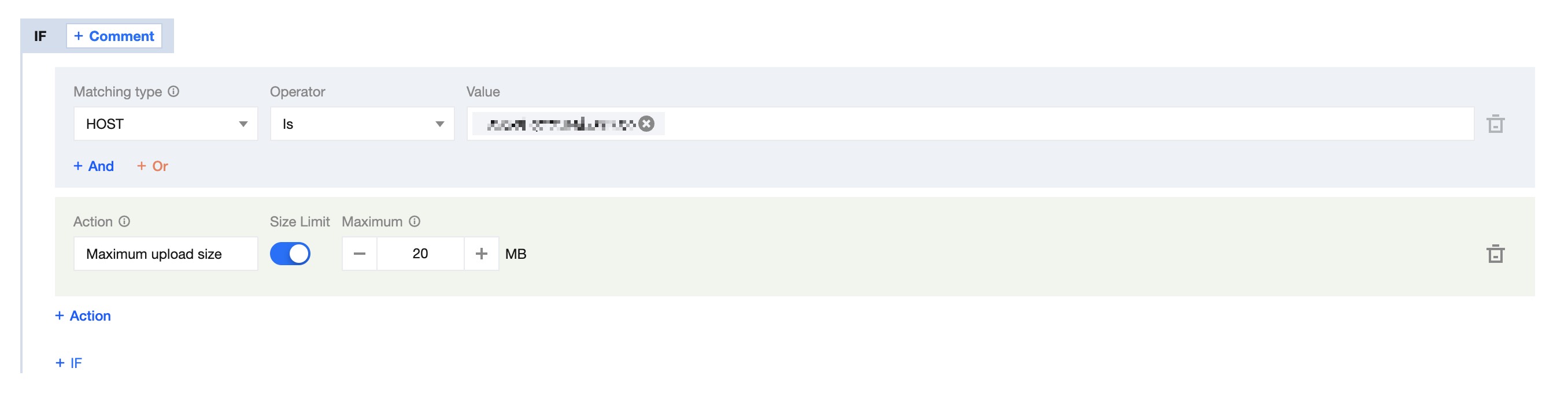
4. In the rule editing page, enter the rule name, select Host as the matching type, and configure it as www.example.com.
5. Click Action, and in the pop-up operation list, select Maximum Upload Size as the operation, and click Enable Size Limit, with a limit value of 20 MB.

6. Click Save and Publish to complete the rule configuration.

Help and Support

Was this page helpful?

Help us improve! Rate your documentation experience in 5 mins.

Feedback