tencent cloud

TencentCloud Managed Service for Prometheus

Product Introduction
Overview
Strengths
Use Cases
Concepts
Use Limits
Features
Service Regions
Purchase Guide
Billing Overview
Pay-as-You-Go (Postpaid)
Free Trial Introduction
Managed Collector Billing Introduction
Archive Storage Billing Introduction
Purchase Methods
Payment Overdue
Getting Started
Integration Guide
Scrape Configuration Description
Custom Monitoring
EMR Integration
Java Application Integration
Go Application Integration
Exporter Integration
Nacos Integration
Common Exporter
Health Check
Instructions for Installing Components in the TKE Cluster
Cloud Monitoring
Non-Tencent Cloud Host Monitoring
Read Cloud-Hosted Prometheus Instance Data via Remote Read
Agent Self-Service Access
Pushgateway Integration
Security Group Open Description
Operation Guide
Instance
TKE
Integration Center
Data Multi-Write
Recording Rule
Instance Diagnosis
Archive Storage
Alerting Rule
Tag
Access Control
Grafana
API Guide
TKE Metrics
Resource Usage and Billing Overview
Practical Tutorial
Migration from Self-Built Prometheus
Custom Integration with CVM
TKE Monitoring
Enabling Public Network Access for TKE Serverless Cluster
Connecting TMP to Local Grafana
Enabling Public Network Access for Prometheus Instances
Configuring a Public Network Address for a Prometheus Instance
Terraform
Terraform Overview
Managing Prometheus Instances Using Terraform
Managing the Integration Center of Prometheus Instances Using Terraform
Collecting Container Monitoring Data Using Terraform
Configuring Alarm Policies Using Terraform
FAQs
Basic Questions
Integration with TKE Cluster
Product Consulting
Use and Technology
Cloud Monitor FAQs
Service Level Agreement
TMP Policy
Privacy Policy
Data Processing And Security Agreement

Agent Self-Service Access

PDF
Focus Mode
Font Size
Last updated: 2024-08-15 17:08:56

Application Scenario

To collect services on self-built IDC, deploy Agent and manage collection configurations, and report monitoring data to the cloud TMP. For cloud services, we recommend using Integration Center, which will manage Agent, offering automated integration for multiple middlewares and scraping tasks.

Obtaining Prometheus Instance Access Configuration

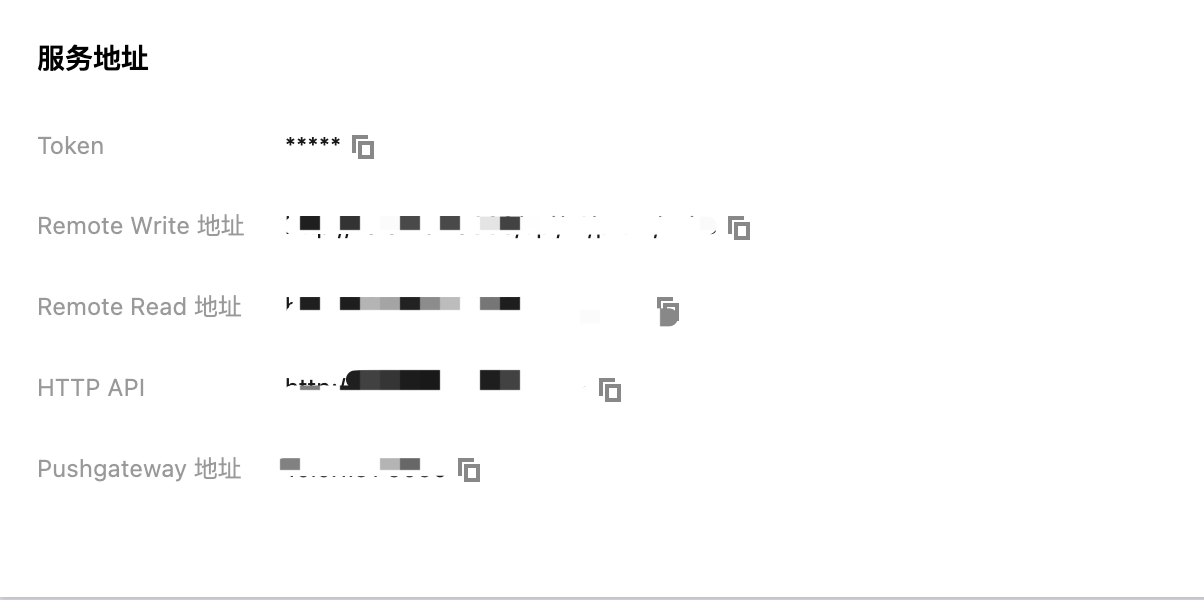
1. Go to Prometheus Monitoring Console, select the corresponding instance ID/Name, and on the Basic Info > Service Address page, obtain the Remote Write address and Token.


2. Obtain APPID on the Account Information page.

Confirming the Network Environment and Connectivity with Cloud Instances

Based on the acquired RemoteWrite address, execute the following command. If the network is connected, the returned information will include 401 Unauthorized.
curl -v -X POST ${RemoteWriteURL}

Installing and Starting vmagent

vmagent uses fewer resources and is widely used due to its compatibility with Prometheus collection configuration and Remote Write protocol. This document only describes common startup options for vmagent, managed through Systemd or Docker. For more detailed information, please see the official documentation.

Common Startup Options

-promscrape.noStaleMarkers: If the collection target disappears, a stale marker for all associated metrics is generated and written to remote storage by default. Setting this option disables this behavior and can reduce memory usage.
-loggerTimezone: The time zone for the time in logs, for example, Asia/Shanghai, Europe/Berlin or Local (UTC by default).
-remoteWrite.tmpDataPath: The file path for temporary data storage to be written after collection.
-remoteWrite.url: The URL where data is written to remote storage.
-remoteWrite.basicAuth.username: Remote storage -remoteWrite.url corresponding basic auth username.
-remoteWrite.basicAuth.password: Remote storage -remoteWrite.url corresponding basic auth password.
-promscrape.config: Path of the collection configuration, which can be a file path or HTTP URL. For more details, please see Reference Documentation.
-promscrape.configCheckInterval: Interval for checking the -promscrape.config configuration changes. For configuration updates, please see Reference Documentation.

Managing via Docker

1. On the vmagent Release Page, select the image version. It is recommended to use latest.
2. Replace the Prometheus instance information in the script and start vmagent.
mkdir /etc/prometheus
touch /etc/prometheus/scrape-config.yaml
docker run -d --name vmagent --restart always --net host -v /etc/prometheus:/etc/prometheus victoriametrics/vmagent:latest \\
-promscrape.noStaleMarkers \\
-loggerTimezone=Local \\
-remoteWrite.url="${RemoteWriteURL}" \\
-remoteWrite.basicAuth.username="${APPID}" \\
-remoteWrite.basicAuth.password='${Token}' \\
-remoteWrite.tmpDataPath=/var/lib/vmagent \\
-promscrape.config=/etc/prometheus/scrape-config.yaml \\
-promscrape.configCheckInterval=5s
3. View vmagent logs
docker ps
docker logs vmagent
If it starts normally, executing the following command will return OK.
curl localhost:8429/health

Managing via Systemd

1. On the vmagent Release page, download the corresponding vmutils-* compressed package according to your operating system and CPU architecture, and decompress it.
2. Replace the access information of the Prometheus instance in the script and start vmagent.
mkdir /etc/prometheus
touch /etc/prometheus/scrape-config.yaml
cat >/usr/lib/systemd/system/vmagent.service <<EOF
[Unit]
Description=VictoriaMetrics Agent
After=network.target

[Service]
LimitNOFILE=10240
ExecStart=/usr/bin/vmagent \\
-promscrape.noStaleMarkers \\
-loggerTimezone=Local \\
-remoteWrite.url="${RemoteWriteURL}" \\
-remoteWrite.basicAuth.username="${APPID}" \\
-remoteWrite.basicAuth.password="${Token}" \\
-remoteWrite.tmpDataPath=/var/lib/vmagent \\
-promscrape.config=/etc/prometheus/scrape-config.yaml \\
-promscrape.configCheckInterval=5s
Restart=always
RestartSec=10s

[Install]
WantedBy=multi-user.target
EOF
systemctl daemon-reload
systemctl enable vmagent
systemctl start vmagent
sleep 3
systemctl status vmagent
3. View logs
journalctl -u vmagent
If it starts normally, executing the following command will return OK.
curl localhost:8429/health

Managing the Configuration

Modifying the Configuration File

Edit the collection configuration file /etc/prometheus/scrape-config.yaml to add/update/delete collection tasks. For Prometheus collection task configuration, see Official Documentation.
global:
scrape_interval: 30s
scrape_configs:
- job_name: agent-monitor
static_configs:
- targets:
- localhost:8429
After the configuration is modified, it will only take effect after the time set by the option -promscrape.configCheckInterval.

Viewing Monitoring Target Information

Execute the following command to view the collection target and check whether the configuration is effective and meets expectations.
curl localhost:8429/api/v1/targets


Help and Support

Was this page helpful?

Help us improve! Rate your documentation experience in 5 mins.

Feedback