tencent cloud

TencentCloud Managed Service for Prometheus

Product Introduction
Overview
Strengths
Use Cases
Concepts
Use Limits
Features
Service Regions
Purchase Guide
Billing Overview
Pay-as-You-Go (Postpaid)
Free Trial Introduction
Managed Collector Billing Introduction
Archive Storage Billing Introduction
Purchase Methods
Payment Overdue
Getting Started
Integration Guide
Scrape Configuration Description
Custom Monitoring
EMR Integration
Java Application Integration
Go Application Integration
Exporter Integration
Nacos Integration
Common Exporter
Health Check
Instructions for Installing Components in the TKE Cluster
Cloud Monitoring
Non-Tencent Cloud Host Monitoring
Read Cloud-Hosted Prometheus Instance Data via Remote Read
Agent Self-Service Access
Pushgateway Integration
Security Group Open Description
Operation Guide
Instance
TKE
Integration Center
Data Multi-Write
Recording Rule
Instance Diagnosis
Archive Storage
Alerting Rule
Tag
Access Control
Grafana
API Guide
TKE Metrics
Resource Usage and Billing Overview
Practical Tutorial
Migration from Self-Built Prometheus
Custom Integration with CVM
TKE Monitoring
Enabling Public Network Access for TKE Serverless Cluster
Connecting TMP to Local Grafana
Enabling Public Network Access for Prometheus Instances
Configuring a Public Network Address for a Prometheus Instance
Terraform
Terraform Overview
Managing Prometheus Instances Using Terraform
Managing the Integration Center of Prometheus Instances Using Terraform
Collecting Container Monitoring Data Using Terraform
Configuring Alarm Policies Using Terraform
FAQs
Basic Questions
Integration with TKE Cluster
Product Consulting
Use and Technology
Cloud Monitor FAQs
Service Level Agreement
TMP Policy
Privacy Policy
Data Processing And Security Agreement

Creating Instance

PDF
Focus Mode
Font Size
Last updated: 2024-01-29 16:01:55
This document uses custom configuration as an example to describe how to create a TMP instance.

Preparations

Before creating a TMP instance, you must complete the following operations:
Sign up for a Tencent Cloud account and complete identity verification.
Create a VPC in the target region and create a subnet in the target AZ in the VPC.

Directions

1. Log in to the TMP console.
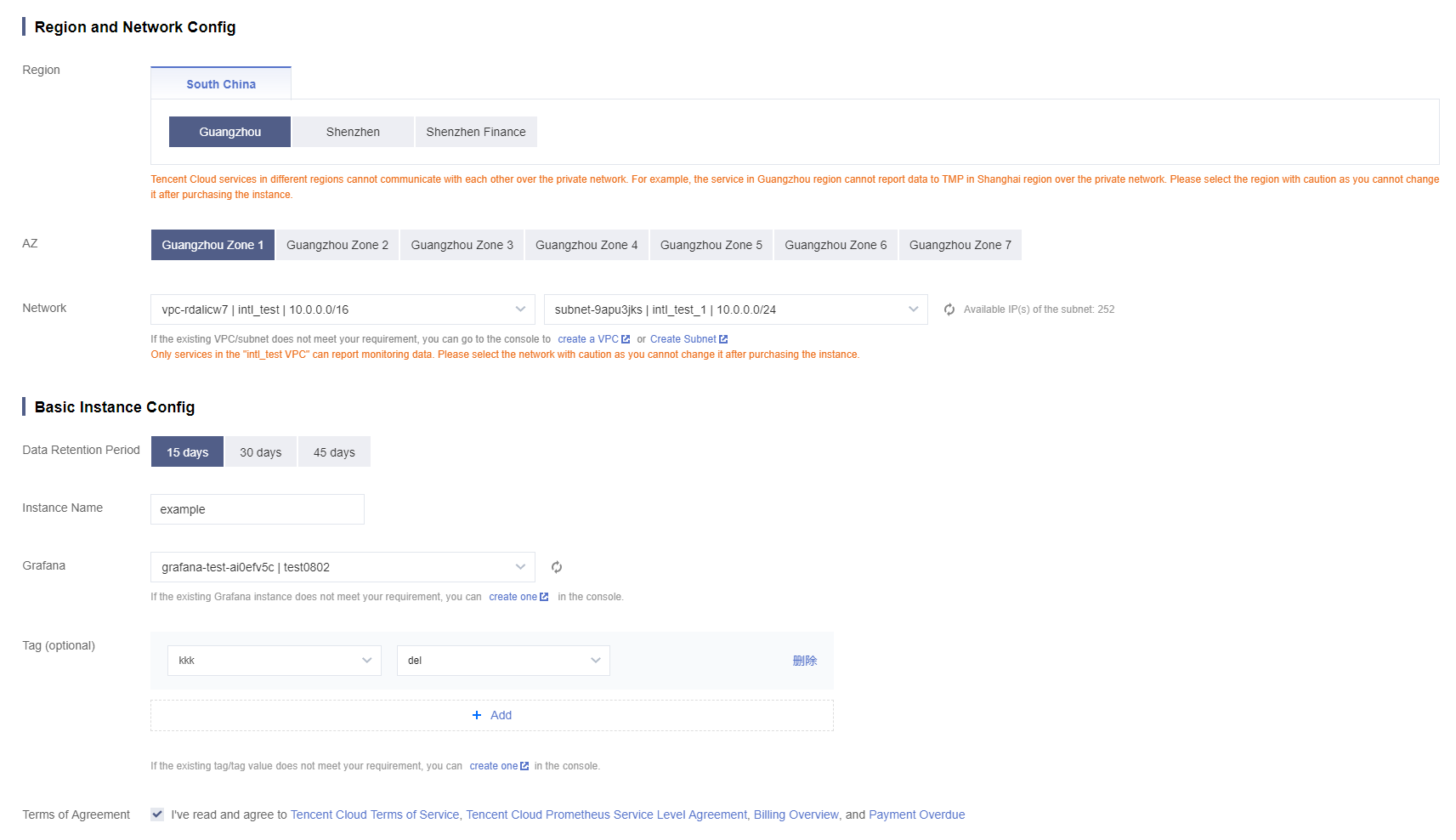
2. Click Create and configure the following information as prompted:
Type
Required
Configuration Description
Region
Yes
Select a region based on the region of your Tencent Cloud service. The price may vary by region, and the real-time price displayed on the purchase page shall prevail. Tencent Cloud services in different regions cannot communicate with each other over the private network; for example, a service in the Guangzhou region cannot report data to a TMP instance in the Shanghai region over the private network. Once an instance is purchased, the region cannot be changed. Therefore, please select the region with caution.
AZ
Yes
Select as needed.
Network
Yes
It indicates a logically isolated network space in Tencent Cloud. A VPC consists of at least one subnet. The system will provide a default VPC and subnet for you in each region. If the existing VPCs/subnets don't meet your requirements, you can create new ones as instructed in Creating VPCs or Creating Subnets.
Product Specs
Yes
The price varies by product specs. For more information, please see Pricing.
Data Retention Period
Yes
The price varies by data retention period. For more information, please see Pricing.
Instance Name
Yes
Enter a custom name of the TMP instance.
Grafana/Grafana Password
Yes
Grafana is enabled by default. After the instance is successfully created, the system will generate a domain name accessible over the public network. The default account of the Grafana service is `admin`, and the password is user-defined.
Validity Period
Yes
Multiple validity periods are available for your choice.
3. After completing the configuration, click Buy Now.


Help and Support

Was this page helpful?

Help us improve! Rate your documentation experience in 5 mins.

Feedback