tencent cloud

TDMQ for Apache Pulsar

Release Notes and Announcements
Release Notes
Cluster Version Updates
Product Announcements
Product Introduction
Introduction and Selection of the TDMQ Product Series
What Is TDMQ for Apache Pulsar
Strengths
Scenarios
How It Works
Product Series
Version Support Instructions for Open-Source Apache Pulsar
Comparison with Open-Source Apache Pulsar
High Availability
Quotas and Limits
Basic Concepts
Billing
Billing Overview
Pricing
Billing Examples
Renewal
Viewing Consumption Details
Overdue Payments
Refund
Getting Started
Getting Started Guide
Preparations
Using the SDK to Send and Receive General Messages
Using the SDK to Send and Receive Advanced Feature Messages
User Guide
Usage Process Guide
Configuring the Account Permission
Creating a Cluster
Configuring the Namespace
Configuring the Topic
Connecting to a Cluster
Managing the Cluster
Querying Messages and Traces
Cross-Region Replication
Viewing Monitoring Data and Configuring Alarm Rules
Use Cases
Client Usage
Abnormal Consumer Isolation
Traffic Throttling Mechanisms
Transaction Reconciliation
Message Idempotence
Message Compression
Migration Guide
Single-Write Multiple-Read Cluster Migration Solutions
Hitless Migration from Virtual Cluster to Pro Cluster
SDK Reference
API Overview
SDK Reference
SDK Overview
Recommended SDK Configuration Parameters
TCP Protocol (Apache Pulsar)
Security and Compliance
Permission Management
Deletion Protection
CloudAudit
FAQs
Monitoring
Clients
Agreements
Service Level Agreement
TDMQ Policy
Contact Us
Glossary
DocumentationTDMQ for Apache PulsarMigration GuideSingle-Write Multiple-Read Cluster Migration Solutions

Single-Write Multiple-Read Cluster Migration Solutions

Focus Mode
Font Size
Last updated: 2025-12-24 15:00:42
This document provides an overview of feasible solutions to the migration between different clusters. You can select a suitable migration solution based on your business scenario.

Scenarios

1. Migration cannot be performed at the virtual cluster level.
2. It is expected to migrate resources under a virtual cluster to different pro clusters.
3. A self-built Pulsar cluster needs to be migrated to a TDMQ for Apache Pulsar cluster.

Single-Write Multiple-Read Solution

The solution is overall simple, clear, and easy to operate. It does not cause data backlogs and achieves a smooth transition. With this solution, users can more flexibly control the resource granularity and grayscale method for the migration.
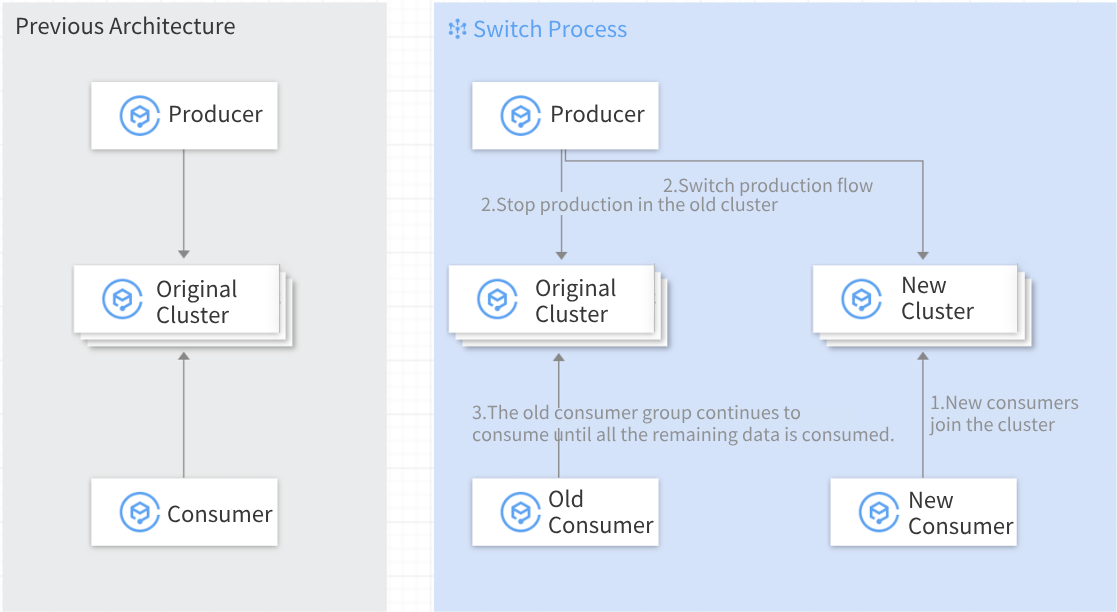

Migration Process

1. Start the business consumer connected to the access point of the new cluster (dual-read, with consumers consuming data from both the original cluster and the new cluster).
2. Change the access point addresses of the producers in the original cluster to those of the producers in the new cluster. Then, restart the producers to ensure that new messages are produced to the new cluster until all producers in the original cluster are modified/disabled (switch of the write operation, allowing the production traffic to be switched from the original cluster to the new cluster).
3. Pay attention to the message backlogs in the original cluster.
4. After you confirm that no backlogged messages remain in the original cluster, disable the consumers of the original cluster. In this case, the business has been migrated to the new cluster (single-read, where consumers only consume messages from the new cluster).
5. After the migration is completed, delete the original cluster.

Help and Support

Was this page helpful?

Help us improve! Rate your documentation experience in 5 mins.

Feedback