Product Selection
Download
Mode fokus
Ukuran font
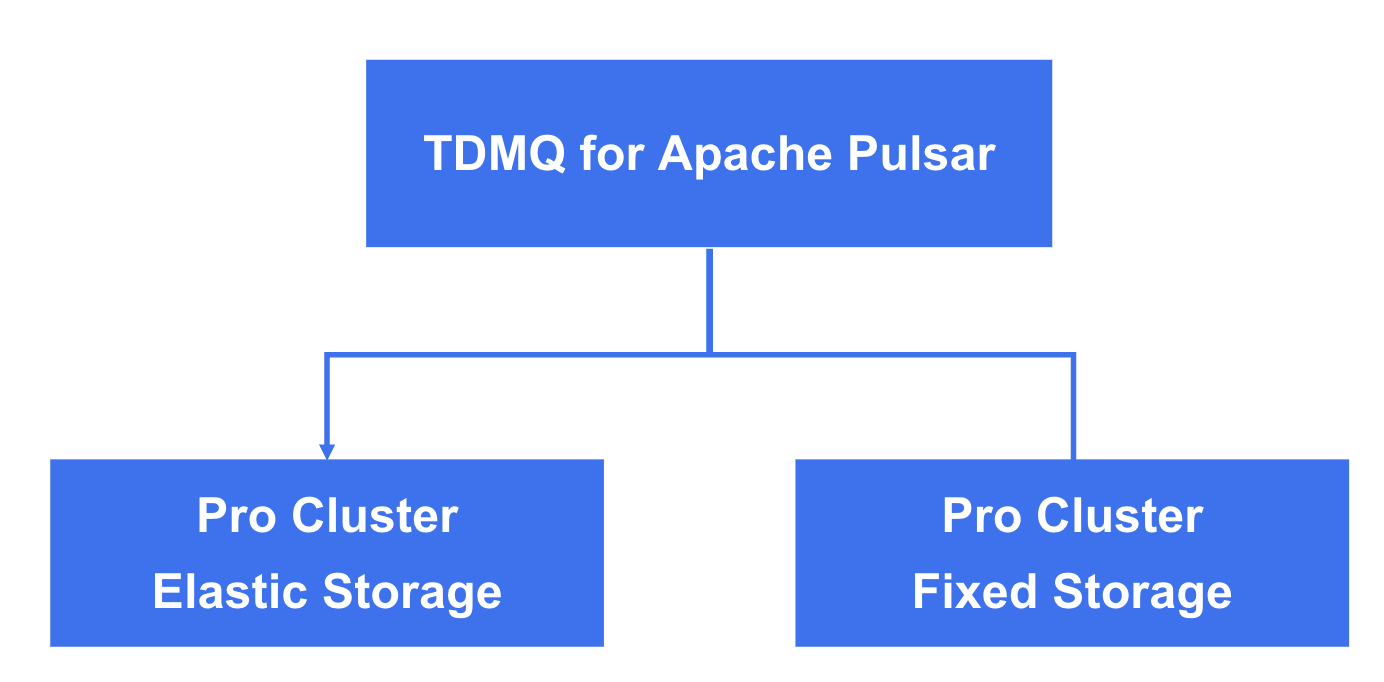
To meet user requirements in different usage scenarios, TDMQ for Apache Pulsar offers
pro clusters (elastic storage), pro clusters (fixed storage), virtual clusters (new purchase not supported), and other product forms. When you purchase a TDMQ for Apache Pulsar cluster, it is recommended that you select a product based on factors such as business use cases, product capabilities, and usage costs.Product Series
The following figure shows the product series of TDMQ for Apache Pulsar.
Recommended Selection Process
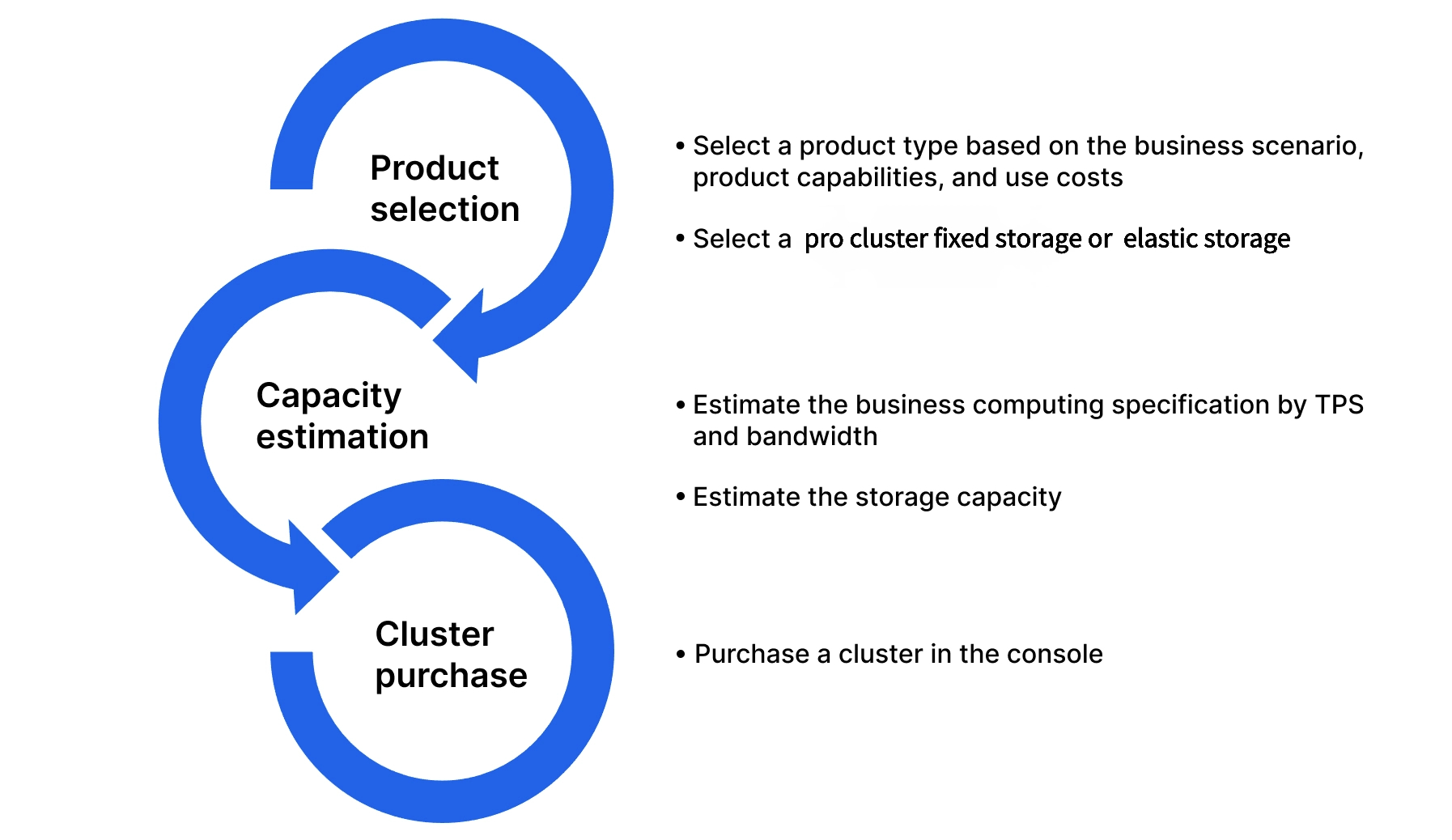
It is recommended that you select a product based on the following process.
Product Selection Analysis
The following table compares the features of two different cluster types of TDMQ for Apache Pulsar in various dimensions.
Comparison Item | Pro Cluster (Fixed Storage) | Pro Cluster (Elastic Storage) | Virtual Cluster (New Purchase Not Supported) |
Instance type | Physical isolation. | Physical isolation at the computing layer; shared storage layer. | Physically shared; logically multi-tenant. |
Target customer groups and scenarios | Leading customers, with high requirements for stability and resource isolation in production environments with heavy business traffic. | Leading customers, with high requirements for stability and resource isolation in production environments with heavy business traffic. | Entry-level customers, with moderate business volume, short-term test, and significant differences between peak and average traffic. |
Billing mode | Yearly/Monthly subscription - prepaid. | Yearly/Monthly subscription - prepaid. | Pay-as-you-go - postpaid. |
Billable item | Based on supported cluster specifications, including TPS, bandwidth, and fixed storage fees. | Based on supported cluster specifications, including TPS, bandwidth, and storage pay-as-you-go fees. | API call fees, message storage fees, and partition topic usage fees. |
Sending/Receiving TPS | Purchased as required based on different computing and storage specifications (2,000 TPS at least). | Purchased as required based on different computing specifications (1,000 TPS at least). | The TPS for production and consumption on a single topic in a cluster is limited to 5,000, respectively. |
Storage | Message persistence is required, resulting in stable storage consumption. | Messages are deleted after being consumed in most scenarios. Storage consumption is small or fluctuates greatly. | Storage is used in pay-as-you-go mode. |
Network | Multiple VPC routes and public network access routes are supported. | Multiple VPC routes and public network access routes are supported. | Multiple VPC routes or public network access routes are not supported. |
SLA | Data reliability: 99.99999999%. Service availability: 99.99%. | Data reliability: 99.99999999%. Service availability: 99.99%. | Data reliability: 99.999999%. Service availability: 99.95%. |
TDMQ for Apache Pulsar Engine | 2.9.2 or 3.0.0. | 2.9.2 or 3.0.0. | 2.7.2. |
Scale-out upper limit | High degree of freedom, supporting up to million-level TPS. | High degree of freedom, supporting up to million-level TPS. | Elastic scaling within a certain range, and elastic usage. |
High-availability capability | Multiple availability zones (AZs) in the same region can be customized for deployment, enhancing the disaster recovery capability. | Multiple AZs in the same region can be customized for deployment, enhancing the disaster recovery capability. | Intra-city cross-AZ deployment is not supported. |
Expert service | Services, such as product upgrades, new service launches, and major marketing campaigns, are provided to ensure smooth business operations. | Services, such as product upgrades, new service launches, and major marketing campaigns, are provided to ensure smooth business operations. | Tencent Cloud standard ticket services are provided. |
Capacity Assessment
After the selected cluster type is confirmed, you need to evaluate the instance specifications required for actual business operations, including computing specifications and storage specifications.
Computing specifications: The computing specifications of TDMQ for Apache Pulsar Pro Edition indicate the maximum TPS for message sending and receiving, and the maximum bandwidth of the cluster instance. You need to select appropriate computing specifications based on actual business operations.
Storage specifications: You can estimate the message volume and size based on the business volume and calculate the required storage space. For pro clusters (fixed storage), the storage capacity is fixed, and yearly/monthly subscription is used. For pro clusters (elastic storage), storage is billed in pay-as-you-go mode. However, clusters of different specifications have different storage upper limits.
TDMQ for Apache Pulsar Pro Edition uses
3 replicas for message storage by default. Note this during the assessment.Purchasing a Cluster
Bantuan dan Dukungan
Apakah halaman ini membantu?
Anda juga dapat Menghubungi Penjualan atau Mengirimkan Tiket untuk meminta bantuan.
masukan