tencent cloud

IoT Hub

Release Notes and Announcements
Release Notes
Product Introduction
Overview
Features
Strengths
Use Cases
Use Limits
Basic Concepts
Getting Started
Quick Start
Scenario 1: Device Interconnection
Scenario 2: Device Status Reporting and Setting
MQTT.fx Connection Guide
Console Guide
Product Management
Rule Engine
Sub-account Access to IoT Hub
Firmware Upgrade
Resource Management
Certificate Management
Developer Manual
Feature Components
Signature Algorithm
Device Authentication
Device Connection Protocol
Gateway Subdevice
Message Communication
Device Shadow
Device Firmware Upgrade
Remote Device Configuration
Resource Management
Device Log Reporting
NTP Service
Device Connection Manual
Device Connection Overview
Connection Based on SDK for C
Connection Based on SDK for Android
Connection Based on SDK for Java
Connection Based on SDK for Python
API Documentation
History
Introduction
API Category
Making API Requests
Device Shadow APIs
Device APIs
CA Certificate APIs
Product APIs
Data Types
Error Codes
FAQs
General
Device Connection and Reporting
Rule Engine
Console
IoT Hub Policy
Privacy Policy
Data Privacy And Security Agreement
Glossary

Device-Level Key Authentication

PDF
Focus Mode
Font Size
Last updated: 2024-12-27 15:44:26

Overview

The IoT Hub platform supports device-level key authentication. In this mode, you need to burn different configuration firmware for each device. The platform will perform certificate authentication or key authentication according to your selection. After successful authentication, devices can establish a connection with the platform for data communication.

Flowchart

Device-level key authentication requires you to burn different firmware for each device. It incurs certain implementation costs in production applications, but it has higher security and is thus recommended.

Directions

1. Log in to the IoT Hub console and create a product and a device as instructed in Device Connection Preparations.
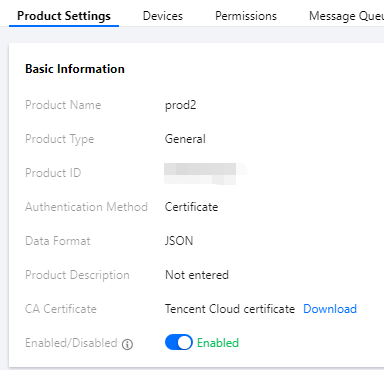
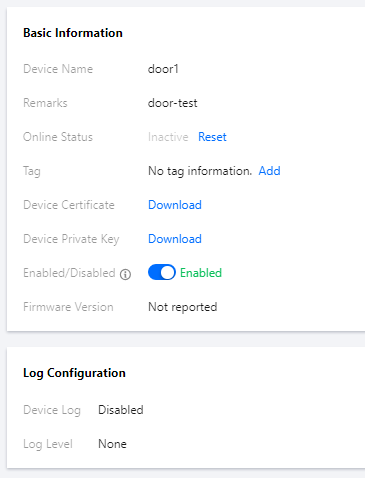
2. Get the product information on the product details page and get the device name and device certificate/key on the device details page.
Product information


Device information


3. Burn the device firmware in the following steps:
3.1 Download the device SDK.
3.2 Implement the HAL layer functions in the SDK for reading and writing product and device information, including ProductID, Devicename, and device certificate or key. For more information, please see SDK for C Connection Description.
3.3 Develop the device firmware based on the SDK according to your actual business needs so as to implement various features such as unique device ID reading, dynamic device registration, connection authentication, communication, and OTA.
3.4 In the production process, batch burn the developed and tested device firmware into the device.
4. The device uses the burned device-level certificate/key to establish a connection with the platform. After successful authentication, it will be activated and connected. At this time, it can exchange data with the cloud to implement business requirements.
Help and Support

Was this page helpful?

Help us improve! Rate your documentation experience in 5 mins.

Feedback