tencent cloud

TDSQL-C for MySQL

Release Notes and Announcements
Release Notes
Product Announcements
Beginner's Guide
Product Introduction
Overview
Strengths
Use Cases
Architecture
Product Specifications
Instance Types
Product Feature List
Database Versions
Regions and AZs
Common Concepts
Use Limits
Suggestions on Usage Specifications
Kernel Features
Kernel Overview
Kernel Version Release Notes
Optimized Kernel Version
Functionality Features
Performance Features
Security Features
Stability Feature
Analysis Engine Features
Inspection and Repair of Kernel Issues
Purchase Guide
Billing Overview
Product Pricing
Creating Cluster
Specification Adjustment Description
Renewal
Payment Overdue
Refund
Change from Pay-as-You-Go to Yearly/Monthly Subscription
Change from Pay-as-You-Go to Serverless Billing
Value-Added Services Billing Overview
Viewing Billing Statements
Getting Started
Database Audit
Overview
Viewing Audit Instance List
Enabling Audit Service
Viewing Audit Logs
Log Shipping
Post-Event Alarm Configuration
Modifying Audit Rule
Modifying Audit Service
Disabling Audit Service
Audit Rule Template
Viewing Audit Task
Authorizing Sub-User to Use Database Audit
Serverless Service
Serverless Introduction
Creating and Managing a Serverless Cluster
Elastic Scaling Management Tool
Serverless Resource Pack
Multi-AZ Deployment
Configuration Change
FAQs
Serverless Cost Estimator
Operation Guide
Operation Overview
Switching Cluster Page View in Console
Database Connection
Instance Management
Configuration Adjustment
Instance Mode Management
Cluster Management
Scaling Instance
Database Proxy
Account Management
Database Management
Database Management Tool
Parameter Configuration
Multi-AZ Deployment
GD
Backup and Restoration
Operation Log
Data Migration
Parallel Query
Columnar Storage Index (CSI)
Analysis Engine
Database Security and Encryption
Monitoring and Alarms
Basic SQL Operations
Connecting to TDSQL-C for MySQL Through SCF
Tag
Practical Tutorial
Classified Protection Practice for Database Audit of TDSQL-C for MySQL
Upgrading Database Version from MySQL 5.7 to 8.0 Through DTS
Usage Instructions for TDSQL-C MySQL
New Version of Console
Implementing Multiple RO Groups with Multiple Database Proxy Connection Addresses
Strengths of Database Proxy
Selecting Billing Mode for Storage Space
Creating Remote Disaster Recovery by DTS
Creating VPC for Cluster
Data Rollback
Solution to High CPU Utilization
How to Authorize Sub-Users to View Monitoring Data
White Paper
Security White Paper
Performance White Paper
Troubleshooting
Connection Issues
Performance Issues
API Documentation
History
Introduction
API Category
Making API Requests
Instance APIs
Multi-Availability Zone APIs
Other APIs
Audit APIs
Database Proxy APIs
Backup and Recovery APIs
Parameter Management APIs
Billing APIs
serverless APIs
Resource Package APIs
Account APIs
Performance Analysis APIs
Data Types
Error Codes
FAQs
Basic Concepts
Purchase and Billing
Compatibility and Format
Connection and Network
Features
Console Operations
Database and Table
Performance and Log
Database Audit
Between TDSQL-C for MySQL and TencentDB for MySQL
Service Agreement
Service Level Agreement
Terms of Service
TDSQL-C Policy
Privacy Policy
Data Privacy and Security Agreement
General References
Standards and Certifications
Glossary
Contact Us

Restoring Entire Cluster to New Cluster

PDF
Focus Mode
Font Size
Last updated: 2026-03-24 16:19:07
TDSQL-C for MySQL supports data recovery using snapshot backups. Its console provides a convenient operation interface, allowing you to quickly restore data with ease. When snapshot backups are used, the system supports database/table-level rollback to the original cluster and entire cluster rollback to a new cluster. This document introduces how to use snapshot backups via the console to perform an entire cluster rollback to a new cluster.
Note:
Billing for the new rolled-back cluster will start after the rollback succeeds. For more information on billing and pricing, please refer to Billing Overview.
When performing an entire cluster rollback to a new cluster, the system will create a new cluster based on your selection. After the new cluster is verified, you can migrate the data back to the original cluster via DTS, allowing you to continue using the original cluster's VIP address; or you can directly use the new cluster, but you'll need to update your applications with the new cluster's VIP address and decide whether to delete the original cluster based on your actual needs.

Feature Limits

When using snapshot backups to perform an entire cluster rollback to a new cluster via the console, swapping the VIP addresses of the original and new clusters is not supported.

Rollback Method

Rollback by backup file: This method restores the cluster to the dataset state of a specific snapshot backup file. The selection range of the backup file is determined by the data backup retention duration you set.
Rollback by time point: This method restores the cluster to any time point within the log backup retention duration you set.

Prerequisites

There is an existing available snapshot backup under the original cluster. To generate a snapshot backup, please refer to Perform Backup steps in each documentation.
The cluster status is running.

Procedural Steps

1. Log in to TDSQL-C for MySQL Console, in the cluster list, click Cluster ID to enter the cluster management page.
2. On the cluster management page, select Backup Management tab, click Roll Back.

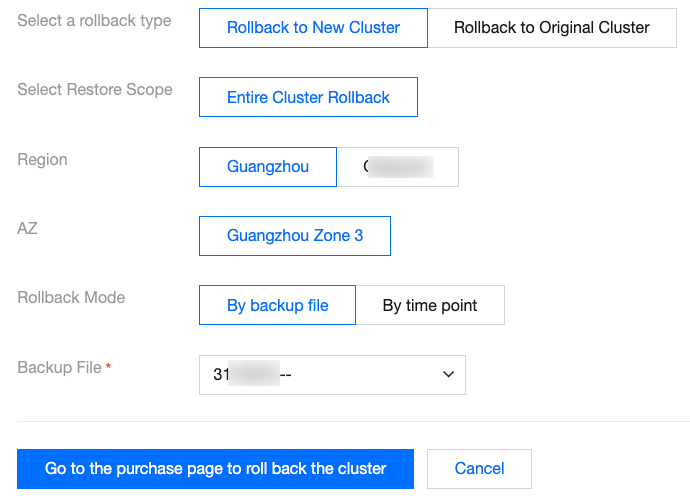
3. On the rollback page, complete the following configuration, click Go to the purchase page to roll back the cluster.

Parameter
Note
Select a rollback type
Select Rollback to New Cluster.
Select Restore Scope
Entire Cluster Rollback.
Region
Select the region for the new cluster. If you want to rollback using a snapshot backup, you need to choose the same region as the original cluster.
AZ
Select the Availability Zone for the new cluster.
Rollback Mode
Support for selecting rollback by backup file or by time point.
Backup File
If the rollback mode is set to backup file, you need to select an existing snapshot backup file for the rollback.
Rollback Time
If the rollback mode is set to time point, you need to select the rollback time point.
4. In the pop-up purchase page, complete the corresponding Database Configuration for the required database form, click Next.
Note:
If your new cluster is to be created as a Serverless instance type, you need to ensure that both the region and availability zone of the original and new clusters support the Serverless instance type. Otherwise, you can only create a cluster with the instance type set to Pre-configured Resources. Please refer to the purchase page for specific support details.
Select Provisioned Resource for instance type
Instance Mode: Provisioned Resource.
Rollback Mode: Support rollback by backup file and by time point.
By backup file: A new cluster can be restored from the specified backup set, and the selection range is based on the time of backup completion and the retention duration.
By time point: A new cluster can be restored from a specific time point, and the selection range is based on the backup retention duration.
Select Restore Scope: Entire Cluster Rollback.
Region: Select the region for the new cluster. If you want to rollback using a snapshot backup, you need to choose the same region as the original cluster.
Source AZ: Select the Availability Zone for the new cluster.
Transfer Linkage: High IO.
Network: Select VPC.
Computational Billing Mode: Supports annual and Yearly/monthly subscription and Pay-as-You-Go billing.
Instance Type: Supports General and Dedicated types.
Compute Instance (read/write): Select the compute specifications for the read-write instance. Only one read-write instance is supported.
Compute Instance (read-only): Select the compute specifications and quantity for the read-only instance. Selecting provisioned and Serverless resource instances to implement a hybrid deployment of two types of read-only instances is supported. Selecting only provisioned or Serverless resource instances as read-only instances is also supported.
Storage Billing Mode: Default is Pay-as-You-Go.
Instance Type: Select Serverless
Instance Mode: Serverless.
Rollback Mode: Support rollback by backup file and by time point.
By backup file: A new cluster can be restored from the specified backup set, and the selection range is based on the time of backup completion and the retention duration.
By time point: A new cluster can be restored from a specific time point, and the selection range is based on the backup retention duration.
Select Restore Scope: Entire Cluster Rollback.
Region: Select the region for the new cluster. If you want to rollback using a snapshot backup, you need to choose the same region as the original cluster.
AZ: Select the AZ corresponding to the new cluster.
Transfer Linkage: High IO Version.
Network: Select VPC.
Computational Billing Mode: Supports pay-as-you-go or resource package.
Note:
Compute Resource Package: Used to prioritize the deduction of actual usage of pay-as-you-go products. Once the resource package quota is exhausted, billing will continue using the pay-as-you-go model. The compute resource package will be deducted based on the actual CCU used per second, making it more cost-effective and flexible than the pay-as-you-go model.
Compute Resource Package (Displayed when the computational billing model is set to resource package): Bind a resource package, which can be any available compute resource package in the same region under the current account and within the validity period. If there are no available resource packages, purchase a resource package first.
Serverless Architecture: Supports single-node and cluster editions.
Computing Power Configuration: Choose the upper and lower limits of the computing power configuration CCU (TDSQL-C Compute Unit). The instance will automatically scale up and down flexibly within the selected resource range. CCU (TDSQL-C Compute Unit) is the billing unit for Serverless computing. One CCU is approximately equal to 1 CPU core and 2 GB memory. The number of CCUs used in each billing cycle is the greater value between the number of CPU cores used by the database and 1/2 of the memory size. For more information on computing power configuration, refer to Service Computing Power Configuration.
Automatic Suspension: Configure the automatic pause time of the instance. If there is no connection to access the database within the set time, the instance will be automatically paused. Once paused, billing will stop.
Storage Billing Mode: Supports pay-as-you-go or resource package.
Note:
Storage Resource Package: Used to prioritize the deduction of actual usage of pay-as-you-go products. Once the resource package quota is exhausted, billing will continue using the pay-as-you-go model. The storage resource package will be deducted based on the actual storage used per hour, making it more cost-effective and flexible than the pay-as-you-go model.
Storage Resource Package (Displayed when the storage billing model is set to resource package): Bind a resource package, which can be any available storage resource package in the same region under the current account and within the validity period. If there are no available resource packages, purchase a resource package first.
5. On the configuration page, set basic and advanced information, including cluster name, default character set, security group, parameter template, and item. After confirming everything is correct, click Buy Now.
6. Return to the cluster list. You can see the new cluster created through rollback. Once the status changes to Running, it can be used normally.

Help and Support

Was this page helpful?

Help us improve! Rate your documentation experience in 5 mins.

Feedback